Archive for October, 2020

Halloween charcoal cookies

30 October 2020

There may not be much of a Halloween celebration this year, and I nearly didn’t find pumpkins to carve as our corner grocer and prime purveyor sold out two days ago (to quote her: ‘I don’t know, I think people must just be so bored’), but I did manage to make these black cookies, naturally coloured with activated charcoal powder, and that makes me happy.

Charcoal crackers are quite common here in Britain, often to be paired with cheese, which gave me the idea for the colouring. I adapted a recipe from our home cookie bible, Alice Medrich‘s Chewy Gooey Crispy Crunchy — while I’m not much of a cookie baker, the children use it all the time. The vanilla cream cheese sandwich version of the sugar cookies proved to be the perfect recipe, to which I simply added a hefty dose of charcoal powder to achieve the deepest black.

Charcoal cookies after a sugar cookie recipe from Chewy Gooey Crispy Crunchy by Alice Medrich

380g (3 cups) flour
2 tsps cream of tartar
1 tsp baking soda
1/2 tsp salt
225g (1 stick) butter, softened
300g (1 1/2 cups) sugar
2 Tbsps milk
1 Tbsp pure vanilla extract
3 Tbsps activated charcoal powder

In a medium bowl, combine the flour, cream of tartar, baking soda, and salt, and mix thoroughly.

In a large bowl, beat the softened butter with the sugar until smooth and creamy. Beat in the milk, vanilla, and charcoal powder. Add the flour mixture and stir to thoroughly combine.

Divide the dough into 2 pieces, and roll each onto parchment paper into thin sheets approximately 1/3 cm (1/8 inch) thick. Place in the refrigerator for at least 2 hours or overnight.

Make a stencil for a bat (or rat, or cat, or any other shape).

Preheat the oven to 175°C (350°F).

Cut out the dough along the stencil shapes, using up the leftover bits and pieces as you go by kneading them together just enough to form a smooth dough and rolling it out again.

Transfer the shapes to a baking sheet lightly dusted with sugar and bake for 10 to 12 minutes.

Pear and Stilton elevenses

23 October 2020

October 23. Cycling through the park speckled golden with leaves and sunlight this morning is a memory for today. Autumn at its most perfect. And already the sky is overcast, dulled and dreary, a few drops even. In London the weather changes five times a day, it’s about catching the rays.

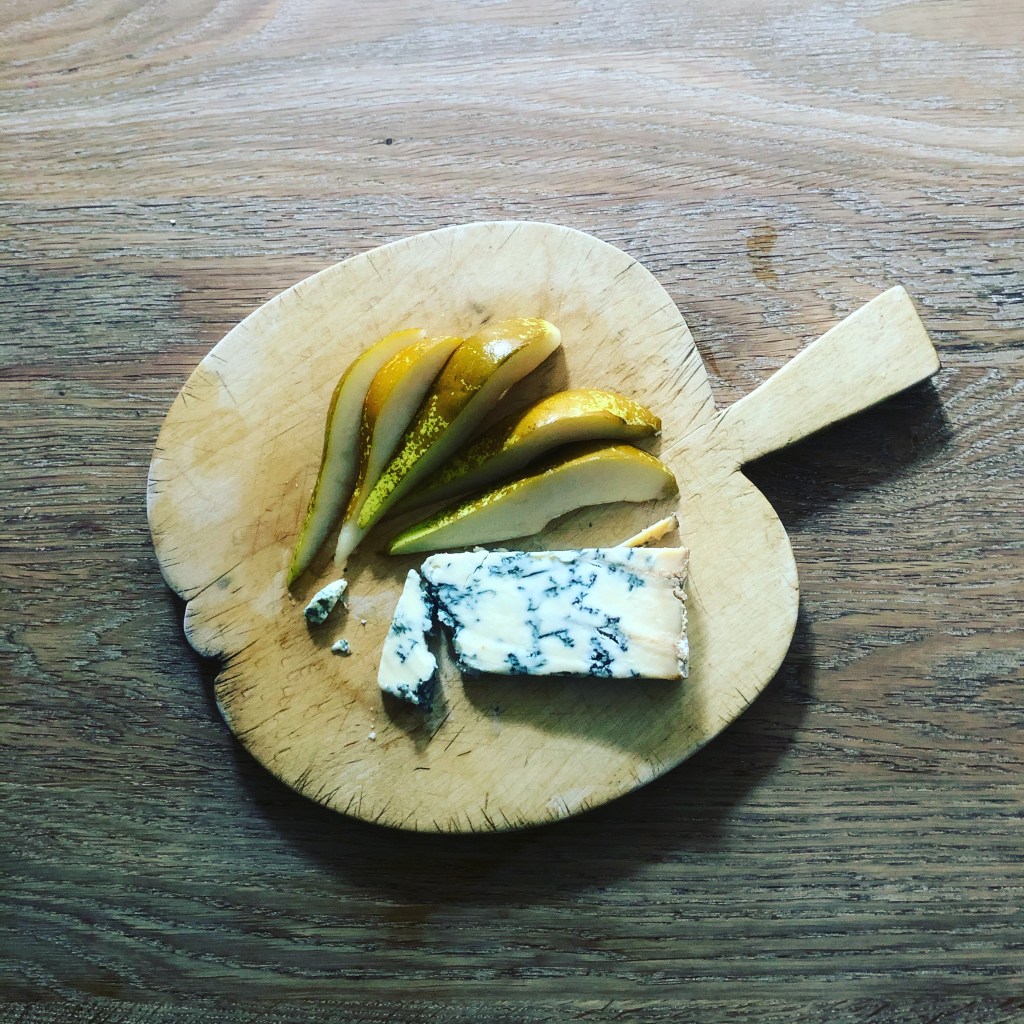
This snack, which may just as well lengthen the sun or brighten a rainy morning, is my favourite thing in autumn.

Pear and Stilton elevenses

A perfectly ripe pear, peeled or not
Stilton

Sourdough biscotti

20 October 2020

This idea sprouted a few months ago as an attempt to use up some of the ‘discard’ from my sourdough starter — in my experience the biggest challenge of a novice sourdough baker. (The ‘discard’ is the part of the sourdough mother that is not used for baking but needs to be cast aside so that fresh flour and water can ‘feed’ the mother.)

It’s now become a joke that everyone started baking sourdough during ‘lockdown.’ I am guilty as charged, and, like everyone else, faced the existential stress, for my fledgeling sourdough mother, of finding flour in April (when, naggingly, every shop was laden with the most beautiful breads) — I even had bags shipped directly from a mill, until that source dried up too. Having (re)embarked on this adventure I was quite resolved to follow through, unlike an attempt from six years ago which miserably petered out.

I am happy to report that my starter has survived, and thrived, since March. It crossed the channel and hung out in Brittany with us for a month, it came back with us, it has even had babies who, as far as I know (and hope!), are still alive and kicking in the neighbourhood. I will write more about my experiences with sourdough, but today I am baking these biscotti. It’s not exactly starting backwards, since the trickiest aspect of sourdough has been to find the rhythm of the starter, the bread, and especially the discard, without ever having to throw any away. It is safest to embark on a sourdough adventure with a few of these ‘discard’ recipes under one’s hat.

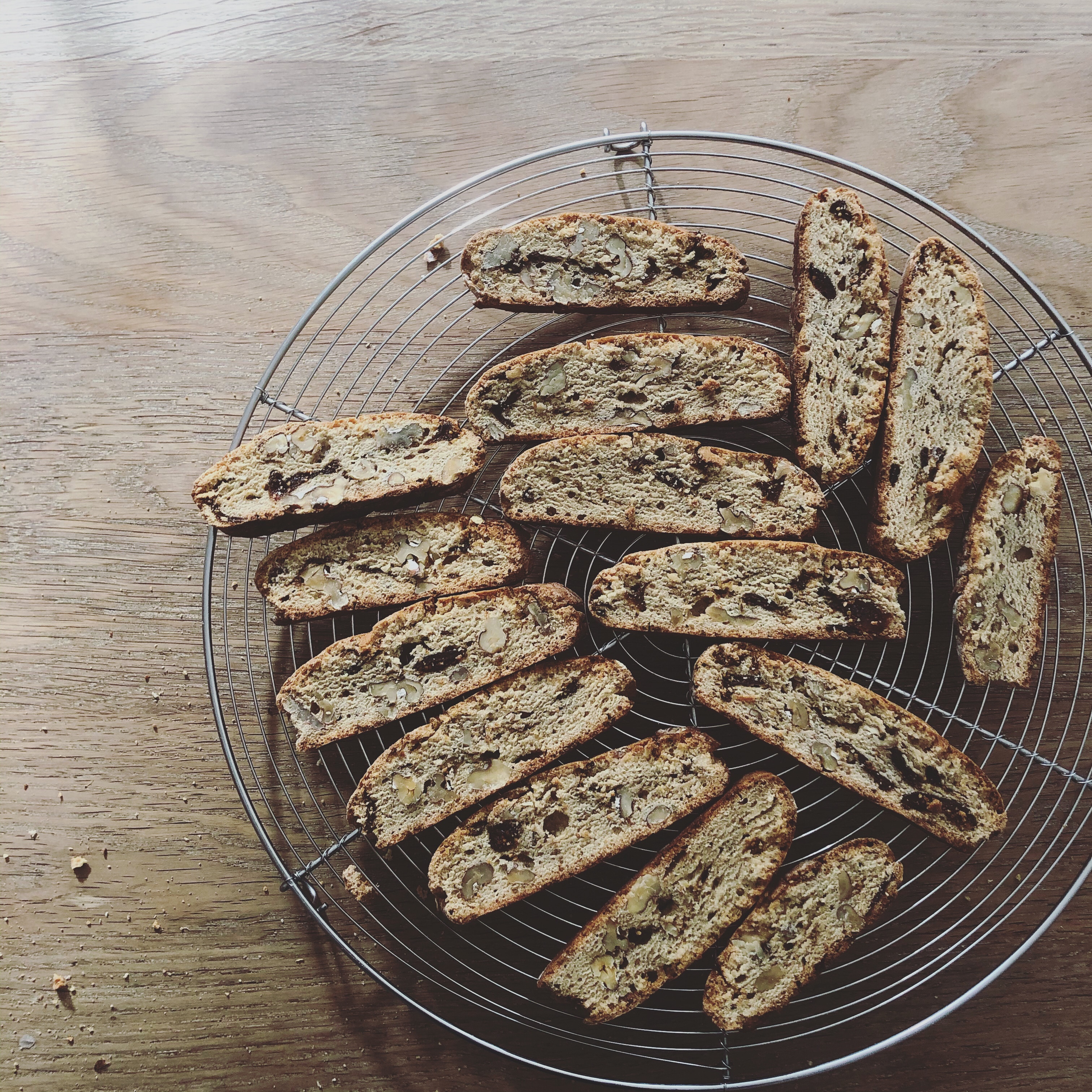
After some attempts and fine-tuning, these biscotti have just the right texture — the ideal balance of a hard crisp outside but ever so slightly yielding inside.

Sourdough biscotti
NOTE: This recipe should be used as a template, with many possible variations in the combination of nuts, fruits, and spices.
I particularly like walnuts/dried figs/fennel seeds and also almonds/anise, and I’m sure pistachio/apricot would also be great.

40g olive oil or melted butter
3 eggs
120g sugar
Zest from one lemon
50g sourdough discard
350g white spelt flour
Generous pinch of salt
This part of the recipe is the variable:
75g nuts (coarsely chopped almonds or walnuts, hazelnuts, pistachios, …)
50g dried fruit if using (dried figs, apricots, …)
1 Tbsp fennel or anise seeds

Method:
In a smallish bowl, whisk together the olive oil (or cooled melted butter) with the eggs, sugar, and lemon zest. Stir in the sourdough discard.

In another, larger bowl, mix the flour with the nuts and fruit, spices, and salt. Create a well and pour in the liquid ingredients. With a wooden spoon, using circular movements, mix to combine thoroughly. Finish by hand, knead a few times, and shape into a flat ball. => If the dough is so sticky that it seems impossible to gather into a ball, add a little flour.

Cover with a tea towel and let the dough rest at room temperature for at least 2 hours, until it feels risen and puffy (it doesn’t need to have noticeably increased in size).

Line a baking sheet with a piece of parchment paper. Shape the dough into two flat oblong logs and leave them to rest, covered, for another 30 min or so, until slightly puffy.

Preheat the oven to 200°C.

Bake the logs for 25 minutes at 200°C, then lower the temperature to 175°C and bake for another 15 minutes. The logs should be slightly coloured.

Remove from the oven, let cool enough to be able to handle, slice the logs, and return the slices to the oven for 5 to 10 minutes on one side depending on how thin you’ve cut them. Turn the biscotti over and cook for another 4 to 5 minutes => watch and check and bake to the desired colour.

The biscotti keep well in a sealed jar for a week.

Yotam Ottolenghi’s tomato chutney

13 October 2020

This is the chutney that entered our life by accident and got stuck. I nearly didn’t make it when I decided to try Ottolenghi’s Tomato and Courgette Loaf published in the Guardian’s weekly food magazine Feast a couple of weeks ago. I often cut corners and simplify recipes, and, regardless of how tempting it was, I wasn’t sure I would have the time, until I realised it was part of the loaf recipe itself. And so the sideshow of Ottolenghi’s recipe became the star at my table.

The loaf was a great success, but the chutney is the recipe I will be making again and again. In fact, the kitchen has barely been without in a fortnight.

Tomato chutney from a recipe by Yotam Ottolenghi in Feast
The recipe calls for fresh tomatoes but I’m pretty sure I’ll try it with tinned ones in a few weeks when there is no other choice.

Olive oil
6 garlic cloves
45g fresh ginger
A large pinch of chilli flakes (or 2 red chillies)
About 2 Tbsps tomato paste
1 tsp turmeric
2 tsps garam masala
1 Tbsp sugar
750g tomatoes
Teaspoon sea salt
Freshly ground black pepper

Smash the garlic with the flat of a knife, peel, and chop roughly. Peel and finely grate the ginger. (Wash and finely chop the chilli if using.) Wash, core, and chop the tomatoes.

In a large heavy saucepan, heat a few tablespoons of olive oil over medium heat. Once hot, add the garlic, ginger, and chilli. Cook, stirring regularly, for a couple of minutes, until fragrant. Add the tomato paste, spices, and sugar, and cook, stirring, for another minute. Now add the tomatoes, the salt, and a good grind of pepper and mix well, scraping the pan to incorporate all the spices. Turn down the heat and simmer for about 45 minutes, until the tomatoes are thoroughly cooked and the chutney has thickened.

Before serving, drizzle a little olive oil over the chutney. It keeps in a closed jar in the fridge for about a week.

Chard gratin

8 October 2020

October 8th. I’ve developed quite a crush on this dish since this August, when our friends brought us a big bunch of chard from their garden. I made a gratin, Louise had SIX helpings, which echoed what everyone was feeling, though we were perhaps not as quick. It has now settled into our regular weeknights.

Chard gratin

750g chard
75g butter
3 Tbsps flour (I usually use spelt though a traditional béchamel would be with wheat, and white or wholemeal depending on my mood)
500ml milk
Sea salt
Freshly ground black pepper
Freshly grated nutmeg
1 garlic clove
A little olive oil or butter for the pan
Grated cheese, preferably gruyère

Preheat the oven to 175°C.

Trim the rough ends of the stalks and any bits of damaged leaves, chop the chard into roughly 2cm (3/4 inch) strips, wash in cold water, and dry thoroughly ( I use a salad spinner).

To make the béchamel: Melt the butter in a medium saucepan. Add the flour and stir continuously with a wooden spoon until the flour and butter lump together and create a mass. Continue cooking briefly, then add the milk, one large splosh at a time, stirring continuously, until all the milk is used up. If the béchamel still looks quite thick, add some water until the consistency is edging towards runny.

Now season the béchamel with a generous pinch of salt, pepper, and freshly grated nutmeg. Taste and adjust.

Rub an ovenproof dish with the garlic clove and grease the dish with a very little bit of olive oil (or butter). Add all the chard, it should seem as if it’s too much => It will reduce a lot while it cooks. Pour the béchamel over the chard as evenly as possible so everything is covered. Now sprinkle enough grated cheese to cover the whole gratin in a thin layer.

Slide into the oven and bake for 30 to 40 minutes, until the top is golden.

Goes well with good sausages or a sturdy fish such as salmon.