Archive for the ‘Baking’ Category

Savory oat, leek, and pecorino scones with za’atar

17 December 2012

DSC_0061

English purists wouldn’t accept these as ‘scones.’ Scones are plain, eaten at tea time, with strawwwberry jam and clotted cream. I’ll worry about that in a few months. I’m still firmly implanted stateside and not above studding scones with currants (ha!), dried cranberries and apricots, almonds, gruyère, walnuts, or even caraway.

I could have named these differently, of course, but they are scones because I made them using a scone recipe. From England. It’s a recipe I copied when I lived there many years ago, when I was ten or so. It’s the second oldest recipe I collected, just after that of the banana cake.

These scones were a happy accident. Leo had a performance at school last week, which was to be followed by a potluck breakfast. As often — or always — happens, at first I wasn’t sure what to bring, then decided I’d pick up something easy like juice since Thomas was in London and I alone with the children all week; later I realized too many parents were already planning to bring juice. So for once, just this once, I wouldn’t bring anything. It’s OK to do that once. Of course the night before, filled with guilt, I felt I absolutely had to bake something, and must make do with whatever was in the house.

So these scones happened. I tasted one just a few minutes out of the oven, with butter melting from the warmth. It was really good. And better still with a little citrus jam — er, ‘marmalade.’ Cold, the next morning, the scones were not quite the hit. It seems people prefer sweets in the morning.

I would insist that these scones, which are very quick to prepare, should be made just before breakfast (or brunch) and eaten immediately, warm, or, if later, toasted.

*

Makes about 16 scones

I used za’atar to add zest and depth of flavor, but I realize it’s not necessarily a house staple (I just happened to have some) and could be substituted with chopped fresh thyme (lemon thyme even better! — is that not helpful?).

1 1/2 cups butter
3 cups flour
1 cup rolled oats
6 tsps baking powder
2 tsps za’atar
1 cup milk
2 eggs
1 cup coarsely grated pecorino
1 long or 2 small leeks
Zest from 1 lemon

Preheat oven to 375°F. Line a baking sheet with parchment and butter generously.

In a small saucepan, melt the butter over low heat. Set aside.

In a large bowl, mix together the flour, oats, baking powder, 1/2 teaspoon salt, and za’atar.

In a medium bowl, whisk the eggs and add the milk and melted butter. Combine this with the oat/flour mixture until all the flour is absorbed.

To clean the leek remove the coarse outer leaves, rinse thoroughly under running water, opening up the inner leaves slightly to make sure no sand remains. Slice the leek very thinly.

Add the leek, ground pecorino, and lemon zest to the dough. Stir to combine well.

With a large soup spoon, scoop out balls of dough and place them on the baking sheet.

Bake for 22 minutes. The outside should be starting to turn golden and feel slightly resistant to the touch but not firm (it will become harder as it cools).

Serve quickly, while still warm, with delicious butter and orange marmalade…

(These scones are really very delicious when warm, so they should be eaten immediately, or toasted or reheated in the oven later.)

Candied orange and lemon peel

8 December 2012

DSC_1007

For years I’ve wanted to do this. Every time, as I gather all the ingredients to make Stollen in early December, I think I really should make candied citrus peel myself. But caught in the rush I end up scrambling and scouring stores desperately to find an acceptable option — usually just barely.

So I’m quite excited. It’s not as if I’d suddenly been graced with lots more time, rather to the contrary, but I guess that’s how it works.

It does take time — a few hours. Peeling, cutting, staying close to the boil. Repeating. It’s time-consuming. But simple. It’s meditative. And worth it.

DSC_0935

Orange peel

I candied the peel to use in Stollen, but there is plenty left over, which can be eaten as is, rolled in sugar, or dipped in dark melted chocolate to make orangettes. Mmmm.

5 oranges

3 cups (600 g) sugar

1 1/2 cups (350 ml) water (more for the first step)

To peel the oranges, trim off a ‘cap’ at either end so the orange sits in a stable position. Cut pieces of peel, equal to approximately a sixth of the fruit, from top to the bottom, including the pith and a bit of fruit. (The flesh can be used elsewhere for example in a fruit salad.) Slice the pieces of peel into strips 1/2 to 1-inch (1 to 2 cm) wide.
Place the peel in a smallish saucepan, cover with water, bring to a simmer and boil for a couple of minutes. Drain, discarding the water. Cover the peel with fresh water and repeat this three times (4 boils altogether).

Rinse the saucepan. Pour the sugar and 1 1/2 cups (350 ml) water, bring to a boil, then add the peel. Simmer, partially covered, for about an hour, removing scum if it occurs, until the peel is soft and translucent on the sides. (The pith should be translucent too.)

Place the pieces of peel on a rack or baking sheet covered with parchment paper and let dry for 24 to 36 hours.

Keep the syrup in the fridge and mix with sparkling water for a refreshing drink, or drizzled over plain yogurt.

DSC_0949

Lemon peel
(Same technique but the quantities are halved, and lemon peel can also be dipped in dark chocolate to make ‘lemonettes’!)

5 lemons

1 1/2 cups (300 g) sugar

3/4 cup (200 ml) water (more for the first step)

To peel the lemons, trim off a ‘cap’ at either end so the orange sits in a stable position. Cut pieces of peel, equal to approximately a sixth of the fruit, from top to the bottom, including the pith and a bit of fruit. (The flesh can be used elsewhere for example in a fruit salad.) Slice the pieces of peel into strips 1/2 to 1-inch (1 to 2 cm) wide.

Place the peel in a smallish saucepan, cover with water, bring to a simmer and boil for a couple of minutes. Drain, discarding the water. Cover the peel with fresh water and repeat this three times (4 boils altogether).

Rinse the saucepan. Pour the sugar and 3/4 cup (200 ml) water, bring to a boil, then add the peel. Simmer, partially covered, for about an hour, removing scum if it occurs, until the peel is soft and translucent on the sides. (The pith should not be white anymore, completely translucent.)

Place the peels on a rack or baking sheet covered with parchment paper and let dry for 24 to 36 hours.

Keep the syrup in the fridge and mix with sparkling water for a refreshing drink, or drizzled over plain yogurt.

*

Related posts

Stollen

A carrot cake for Halloween

9 November 2012

I felt so organized, I had it all planned out. I would not only make the cake but photograph it and publish it here on Halloween. My plans were thwarted by a storm which, uncharacteristically among New York weather forecasts, turned out to be stronger and much more damaging than anyone expected. Taking the warnings lightly at first we didn’t stock up on food, water, or candles. We didn’t try to locate our missing flashlight.

Subways stopped running on Sunday evening; on Monday schools and offices were closed. Homebound by this citywide shutdown, we huddled and played games all morning. The hurricane was on its way, barely perceptible but for the blustery weather, and we were waiting. Suddenly we felt we must go out. Now was the moment, while there was still time.

The impulse was to go toward the water, see the swollen river, perch on benches to watch the eerily high Hudson. It seems frivolous now. The city was already deserted. The empty park, the windswept streets. We decided perhaps we should make provisions, after all, and my thoughts were, stubbornly, on the Halloween cake.

Some stores that had been open were closing, sending us and a few forlorn tourists on their way. We finally found one, ransacked of chicken and ice cream but with plenty of carrots and walnuts. I forgot to look for candles. We stopped at a pharmacy, they were sold out. I bought two different sizes of batteries hoping one might fit the flashlight, if I could find it.

That night the hurricane came with howling winds and crashing trees, but in our corner of town the power didn’t go out, the lights barely flickered. The next morning I even made the cake. Then the news started getting worse. Those without power were soon without water. Stories of houses burned to the ground, scenes of complete devastation.

So we started checking up on friends, offering food, hot showers, and power outlets. And friends came. And it was Halloween. And though all was dark downtown and broken elsewhere we went trick or treating in Harlem, with neighbors. I even finished the cake, with icing and evil-looking spiders. Just in time.

The news kept getting worse. Within a few days some areas recovered electricity, water, and heat; others did not. Many have lost much more. We were unnaturally lucky, so close and so unscathed. My mind hasn’t been on cooking. Feeding friends and family, yes, but not cooking.

***

Carrot Cake

For the past three years I’ve made carrot cake for Halloween, adorned with what I think are pretty cool, mean-looking, edible prune and cranberry spiders. I’m not exactly sure how I got hung up on that particular type of cake but in my mind it presented itself as the natural choice. I was inspired by a few recipes to achieve this one, which comes quite close to my ideal version of a carrot cake. Dense but moist, not too sweet, with nuts.

1 cup (225 g) butter (and a little extra to butter the pan)

1 1/4 cup (200 g) brown sugar

4 eggs

1/2 (150 ml) cup buttermilk

1 tsp vanilla extract

1/4 cup (75 ml) honey

2 cups (250 g) flour, half white half whole wheat

2 tsps baking powder

1 tsp baking soda

2 tsps salt

2 cups (250 g) finely grated carrots

1 1/2 cups chopped walnuts

1/2 (100 g) cup raisins

1 cup (250 ml) apple sauce

Take the butter out of the refrigerator to soften at room temperature for about 15-20 min.

Preheat the oven to 350°F (175°C) and line the bottom of an 11-inch (28 cm) round cake pan with parchment paper. Butter the paper and the sides of the pan.

In a large bowl, beat the softened butter with the sugar until the mixture becomes light colored and fluffy. Add the eggs, one at a time, whisking well to combine. Add the buttermilk, vanilla extract, and honey, mixing well.

In another bowl, mix together the flours, baking powder, baking soda, and salt.

Add the flour to the sugar/butter/egg mixture, stirring just enough so the flour disappears.

Gently add the carrots, walnuts, raisins, and apple sauce.

Bake in the oven for 1 hour to 1 hour 15 min. The cake is done when a knife inserted in the center of the cake comes out clean.

*

Icing

8 Tbsps (110 g) unsalted butter

6 oz. (170 g) cream cheese

1 lb (500 g) mascarpone

1 1/2 cups (150 g) icing sugar

Zest and juice from 1 lemon

At room temperature, let the butter become very soft. In a medium bowl, beat it well with a spatula.

In a small bowl, beat the cream cheese well before mixing it with the butter. Once the cream cheese is incorporated with the butter, beat the mascarpone well before adding it to the butter and cream cheese.

Sift the icing sugar before mixing it into the butter/cream cheese/mascarpone mix.

Finish by stirring in the lemon zest and juice.

Refrigerate the icing about 1/2 hour before spreading it onto the cake.

*

Spiders

1 prune and 1 large sweetened cranberry per spider

Cut the prune into thin slivers lengthwise to create eight spider legs. Place the cranberry on the cake so as to make the body of the spider. Arrange the ‘legs’ around it.

Orange almond cake

28 January 2012

It’s a tantalizing cake. It has taunted me since Malou posted the recipe in a comment last April; the season of oranges had passed.

As winter came again the cake was on my mind. I meant to bake it for a skiing weekend; then didn’t. This week, finally, I did.

It is a cake for snowy days. When the light is low, the trees are bare, and the cold air breathtaking. The cake, by contrast, is light, spongy, melting. The sunny flavor of oranges with more than a hint of bitter from the pith.

It’s surprising, addictive, and leaves you wondering how the score might be played a dozen other, slightly different ways.

I love it. With tea.

***

With many thanks to Malou for the recipe

Update: I have since discovered that this is a famous Claudia Roden recipe !

2 large untreated oranges

6 large eggs

1 1/4 cups (250 g) sugar

2 generous cups (250 g) ground almonds

2 tsps baking powder

Candied orange slices for decoration (optional):

1 untreated orange

1 cup (200 g) sugar

*

Place 2 oranges in a small saucepan, cover with water, and simmer slowly for 2 hours, adding water if necessary.

Remove the oranges from the water and let cool. Cut the oranges in half, then each half again in two. Remove pips if necessary. Purée the oranges in a food processor. (The orange purée can be made a day in advance.)

Preheat the oven to 350°F (175°C) and line a 9 inch (24 cm) baking tin with parchment paper that should be buttered generously.

In a large bowl, mix the eggs and sugar until light and fluffy. Add the orange purée, the ground almonds, and the baking powder, and mix well until thoroughly combined.

Pour the batter into the tin, slide into to oven, and bake for 1 hour, until a knife or skewer inserted in the middle of the cake comes out clean.

For the candied orange slices:

In a small saucepan, make a sugar syrup with 1 cup sugar and 1 cup water. Bring to a simmer and cook for about 5 minutes.

Slice the orange as thinly as possible. Add the slices to the syrup, and cook for about 10 to 15 minutes. Remove the slices carefully one by one, and place them on a rack or parchment paper to dry for about half an hour. Return the orange slices to the syrup, and simmer for another 5 to 10 minutes. Let the slices dry for at least 1/2 hour. Reduce the syrup until it thickens and reserve.

When ready to serve, place a few orange slices on top and drizzle with a little syrup. **The cake gets even better after a day or two, so it should ideally be made in advance.**

Note: The candied orange was not in the original recipe, but I thought they looked nice and added a little something. However, the cake being very soft it is difficult to cut through the candied orange on top of the cake, so it is best cut on the side as the cake is served.

*

Related posts

Poppy seed and almond cake

Cake with pear and toasted hazelnuts

Plum cake

10 October 2011

Geese are heading South over Manhattan this morning.

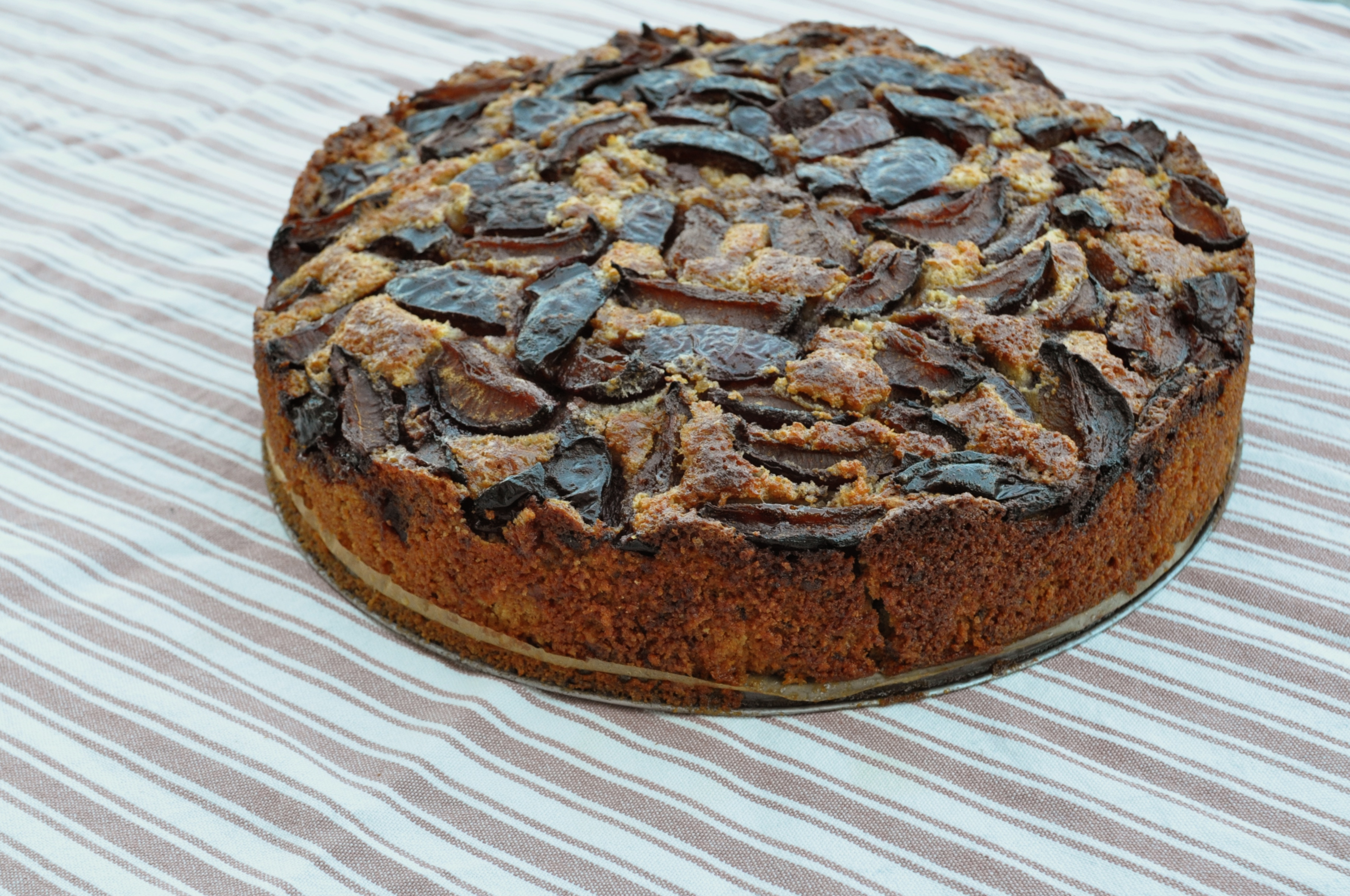
So briefly, before it’s too late, before the plums are all gone, here is Nigel Slater‘s “Wonderfully moist, fresh plum cake.” It is exactly that, at the very least.

It is autumnal and luscious. With a crunch from the chopped walnuts and a hint of spice, which I couldn’t resist adding to the recipe.

***

Recipe very slightly adapted from Nigel Slater’s The Kitchen Diaries

I have doubled the recipe and I doubt anyone would mind. However if it is just for one or two, the recipe can easily be halved. The cooking time would then be 40 – 45 minutes at an oven temperature of 350°F (180°C).

32 plums

1 1/2 cups (300 g) butter

1 1/2 cups (300 g) sugar

6 eggs

1 1/4 cups (150 g) flour

3 tsps baking powder

2 cups (200 g) ground almonds (1 1/2 cups whole almonds yields 2 cups once ground)

1 cup (100 g) walnuts

Zest from 1 lemon

2 Tbsps muscovado (dark brown) sugar

2 tsps powdered ginger

***

Preheat oven to 375°F (200°C).

Line the base of a cake tin 10 1/2 inch (27 cm) in diameter with parchment paper. Butter the paper and the sides of the tin.

Wash the plums, halve them, remove the stones, and cut each half again in two. Set aside.

In a large mixing bowl, beat the butter and sugar thoroughly until light and fluffy.

In a small bowl, break the eggs and beat them slightly with a fork. Then add them little by little to the butter/sugar mixture.

Sift the flour together with the baking powder and fold in gently with a spatula or wooden spoon. Gently add the lemon zest and ground almonds.

Roughly chop the walnuts and add them too.

Sprinkle the muscovado sugar and ginger onto the plums and toss carefully, preferably with bare hands in order not to squash the plums.

Scrape the batter into the cake tin and place the plums on top, pushing them into the batter ever so slightly (they will sink in more as the cake cooks).

Bake the cake for about 1 hour 15 minutes. Check for doneness by inserting a knife or skewer into the cake, which should come out clean. But also gently move the cake tin. If the center jiggles it needs a little more time.

Let the cake cool a little before removing from the tin.

*

Related posts

Cake with pear and toasted hazelnuts

Orange almond cake

Plum jam with candied ginger