Archive for the ‘Homemade and preserves’ Category

Oatmeal raisin walnut cookies

25 May 2011

I’m in a baking state of mind, and a bit perplexed by it.

As much as I love to cook, I don’t bake very often. Except when I want to make dessert for dinner with friends, and even then I usually manage to devise a non-baked sweet. But these days I’ve been baking walnut tarts and banana cakes, and, most surprisingly, the other day at 10 pm I felt compelled to try to recreate my childhood memory of a seriously addictive chewy almond macaroon. (It was an improvisation and not an entirely terrible first attempt. To be continued.)

This weekend I baked oatmeal raisin walnut cookies, for no particular reason.

The recipe is very slightly adapted from the Once Upon a Tart… cookbook. It has less sugar, fewer raisins, and leaves out the cinnamon. I wanted something subtle and understated.

When I first tasted one, straight out of the oven, I was worried it lacked something: some spice perhaps, or some sugar — why am I always compelled to tinker with recipes? But the next day I felt vindicated. They were exactly as I wanted. These cookies don’t wow into submission at first bite; they seduce stealthily, enticing, unwittingly, to reach for another, and another, and another…

Resist the temptation to eat the cookies straight off the rack. Wait a few hours and they will be exactly what you were hoping for.

***

Slightly adapted from the Once Upon a Tart… cookbook

1 cup (225 g) butter
1 1/4 cup (250 g) sugar
2 eggs
1/3 cup (100 ml) liquid honey
1 1/2 cups (175 g) flour
4 cups (400 g) rolled oats
1/2 tsp salt
1 1/2 cups (175 g) coarsely chopped walnuts
1 cup (125 g) raisins

***

Preheat oven to 400°F (200°C).

Take the butter out of the refrigerator to soften.

In a large bowl, beat the softened butter and sugar with a wooden spoon until light and fluffy. **It’s important here to beat the ingredients thoroughly, for 5 to 10 minutes.** Add the eggs, one at a time, beating with a whisk to combine well. Add the honey and mix.

In a separate bowl, mix together the flour, the oats, and the salt.

Combine  the butter/sugar/egg/honey mixture with the flour/oats/salt. Mix until the flour has disappeared.

Stir in the walnuts and raisins.

Line a baking sheet with parchment paper. Butter the paper. With a large spoon or ice cream scoop, transfer small balls of dough to the baking sheet, flatten and shape them with your fingers, making sure to leave about 1 in (2.5 cm) between each cookie.

In the oven for 12-15 minutes, until the cookies start turning brown at the edge. The cookies will still feel soft to the touch but will harden as they cool.  [12-13 minutes works for 2 in (5 cm) cookies. Adjust time according to the size of the cookies.]

Wait until tomorrow. Store in a cookie jar or other airtight container.

*

Related posts

Banana cake

Busy-day cupcakes

Cranberry sauce and a Thanksgiving menu

22 November 2010

Who wouldn’t love a holiday whose sole purpose is to share a meal? As a French woman I’ve always wondered why the French didn’t come up with that idea.

I started making Thanksgiving dinners long before I moved to the United States. The custom began with my mother, who is American (in a somewhat roundabout way), and though I cannot remember that we celebrated Thanksgiving every year as a family, I certainly picked up the tradition when I left home, and have celebrated, if not hosted it consistently since.

My first endeavor involved roasting a chicken with wild rice stuffing in a tiny countertop oven in a small Parisian studio apartment. Later, in Germany, turkeys replaced chickens as the dinner parties became larger to fit the size of the beautiful old apartments students could afford in Berlin in the 1990s (I haven’t lived in such a big apartment since!). I discovered that KaDeWe was the only store in the city to carry (frozen) turkeys in November.

Since I moved to New York I have expanded on and modified recipes, and refined a menu that to me is traditional, though it isn’t exactly, in spite of the turkey, cranberry sauce, and pumpkin pie. On Thursday I will make the dishes I have honed in recent years. In the future I am sure some things will change.

2010 Thanksgiving menu

Pumpkin leek soup

Heritage turkey with apple chestnut stuffing

Sautéed hen of the woods and king trumpet mushrooms

Mashed celeriac with parsley

Cranberry sauce (recipe below)

Pumpkin pie

And other desserts brought by the guests

***

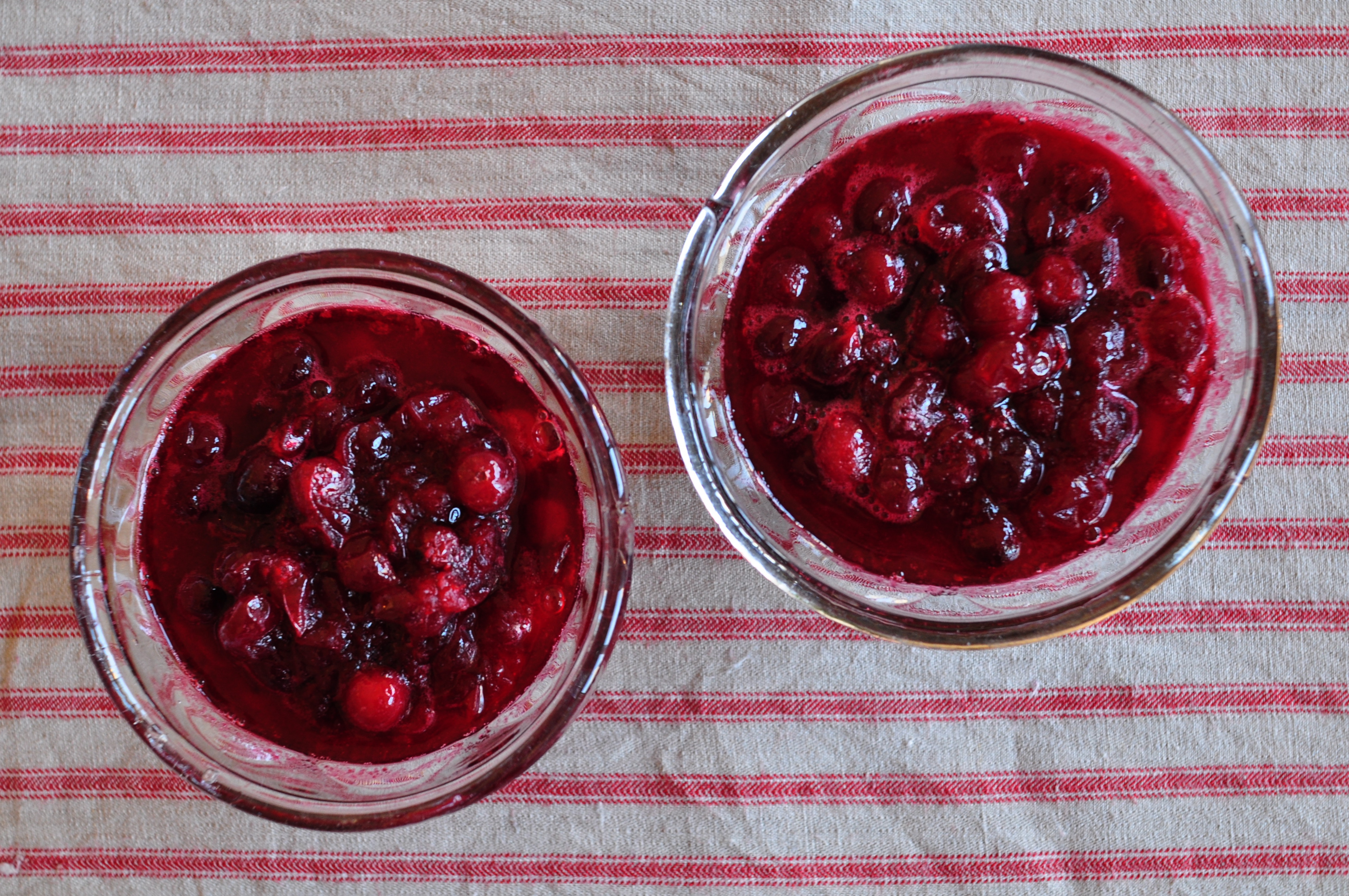
Cranberry sauce

There is no possible excuse for buying cranberry sauce it’s so ridiculously easy to make. I usually do it the weekend before Thanksgiving.

***

3 x 12 0z (340g) bags* cranberries

3 cups (750ml) water

2 cups (450g)  sugar

Zest of 2 untreated lemons

1 Tbsp Grand Marnier (optional)

***

Place the cranberries in a large bowl, fill with water and toss to wash. If you are obsessive as I am, check through the cranberries one handful at a time to sort out the soft, discolored ones, placing the good cranberries in a colander as you go. (This is not exactly necessary, but I love the ritual and the feel of the cranberries through my fingers… Otherwise just strain the berries through a colander.)

In a medium saucepan, dissolve the sugar in the water and bring to a boil, stirring occasionally. Add cranberries and lemon zest, mix and let simmer for 15-20 minutes, stirring occasionally, until the cranberries have popped. Remove from heat and mix in some Grand Marnier if desired.

Once cool, transfer to a jar or bowl and refrigerate (if you make the cranberry sauce a while in advance, sterilize the jars in boiling water, pour in cranberry sauce while hot, and seal tightly).

*For some reason, cranberries are practically always sold in 12 oz bags, so I started using that as the reference.

Quince paste

3 November 2010

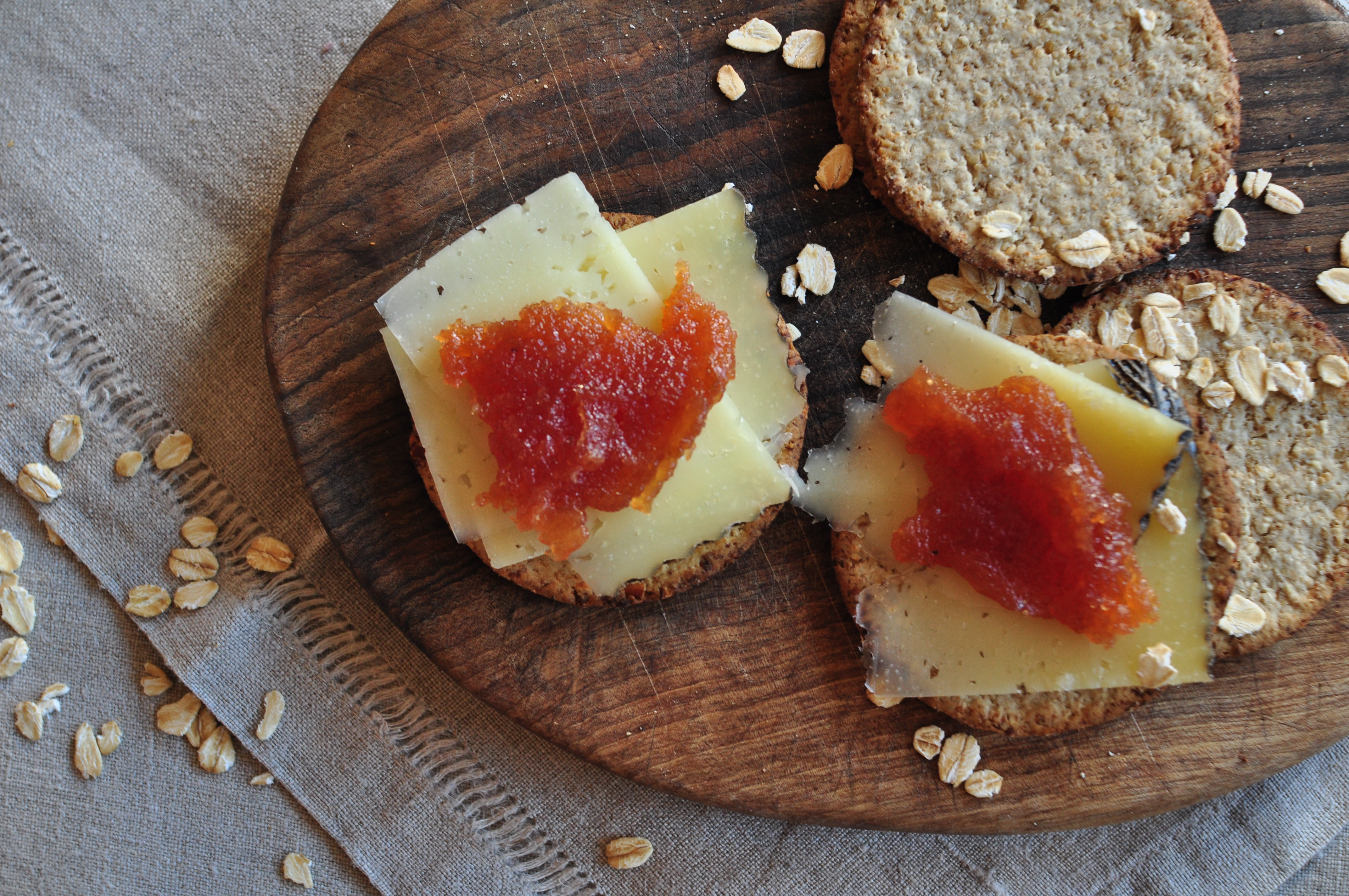
Quince paste, also known as membrillo in Spain or cotognata in Italy, is a thick, sweet fruit paste that pairs perfectly with Manchego and other types of hard sheep’s milk cheeses. It keeps for a while though it never lasts long. I eat it off the tip of a knife when the children aren’t looking. It’s irresistible.

I use the fruit cooked to make quince jelly for this recipe, but the quinces could also be baked, covered, in a low oven (300°F or 150°C) for about 1 1/2 hours.

***

Stewed quinces (without the juice) or baked quinces (hard cores removed)

Sugar

Lemon juice

***

Purée the quinces with a vegetable mill (the skins and seeds will be retained by the mill).

Weigh the purée and add the same amount of sugar in a heavy-bottomed saucepan. Add the juice from half a lemon per 2 lb (1 kg) of fruit. Mix, bring to a lively boil, and stir constantly (otherwise the quince will burn very quickly) until the mass darkens and thickens. Depending on the amount of purée, it may take more than an hour.

Pour onto a large flat plate or shallow container and let set. Quince paste keeps for months in the refrigerator.

Quince jelly

3 November 2010

I made quince jelly last year for the first time. It’s not that I don’t sincerely love quince, it’s because I don’t like making jelly very much. To make jelly the fruit is cooked in water, and only the clear juice is used. An awful lot of pulp is wasted in the process. Of course it can be used as a purée to eat with yogurt, but it does not last, and there is only so much quince purée a family can eat in a couple of days. For this reason I don’t make jelly, generally. But last year as quinces appeared at the market I simply couldn’t resist. Having made the jelly (a few pounds of quinces rendered three very small jars), I had a lot of quince pulp on my hands, and dismayed at the idea that it might go to waste, I suddenly thought about membrillo, the Spanish quince paste that pairs so perfectly with Manchego and other hard sheep’s milk cheeses. As it happens, all that is required for quince paste is fruit pulp and sugar.

So making quince jelly has become a perfect excuse to make quince paste (or the other way around?), and I think no recipe for one should ever be published without the other.

***

Quinces

Water

Sugar

***

Making jelly is a fairly long process, but it can be broken up into 2 stages if you don’t have a big uninterrupted chunk of time.

Wash quinces thoroughly to remove fuzzy coat. Cut quinces into quarters or eighths, depending on the size of the fruit so all the pieces have approximately the same size. Place quince pieces in a large, heavy-bottomed saucepan and add just enough water so it reaches the top layer of quinces but does not cover the fruit. Bring to a boil and simmer gently until the fruit becomes soft, stirring occasionally to submerge the fruit on top so it gets a chance to cook through. Poke around to check that all the pieces have softened (quinces will cook through at a different rate depending on how ripe they are – it could take up to 1 1/2 hours). Once all the quince is very soft, remove from heat.

**You can take a break at this point. Leave the quinces in the water, let cool and place in refrigerator once cool for up to 24 hours. If you refrigerate the cooked fruit, you will have to reheat it slightly to release the liquid before starting the next stage.**

Strain the juice through a fine mesh sieve and then through a cheesecloth to remove any impurities. Don’t mash the fruit or squeeze the cheesecloth too much or the jelly will become murky. Reserve fruit pulp for paste (refrigerate unless using immediately).

Measure the juice as you pour it into a (smaller) heavy-bottomed saucepan. For every cup (250 ml) of juice, add 2/3 cup (150 g) sugar. Bring to a boil and simmer, skimming off any foam that forms on the surface. After about 20-30 minutes, check regularly whether the juice has “gelled.” To do this take out a small spoonful and let it cool. Once cold, the juice should have thickened in the spoon, and when you try to pour it the drip is not liquid but heavy, as though it was sticking to the spoon.

Sterilize jars in boiling water for 5 to 10 minutes. As soon as the juice has “gelled,” remove from heat and pour immediately into sterilized jars and close tightly. Keeps unopened for up to a year; once opened should be stored in the refrigerator.

Chicken liver terrine

8 October 2010

I love this recipe for many reasons: it’s absolutely delicious, quick to make, can (or rather should) be prepared in advance, and, well, it’s liver. I find all sorts of excuses to make it. Tomorrow it will be lunch in the country; it’s been good for parties or Easter brunch; but more simply it is the recipe upon which I fall back when we have friends for dinner and I am undecided about what to make. It helps unlock my imagination and inspires the rest of the meal. Most often I serve it with baguette as a tapas-style apéritif together with olives and nuts, radishes or cherry tomatoes – depending on the season.

***

1 lb (450 g) chicken livers

3/4 cup (180 g) and 2 Tbsp (20 g) butter

1 small onion (or large shallot)

Olive oil

1 large sprig each sage and thyme

1 Tbsp Madeira wine (Marsala also works well)*

1 Tbsp brandy

Salt and pepper

***

Trim the fat from the chicken livers and set aside.

In a small saucepan, melt 3/4 cup butter over low heat. Once melted set aside.

Finely chop the onion (or shallot). In a large skillet, melt 2 Tbsp of butter together with a little olive oil (the oil prevents the butter from burning). Add the chopped onion, cook over medium heat, and as soon as it becomes translucent add the whole sage and thyme and stir to mix flavors. Immediately increase the heat to high and add the chicken livers. After a couple of minutes the livers should be slightly brown; turn them over. Sprinkle the Marsala and brandy over the livers and cook for a few minutes until the liquid has evaporated. Remove from the heat and season with salt and pepper.

When the livers are cool enough to handle, remove the sage and thyme, transfer to a cutting board, and chop finely. Place the livers in a bowl, add the scrapings from the skillet as well as the melted butter and mix well. Transfer the livers to a terrine dish (any bowl will do) and place in the refrigerator for a few hours and up to two days. It gets better after a day or so.

*The absence of Madeira or Marsala absolutely should not keep you from making this recipe. Just replace with a little brandy. On the other hand, it creates an opportunity to buy the wines, which deserve to be kept in your bar or pantry and will come in handy, for example when making stewed pears (recipe to come later this year).