Mimosa (deviled) eggs

29 March 2012

The trees are blooming in New York; it’s showstopping. Forsythias, exuberant magnolias, Callery pears like downy street clouds, vaporous cherry blossoms. And yet.

It isn’t time! I am still anticipating winter; the snow, the stews, the spiked hot chocolates by the fire. I have a notebook full for recipes longing for freezing temperatures: braised short ribs, slow-cooked duck, a quick spicy lentil soup if you’ve come home late from the cold. I see they will have to wait.

The year is creeping ahead, chives and tarragon have pierced my balcony beds, and so, submitting to nature’s infectious enthusiasm, I have embraced spring — but not, I admit, without a pinch of regret for a winter that wasn’t really.

***

6 eggs

About 10 stalks chives

About 3 stalks tarragon

5 or 6 leaves parsley

3 tsps mayonnaise

2 tsps red wine vinegar

Sea salt

Freshly ground black pepper

Smoked Spanish paprika

*

Fill a small saucepan (just about large enough to fit the eggs) with water. Bring to a boil. Add the eggs to the water one at a time, carefully, with a large spoon so they don’t hit the bottom and crack. Boil gently for 12 minutes. (I decided not to adopt the method Michel Roux uses in his book Eggs, which starts the eggs in cold water. However I have taken note of his advice to make sure the water boils gently, in order to avoid rubbery whites.)

Meanwhile, chop the herbs very very finely.

Once the eggs are cooked, strain the boiling water and add lots of cold water so they cool quickly.

Peel the eggs. Slice each in half lengthwise, carefully scoop out the yolks, and place them in a plate or shallow bowl.

Mash the egg yolks thoroughly with the mayonnaise, vinegar, finely chopped herbs, a pinch of salt, and a grind of black pepper.

With a small spoon, scoop the yolks back into the egg whites as neatly as possible.

At the very last minute, sprinkle a pinch of paprika on each egg.

*

Related posts

Pork rillettes

Chicken liver terrine

Marinated olives

Roasted almonds with Spanish paprika

Cuban bread

20 March 2012

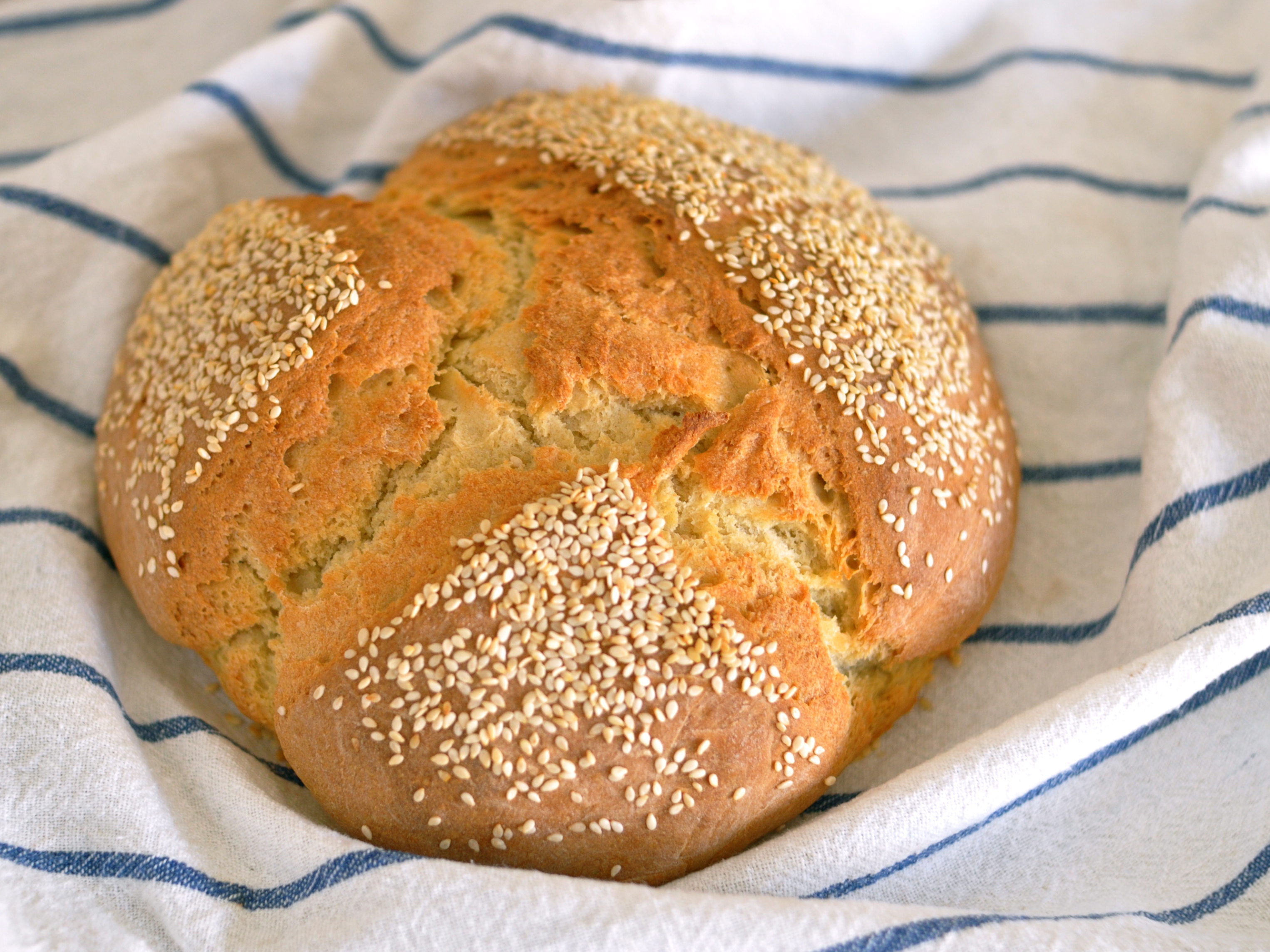
In his New Complete Book of Breads, Bernard Clayton doesn’t elaborate on this bread’s name; he does, however, call it “… a beginner’s dream.” And adds “Often I have used it in baking classes to demonstrate the ease with which good bread can be made.”

He might also have pointed out that this handsome bread is just the right measure of dense and chewy on the inside, with a soft but assertive crust on the outside, and that the rising time is only 15 minutes, which means the bread can be made from start to finish within an hour and a half, which is pretty great if — like me — you leave bread making to the last minute.

I first made it last September, realizing there was no bread in the house a bare ninety minutes before guests were to arrive for brunch. The name had also caught my eye and indeed it complemented well the baked eggs with cherry tomatoes, basil, and dash of balsamic vinegar I was serving that day.

Back then I hoped this sudden baking impulse would set the tone of a home-baked-bread–filled year, and perhaps even lead to realizing the sourdough fantasy I’ve been chasing.

Well, there hasn’t been much bread baking in the interim, let alone a sourdough adventure. Not a single loaf, in fact, until I baked this same Cuban bread for brunch again recently. It was well complemented, this time, by fried eggs with sautéed leeks and mushrooms atop grilled polenta (or that was the intention — the reality wasn’t quite so neat, but delicious nonetheless).

Happy spring!

***

From Bernard Clayton’s New Complete Book of Breads

5 to 6 cups white flour

2 packages yeast

1 Tbsp salt

2 Tbsps sugar

2 cups hot water (120°-130°F or 50°-55°C)

Sesame or poppy seeds (optional)

*

Prepare a baking sheet lined with parchment paper.

Place 4 cups of flour in a large bowl, add the yeast, salt, and sugar, and stir until they are well blended.

Pour in the hot water (using a thermometer is best here because if the water is too hot the yeast won’t work its magic, but, in the absence of such a device, a very unscientific gauge for right temperature is to place the little finger into the water and slowly count to ten. The water should feel quite hot at the end but below burning).

Beat with 100 strong strokes, or for 3 minutes with the flat beater of a hand mixer.

Gradually work in the remaining flour, half a cup at a time, until the dough is no longer too sticky and can be shaped into a ball. Kneed the dough for 8 minutes by hand on a floured work surface or in a hand mixer with a dough hook until it feels smooth, elastic, and “alive.”

Shape into a ball in a greased bowl and let the dough rise in a warm place until it has doubled in size, about 15 minutes.

Punch down the dough, separate it into two equal parts, and shape each into a smooth round. Place onto the parchmented baking sheet and cut an X on each loaf using a sharp knife. Brush with water and sprinkle with sesame or poppy seeds if desired.

Place the baking sheet with the loaves in the middle of a cold oven and place a large pan with hot water on a grate below, and heat oven to 400°F (200°C). **The bread will continue to rise in the oven as it is heating.**

Bake for about 50 minutes, until the bread is a deep golden brown. To check for doneness, knock on the bottom crusts; the loaves should sound hollow.

Let cool before slicing.

*

Related posts

Basic | Sweet pie crust

Banana cake

Stollen

Figs, walnuts, and chocolate

9 March 2012

Always an arm’s reach and no cooking away from an excellent dessert, and most delicious when the figs are broken open and stuffed with walnut halves.

It’s what we had at home most nights when I was a teenager. Every evening dinner included a main course, a salad, perhaps cheese, and, invariably, yogurt — plain, with a generous spoonful (or two) of jam or honey. And when one (or two) yogurt(s) left us with a feeling of not enough, we grabbed the nutcracker, the figs, and procrastinated with dessert before getting back to our homework.

*

Related posts

Figs with mascarpone

Sunday reading | 26.02.2012

26 February 2012

The semifinalists of the James Beard Foundation awards were announced this week. These are the most prestigious restaurant awards in the United States and interesting as such, but the nominations also provide a useful list of interesting restaurants to try, handily largely organized by region.

Though I sometimes feel I’ve read many pieces about pairing wine with food, I still always gravitate toward these articles, perhaps because I imagine reading about wine pairing will magically cure me of what is often a somewhat halfhearted approach at home. Reading this column by Meg Houston Maker, whose blog I also like very much, gave me new impetus. So, heeding the first recommendation that “what grows together goes together” to honor a ragù alla Bolognese I had watched gently simmer for over four hours, yesterday I perused my local wine store for a good choice from Northern Italy, preferably Emilia Romagna, the region of Bologna. We drank this 2008 Gradizzolo Negrettino. The wine was a discovery, and a perfect complement.

Ten days ago I had dinner at Allswell in Williamsburg, and as it happens, Pete Wells, the restaurant critic of the NY Times, wrote a short piece about it just this week. To me the food that night was somewhat underwhelming and I was ready to dismiss it. In light of this piece I will take a second look.

And one last link for the pleasure of a fun, well written article about the Eastern European plum brandy slivovitz. Although my sister brought bottles back from Bulgaria and Thomas claims to know it, I lack the emotional connection. It made me laugh nonetheless.

Walnut tarte with Chartreuse

24 February 2012

Some years ago I developed an interest in cocktails. It was triggered by an arcane email correspondence about absinth and Sazeracs leading up to our yearly skiing vacation in Haute Savoie, and quite quickly developed into a somewhat obsessive search for the perfect Sazerac in New York, at a time when few bartenders here knew what a Sazerac is, let alone how to make a good one.

My interest in Sazeracs grew into a more general curiosity for all things cocktail — mixer’s alcohols, bitters, techniques for making larger ice cubes — which happily coincided with the beginning of the cocktail trend in the city. Had I been writing then, cocktails would have featured prominently.

These days I drink mostly wine, except when my cocktail-fiend friend and then fellow-bar-stalker comes over for dinner, a bottle of gin or good rye in tow; I don’t have cocktail recipes jotted down on every second page of my little black notebook; and my cocktail bar recommendations would probably have a taste of five years ago. But I do still own a ludicrous number of partially full liquor bottles.

I will have to find creative ways of using Luxardo and Lillet, in the meantime, this tarte is a good excuse to tackle the Chartreuse.

***

This recipe is part of my “Schindler book” collection. Judging by its position in the book, which I copied in chronological order, I found it when I was about twenty. Unfortunately I can’t remember its exact origin, though I’m pretty sure I wrote it down after a vacation in France in the Vercors close to Grenoble, the region of walnuts and Chartreuse.

Unsweetened pie crust

250 g flour

125 g butter plus a little more to butter the pan

The filling

3/4 cup (200 g) crème fraîche

1 cup (200 g) sugar

2 generous cups (200 g) shelled walnuts

1 1/2 liquid ounces Chartreuse

*

The pie crust

Prepare the pie crust at least 1 hour in advance, as it needs to rest.

Place the flour in a large bowl, cut the cold butter into 1-inch pieces and work it with the fingertips into the flour, to obtain the consistency of coarse breadcrumbs. Add drops of cold water, little by little, until the dough sticks and can be shaped into a ball.

Cover the ball of dough with a damp cloth and place in the refrigerator for at least an hour, and up to one day.

Take the dough out of the refrigerator 10 to 15 minutes beforehand so it has time to soften at room temperature.

Preheat oven to 375°F (190°C) and generously butter a 12 inch (30 cm) pie pan.

To roll out the dough, lightly dust a clean, flat surface with flour and roll out the dough into a circle until it is 1/4 inch (1/2 cm) thin.**To prevent the dough from sticking to the the floured surface, turn it at the beginning then lift it regularly, all the while adding a little flour on either side and on the rolling pin.**

To transfer the dough to the pie pan, gently fold it in half once, then fold it in half again, and carefully place the folded dough in the buttered pie pan, positioning the angle in the center. Unfold, pressing gently onto the pan and sides, and cut off excess dough from the edges.

Bake the pie crust blind for 15 minutes. **When baking blind either poke a bunch of small wholes into the crust with a fork, or use dried beans or ceramic baking weights on the crust to prevent it from rising.**

*

The tarte

Increase the oven temperature to 400°F (200°C).

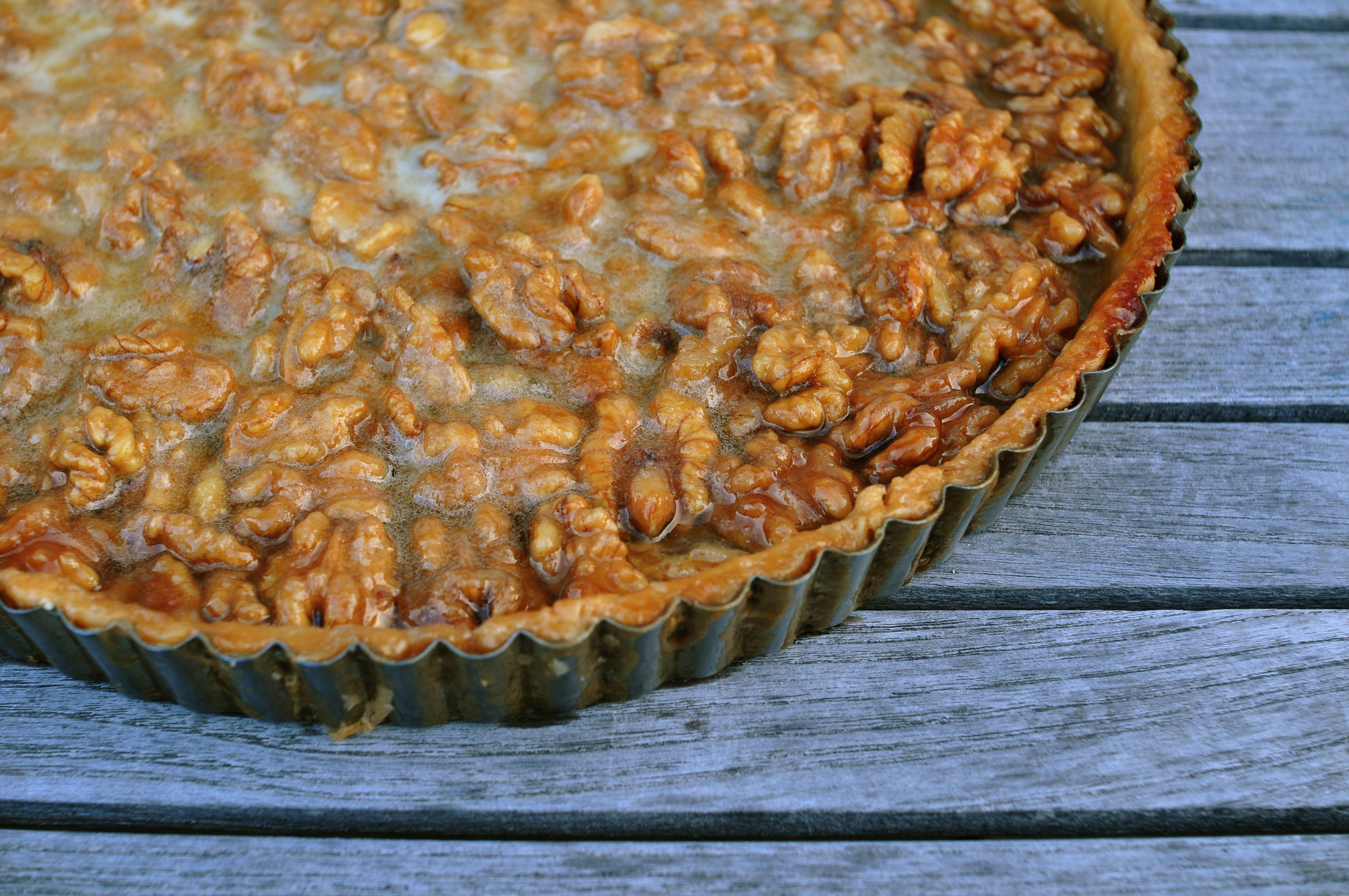
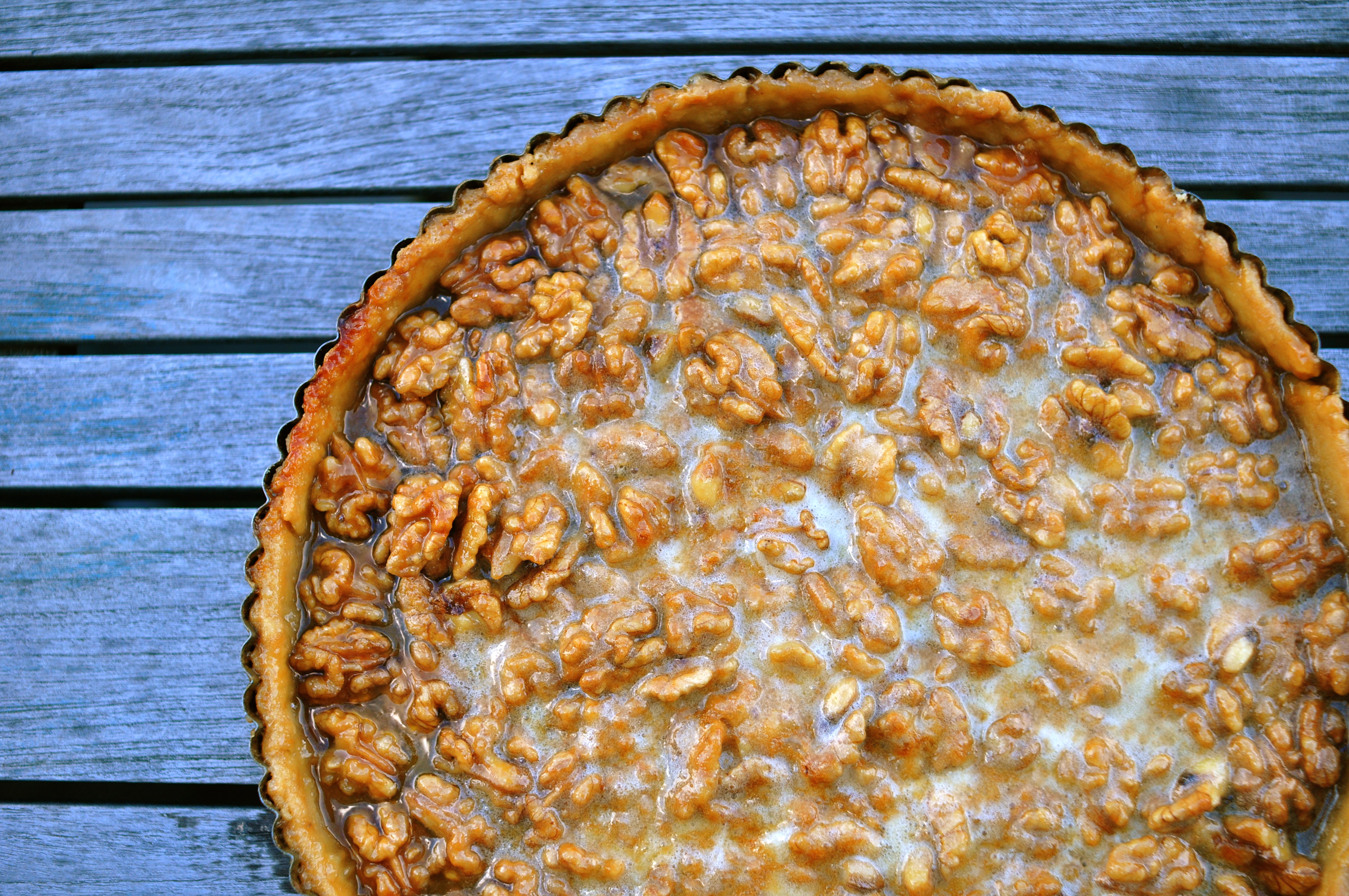
In a large bowl mix the crème fraîche and sugar, add the walnuts and the Chartreuse. Pour the mixture into the blind-baked crust.

Place the tarte in the oven on a larger baking sheet or aluminum foil, as the filling is likely to bubble over. Bake for 20 minutes.

Let the pie cool before eating. It becomes sticky and brittle, reminiscent of baklava. Mmmm!

*

Related posts

Quince and apple tarte

Best award-winning pumpkin pie

Basic | Sweet pie crust