Posts Tagged ‘homemade’

Green tomato chutney

6 October 2010

Because every time I see green tomatoes I feel compelled to buy some…

Unripe green tomatoes (not the heirloom variety) usually appear toward the end of tomato season, in early fall. Tomatoes that remain in abundance on the vines but may not get a chance to ripen are picked green before the cold weather sets in.

I buy green tomatoes every year at least once, just for the pleasure of seizing the fleeting moment. I have made green tomato jam, which I remember from my childhood; I have improvised fried green tomatoes, after seeing the movie; this year I decided to make green tomato chutney. This recipe is compiled from examples I found in a couple of my cookbooks and online.

***

3 lb (1.5 kg) green tomatoes

1 lb (450 g or about 2 medium) apples

2 medium onions

1 untreated lemon

Small piece fresh ginger root (about 2 in or 5 cm long)

Handful of raisins (optional)

1/2 tsp cayenne pepper

1 1 /2 tsp salt

1 1/2 cups (300 g) brown sugar

2 cups (1/2 l) cider vinegar

***

Coarsely chop tomatoes and apples, finely chop onions, and very finely chop lemon (with rind) and ginger (without peel). Place all in a large, heavy-bottom saucepan. Add raisins, cayenne, salt, sugar, and vinegar. Mix.

Slowly bring to a boil then simmer over low heat for at least 2 hours, stirring occasionally to prevent sticking to the pan, until the chutney has thickened.

Sterilize jars in boiling water for 5 to 10 minutes. Pour hot chutney into sterilized jars and close immediately. Wait for a few weeks as chutney needs to mature.

Yogurt

29 September 2010

Making yogurt without a machine is very easy if you accept a slight degree of unpredictability, as yogurt cultures can be temperamental. The tricky part is keeping the yogurt at the right temperature while it sets, and this is where a yogurt maker helps, but it’s by no means indispensable (I don’t own one and I have been making yogurt for years).

Like many people interested in making yogurt at home, I knew it was easy – theoretically. But it wasn’t until I witnessed it that I realized how ridiculously simple it really is. The main steps are very straightforward: heat milk – let cool – stir in a spoonful yogurt  – let set; but of course, the devil is in details.

***
Step 1: Scald milk

In a saucepan, heat milk until bubbles begin to form. Remove from heat.

Step 2: Let milk cool to just above body temperature

Yogurt cultures are most active just above body temperature, at 110°F (43°C). A good way to gauge the temperature without a thermometer (I don’t own one, either) is to place your little finger in the milk and count to 10. It should feel warm but not burn. If the milk is too hot it will kill the yogurt cultures. If it is too cold the yogurt will take forever to set or not set at all.

Step 3: Stir in 1 tablespoon “starter” yogurt per quart (liter) milk

Any commercial plain yogurt works, as long as it contains live cultures (specified in the ingredients).

Using more “starter” yogurt will not help, on the contrary. Think of it as overcrowding; too many live cultures make the yogurt thinner and more sour.

Stir well so the starter yogurt dissolves into the milk.

Step 4: Pour milk into container(s)

Any container will do, large or small, jar, bowl, storage container, etc.

Preheat container(s) with hot water to maintain as much heat as possible. Cover with lid, cloth, or parchment paper (this makes a difference; left uncovered the yogurt doesn’t set as well).

Step 5: Let set in a warm place

The temperature should stay as close as possible to 110°F (43°C). This is the tricky part, the one for which the yogurt maker was invented, but there are a number of other ways to maintain heat. I have tried the following methods, they all work, it’s a question of choosing the one most practical for you:

  • Place containers in a cooler bag (space permitting, add a bottle of hot water to maintain heat)
  • Wrap a towel around the containers and place in the warmest place in the house
  • Preheat oven to 200°F (90°C), turn off oven (very important!), and place yogurt containers in the preheated oven. (Don’t forget the yogurt and accidentally turn the oven on for another use. I must admit it has happened to me. More than once…)

Do not disturb the yogurt until it is set – anywhere from 3 to 12 hours. (It happens that the yogurt doesn’t set, in that case the same milk can be reheated to repeat the process.)

Yogurt keeps in the refrigerator for weeks.

Marinated olives

17 September 2010

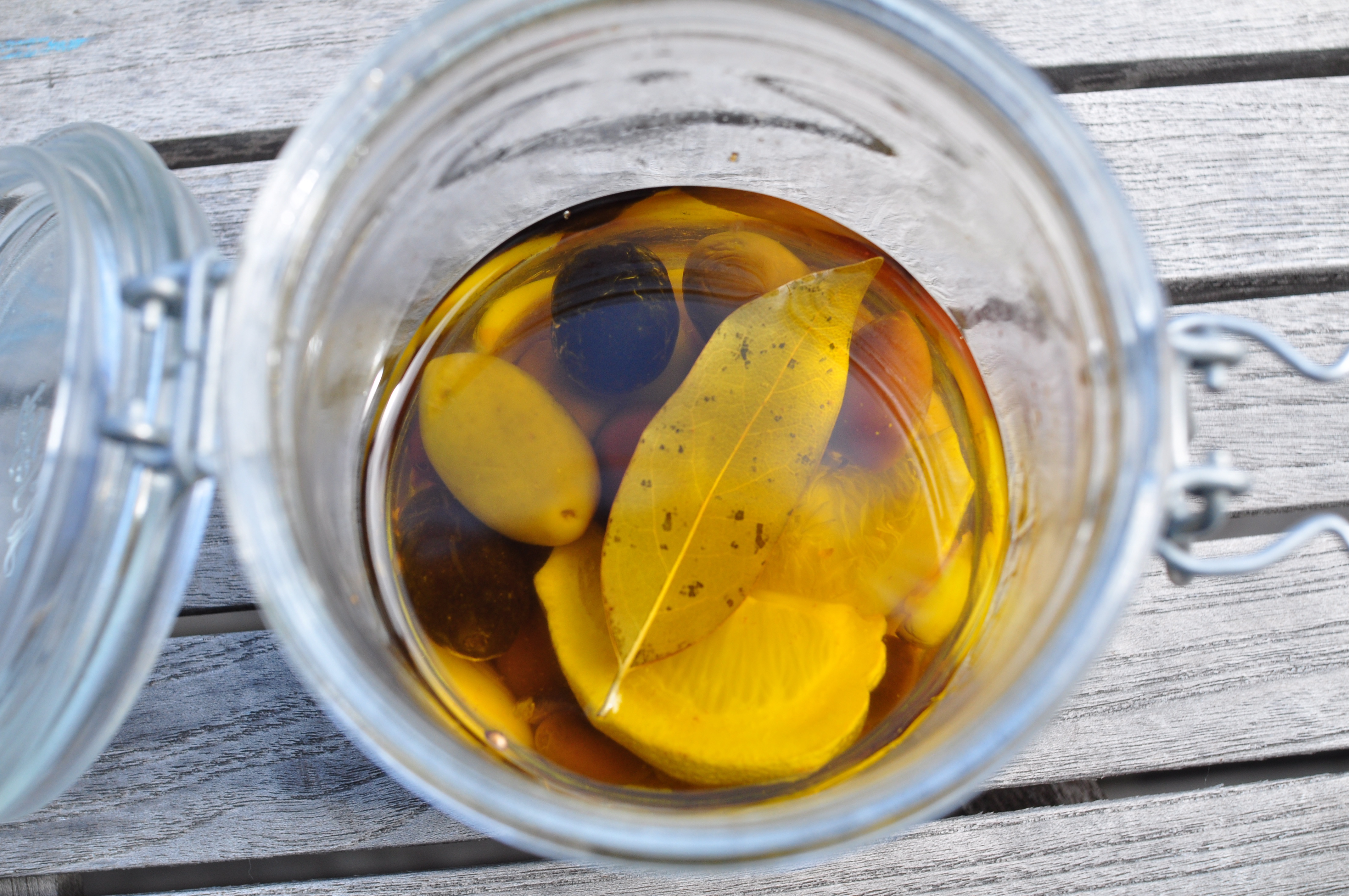
We usually serve olives as part of an aperitif, but between dinner invitations, they often end up forgotten at the back of the fridge. To avoid throwing olives away, and to ensure a ready supply for any unexpected visitor, I started keeping a large jar of marinated olives on hand on my kitchen counter. It’s practical, avoids waste, and the olives are very good.

***

Olives, any mix of green, black, Picholine, Kalamata, Cerignola, Niçoise, etc – or just one kind

Coriander seeds, coarsely ground in a mortar

Black peppercorns

Garlic cloves

Bay leaves

Dried red chillies

Lemon wedges

Olive oil

***

Mix the olives with the coriander, peppercorns, whole garlic cloves, bay leaves, lemon wedges, and chillies. Put in a jar and cover generously with olive oil. **Anything that is not submerged will become moldy.** Place a lid on the jar but do not close it hermetically, as the olives need to breathe.