Archive for the ‘Holidays’ Category

Quick lemon and lime tart

2 May 2012

In my world, lemon pie is a little like roast chicken; having been introduced to the utterly convincing very elaborate version, I had forgotten how quick and easy it can also be.

The herbs-stuffed-under-the-skin-of-the-chicken version of lemon pie is that of the River Café Cookbook Blue. It requires 6 whole eggs plus 9 yolks and half an eternity of patient stirring over a very low fire. It is the mother, grandmother, fairy godmother, and evil aunt of all lemon pies. It should be made at least once in a lifetime.

But if you don’t have 15 eggs or an entire day to spare, there is this recipe, which asks for nothing more than to whisk all the reasonably proportioned ingredients together, pour them into a pre-cooked tart shell, and bake.

This is the child prodigy of lemon pies. Effortless. Very tart, with an unconventional twist of lime. Addictive.

***

Recipe slightly adapted from The Naked Chef by Jamie Oliver

1 unbaked sweet pie crust

Egg-wash (1 egg and a little milk)

Zest from 2 limes

3/4 cup (200 ml) fresh lime juice (4 to 5 limes)

Zest from 2 lemons

3/4 cup (200 ml) fresh lemon juice (3 to 4 lemons)

1 1/2 cups (300 g) sugar

8 large eggs

1 1/2 cups (350 ml) heavy cream

*

Preheat oven to 350°F (175°C).

With a fork, mix 1 egg with a little milk and egg-wash the uncooked pie crust before baking blind.

Bake the pie crust blind for 10 to 12 minutes minutes. **When baking blind either poke a bunch of small wholes into the crust with a fork, or use dried beans or ceramic baking weights on the crust to prevent it from rising.**

Remove the blind-baked crust from the oven and set aside while making the filling.

Grate the limes and lemons for their zest. Squeeze the limes to obtain 3/4 cup juice and the lemons to obtain 3/4 cup lemon juice.

In a large bowl, whisk together the sugar and eggs until the yolks are completely broken up and the mixture becomes very smooth.

Stir in the heavy cream, then the lime and lemon juice.

Place the blind-baked pie crust back onto the oven rack then pour in the filling (this avoids spillage, as the pie will be filled up to the rim).

Bake the tart for 35 to 40 minutes until it is barely starting to turn golden and still a little wobbly in the middle. It will set as it cools.

Let cool completely before serving.

Fresh strawberries or raspberries would be a great complement to this pie, but just a little unsweetened home-whipped cream goes really well too.

*

Related posts

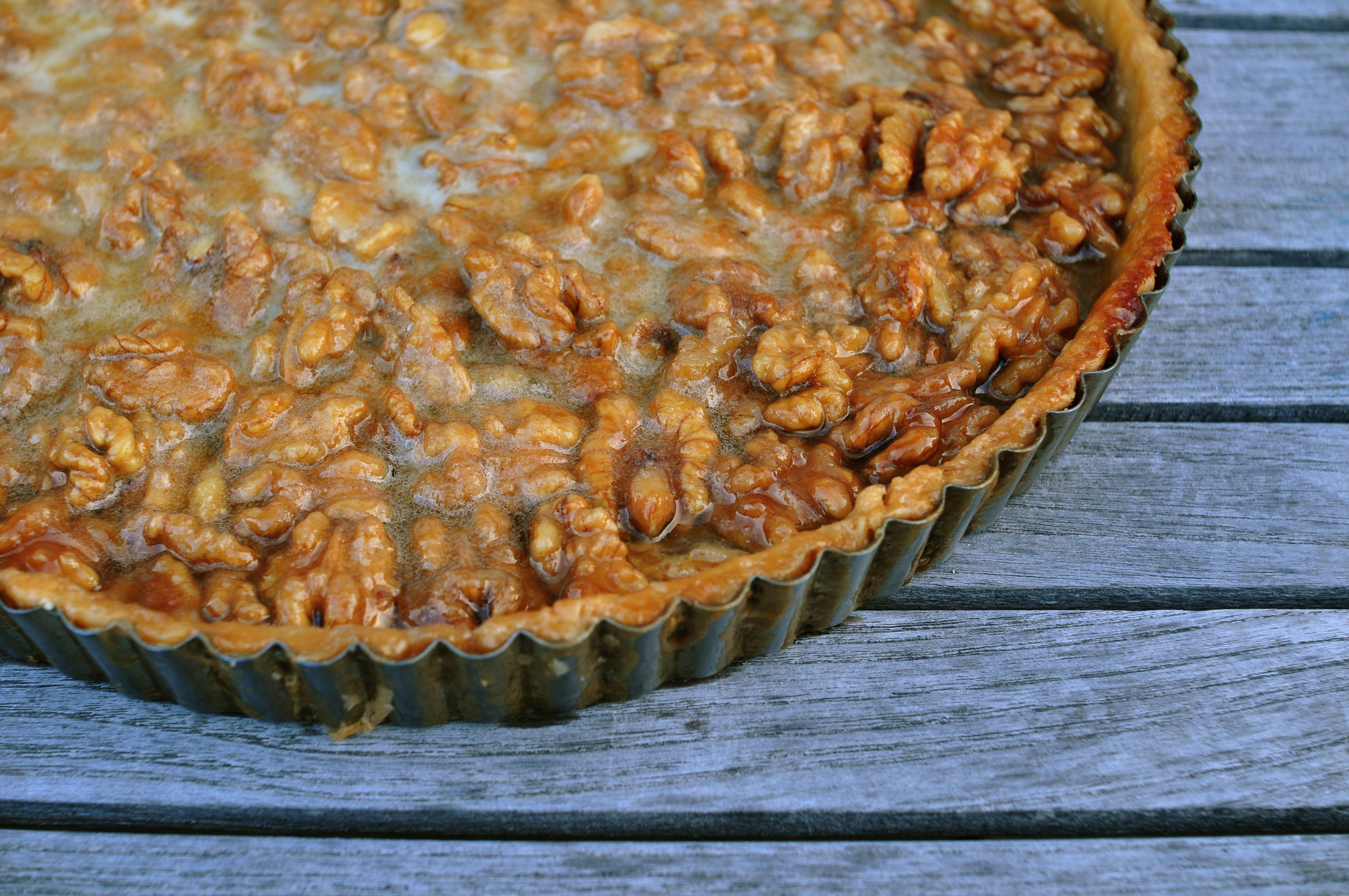
Walnut tarte with Chartreuse

Roast chicken with lemon and fennel seeds

Basic | Sweet pie crust

Figs, walnuts, and chocolate

9 March 2012

Always an arm’s reach and no cooking away from an excellent dessert, and most delicious when the figs are broken open and stuffed with walnut halves.

It’s what we had at home most nights when I was a teenager. Every evening dinner included a main course, a salad, perhaps cheese, and, invariably, yogurt — plain, with a generous spoonful (or two) of jam or honey. And when one (or two) yogurt(s) left us with a feeling of not enough, we grabbed the nutcracker, the figs, and procrastinated with dessert before getting back to our homework.

*

Related posts

Figs with mascarpone

Walnut tarte with Chartreuse

24 February 2012

Some years ago I developed an interest in cocktails. It was triggered by an arcane email correspondence about absinth and Sazeracs leading up to our yearly skiing vacation in Haute Savoie, and quite quickly developed into a somewhat obsessive search for the perfect Sazerac in New York, at a time when few bartenders here knew what a Sazerac is, let alone how to make a good one.

My interest in Sazeracs grew into a more general curiosity for all things cocktail — mixer’s alcohols, bitters, techniques for making larger ice cubes — which happily coincided with the beginning of the cocktail trend in the city. Had I been writing then, cocktails would have featured prominently.

These days I drink mostly wine, except when my cocktail-fiend friend and then fellow-bar-stalker comes over for dinner, a bottle of gin or good rye in tow; I don’t have cocktail recipes jotted down on every second page of my little black notebook; and my cocktail bar recommendations would probably have a taste of five years ago. But I do still own a ludicrous number of partially full liquor bottles.

I will have to find creative ways of using Luxardo and Lillet, in the meantime, this tarte is a good excuse to tackle the Chartreuse.

***

This recipe is part of my “Schindler book” collection. Judging by its position in the book, which I copied in chronological order, I found it when I was about twenty. Unfortunately I can’t remember its exact origin, though I’m pretty sure I wrote it down after a vacation in France in the Vercors close to Grenoble, the region of walnuts and Chartreuse.

Unsweetened pie crust

250 g flour

125 g butter plus a little more to butter the pan

The filling

3/4 cup (200 g) crème fraîche

1 cup (200 g) sugar

2 generous cups (200 g) shelled walnuts

1 1/2 liquid ounces Chartreuse

*

The pie crust

Prepare the pie crust at least 1 hour in advance, as it needs to rest.

Place the flour in a large bowl, cut the cold butter into 1-inch pieces and work it with the fingertips into the flour, to obtain the consistency of coarse breadcrumbs. Add drops of cold water, little by little, until the dough sticks and can be shaped into a ball.

Cover the ball of dough with a damp cloth and place in the refrigerator for at least an hour, and up to one day.

Take the dough out of the refrigerator 10 to 15 minutes beforehand so it has time to soften at room temperature.

Preheat oven to 375°F (190°C) and generously butter a 12 inch (30 cm) pie pan.

To roll out the dough, lightly dust a clean, flat surface with flour and roll out the dough into a circle until it is 1/4 inch (1/2 cm) thin.**To prevent the dough from sticking to the the floured surface, turn it at the beginning then lift it regularly, all the while adding a little flour on either side and on the rolling pin.**

To transfer the dough to the pie pan, gently fold it in half once, then fold it in half again, and carefully place the folded dough in the buttered pie pan, positioning the angle in the center. Unfold, pressing gently onto the pan and sides, and cut off excess dough from the edges.

Bake the pie crust blind for 15 minutes. **When baking blind either poke a bunch of small wholes into the crust with a fork, or use dried beans or ceramic baking weights on the crust to prevent it from rising.**

*

The tarte

Increase the oven temperature to 400°F (200°C).

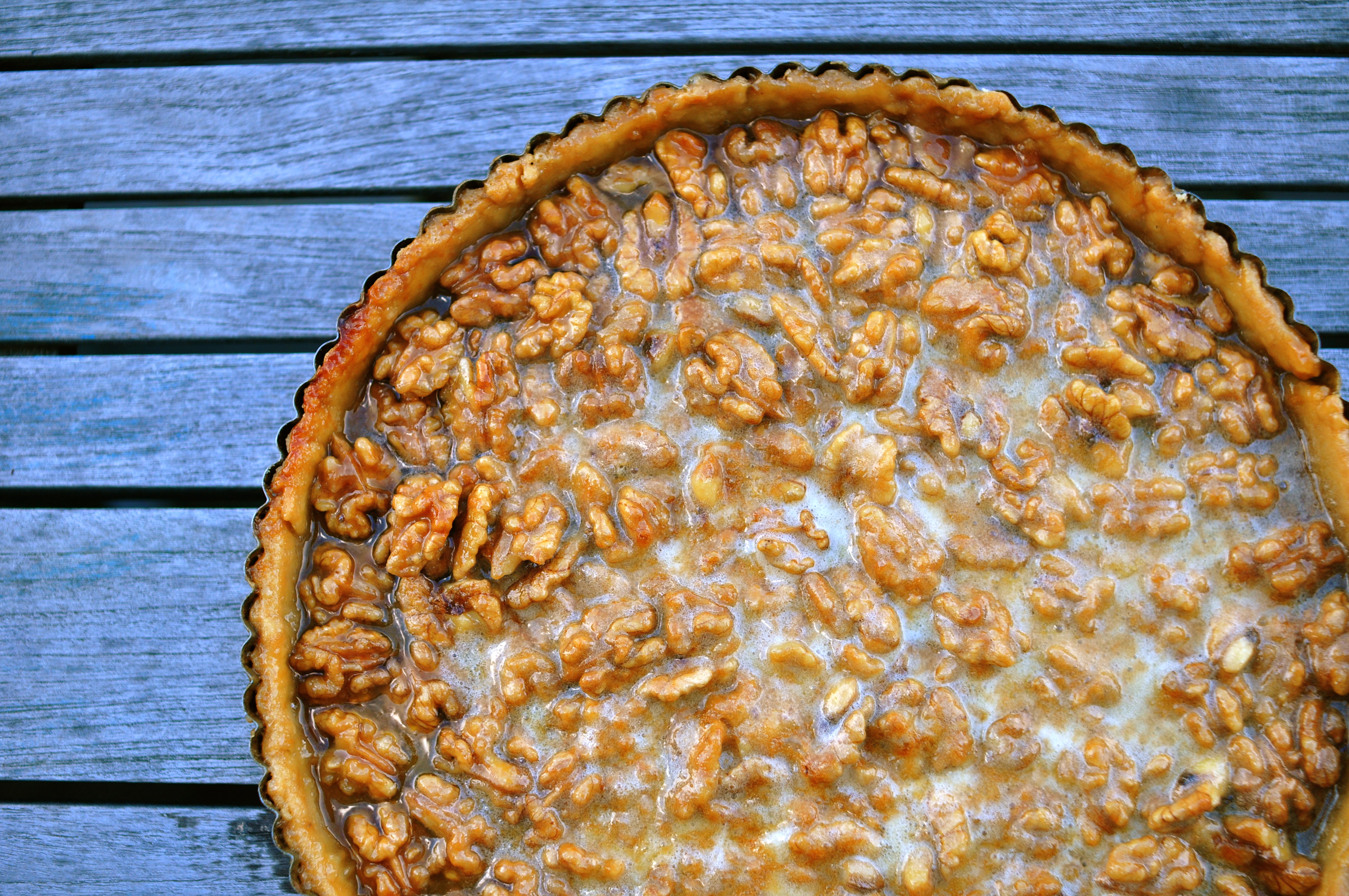
In a large bowl mix the crème fraîche and sugar, add the walnuts and the Chartreuse. Pour the mixture into the blind-baked crust.

Place the tarte in the oven on a larger baking sheet or aluminum foil, as the filling is likely to bubble over. Bake for 20 minutes.

Let the pie cool before eating. It becomes sticky and brittle, reminiscent of baklava. Mmmm!

*

Related posts

Quince and apple tarte

Best award-winning pumpkin pie

Basic | Sweet pie crust


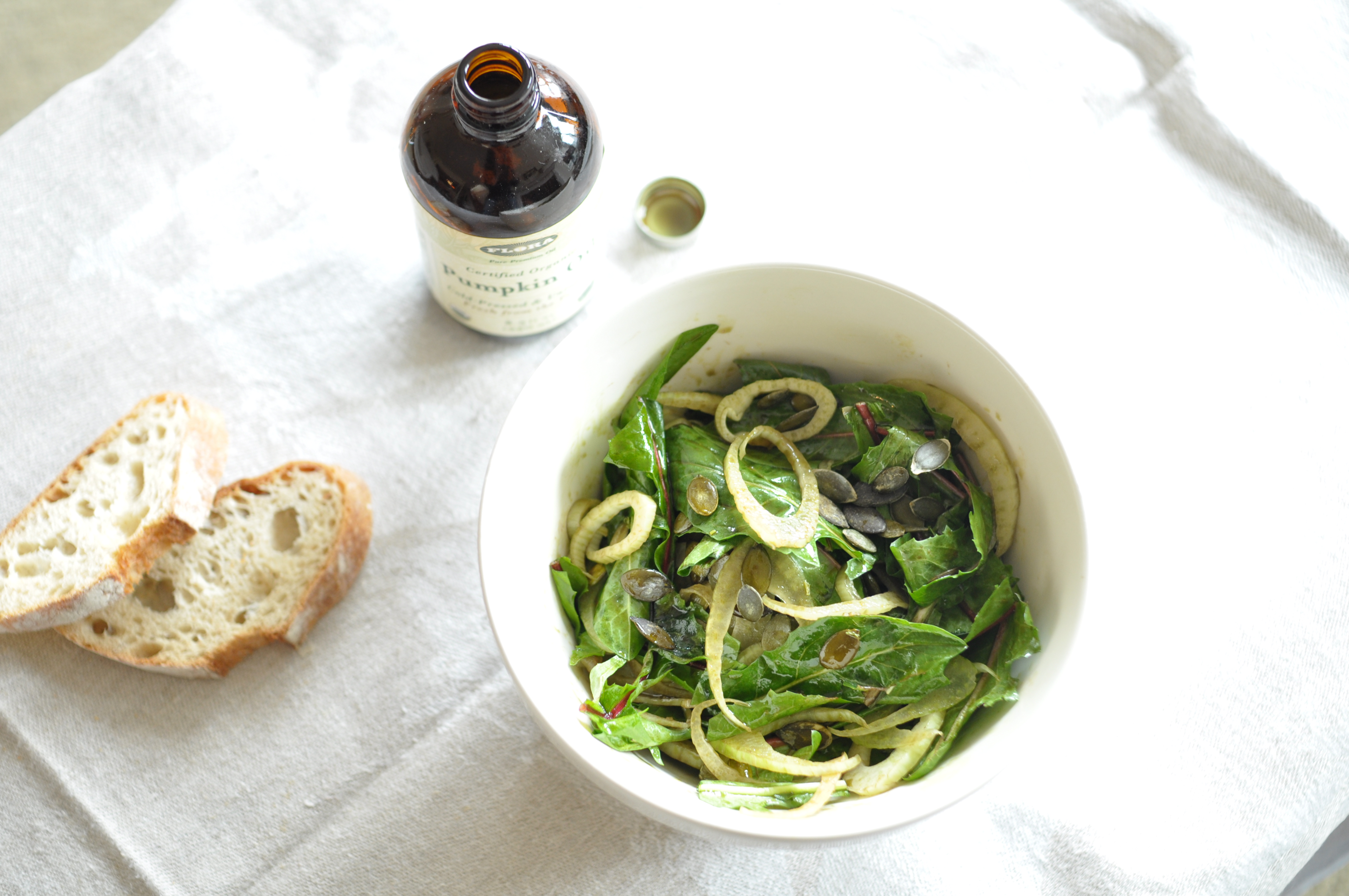
Dandelion, fennel, and pumpkin seed salad with pumpkin seed oil

18 February 2012

I was craving something green.

***

Pumpkin seed oil is quite common in Germany and Austria. Here in New York I have found it in health food stores, in the refrigerated section.

I rarely prepare salad dressing on the side; I usually just sprinkle the oil and lemon juice or vinegar directly onto the greens. It’s faster. The traditional ratio for salad dressing is three parts oil for one part vinegar but I prefer a little more pep.

1 bunch dandelion leaves

1 fennel bulb

1 Tbsp pumpkin seed oil

2 Tbsps olive oil

1 Tbsp Balsamic vinegar

1 Tbsp Lemon juice

Flaky sea salt

Freshly ground black pepper

A small handful of raw pumpkin seeds

*

Cut off the lower part of the dandelion stems, wash the leaves and spin or pat dry with a clean kitchen towel. Tear or chop the larger leaves in half.

Cut off the stems and remove the coarse outer layer of the fennel bulb. Thinly slice it crosswise to obtain rings.

Place the dandelion leaves and fennel rings in a bowl. Sprinkle with the pumpkin seed and olive oils, the vinegar, the lemon juice, and toss well to dress the greens. Season with salt and pepper, and the pumpkin seeds, and toss one last time.

*

Related posts

Endive salad with apples, walnuts, and comté

Lentil and fennel salad with lemon and parsley

Parsnip and butternut squash soup with sage

Foie gras terrine

28 December 2011

DSC_0214

The first memory I have of foie gras is a conversation with my parents. We were in the car. I don’t remember whether I was 8, 10, or 12, but I think we were visiting friends in the Périgord, one of the prime foie-gras producing regions in France.

My parents were explaining foie gras: Duck or geese are force-fed excessively until their livers become abnormally large. These livers are prepared most delicately and the result is terribly delicious, a rare delicacy to be savored with due appreciation for what goes into its making.

I was appalled, and had no idea what the dish actually was. Foie gras, a French regional specialty? I pictured a sort of liver stew, and swore solemnly never to eat it. Quite honestly, forsaking liver stew forever didn’t seem like such a sacrifice. Had I known.

Later, much later, I ate foie gras, of course, and was compelled to admit that my parents were right.

Now I make foie gras terrine once a year, for Christmas eve. Have all my scruples disappeared or have I discovered many shades of grey? Am I willing to forsake anything for pleasure or have I been convinced that producing foie gras is not as barbaric as it sounds?

Just as I don’t eat meat or chicken raised industrially and buy eggs from pastured hens if I can, I always get foie gras from Hudson Valley Foie Gras. I believe they raise happy ducks. I am sure some will disagree.

***

More than usual, the raw product is crucial here. In New York the best source of good foie gras is Hudson Valley Foie Gras.

The tricky part about preparing foie gras is deveining the lobes. I learned it from my mother, who learned it from a friend, but I found this good video online. It’s in French but the images are self-explanatory.

This recipe is very slightly adapted from one by the French chef Michel Guérard. It uses many aromatics but in very small quantities, so the taste of the foie gras is enhanced but not overpowered.

2 raw foie gras livers about 1 1/2 lbs (600 g) each

1 quart (1 liter) whole milk

16 g (2 level Tbsps) finely ground (in a mortar) fleur de sel or unrefined sea salt

3 g (1 1/2 tsps) freshly ground white pepper

1 pinch freshly ground nutmeg

1 pinch freshly ground allspice

1 tsp finely ground sugar

2 cl Madeira

2 cl dry Sherry

2 cl Armagnac

*

When cold the foie gras is quite hard, so in order to devein it it needs to soften a little. Pour the cold milk and about half as much hot water in a large bowl (the liquid should be warm). Put in the raw foie gras and let it soften for about an hour.

Remove the livers from the milk, place them on a large board, and, working carefully with the blunt side of a sharp knife, remove the veins from the liver. To do this, start at the big knot of veins and carefully follow the veins, removing as much as possible to avoid any blood stains in the liver.

Place the deveined livers in a shallow dish and sprinkle with the spices and alcohol. Let marinate for a few minutes or up to 12 hours in the refrigerator (I have done it both ways and would be hard pressed to say definitively which is better. I’d make it depend on what is more convenient, logistically).

Preheat oven to 250°F (120°C) and place a large shallow pan filled with 1  inch (2.5 cm) of water at 150°F (70°C).

Place the livers in the terrine, and the terrine (without the lid) in the pan of water. Cook for 40 minutes, checking regularly that the water stays at 150°F (70°C) the whole time.

Once cooked, the liquid fat should have risen over the livers and cover them by about 1/2 inch (1 cm).

Close the terrine and let it cool at room temperature for about 2 to 3 hours, then transfer to the refrigerator.

Foie gras must be made at least 24 hours in advance, is best after 3 to 4 days, and will keep for about 8 days.

*

Related posts

Chicken liver terrine