Archive for the ‘Fall’ Category

Fettucini with immediate tomato sauce

4 October 2012

The last of the summer’s ripe tomatoes may be a little soft, a little blemished, they may not warrant much attention as heads will be turned by the arrival of bright yellow squash and orange pumpkins. What these tomatoes want is this sauce exactly. It is so quick, so easy that it will barely distract from the anticipation of slow roasts and apple pies. It is so good that those blemished tomatoes may soon be missed, as the creeping cold leaves heaps of unripened green tomatoes in its wake, with no better prospect but to be transfigured into chutney.

The sauce sort of made itself one night, and I was taken aback by how easy it was to create such a good sauce in so little time. I’d always supposed that good tomato sauce needs to simmer gently and reduce patiently. On that evening there was no time and, temptingly, in the kitchen, some good fettucini and a few roma tomatoes.

All I did was cut the tomatoes lengthwise in sixths, slice a few garlic cloves, heat some olive oil in a large skillet, throw in the garlic for barely a minute, add the tomatoes, and wait until most of the juice had evaporated and the tomatoes hinged on golden and in some places brown. It took perhaps 10 minutes, just about the time to boil the pasta.

***

For two

5 ripe tomatoes

2 cloves garlic

Good olive oil

Sea salt and freshly ground black pepper

200 g good fettucini

Really good olive oil

Parmigiano-reggiano

Few basil leaves

*

Bring a large pot of heavily salted water to boil for the pasta.

Cut tomatoes in half lengthwise then in half in thirds. Peel and thinly slice the garlic.

Carefully slide in the fettucini. Cook in a heavy boil.

Heat a generous amount of olive oil in a large heavy skillet. **The skillet should be large enough so the tomatoes are in one layer only.** Cook the garlic for barely a minute over medium to high heat, until translucent, then add the tomatoes. Season generously with salt and pepper. Cook the tomatoes over high heat until a lot of the juice has evaporated and they start turning brown.

Start checking the pasta regularly after about 8 minutes (by carefully taking one out and eating it). Drain quickly in a colander as soon as the pasta is just al dente (or to desired consistency) and return immediately to the pot used for boiling the pasta (one could use another pot but it’s much simpler this way). **It is important not to overdrain the pasta. If it is too dry it will become sticky.** Quickly drizzle generously with good olive oil so the pasta doesn’t stick.

Transfer the pasta to individual bowls. Spoon over the tomatoes, add a drizzle of very good olive oil, tear up a few leaves of basil on each bowl, and grate some parmigiano to finish.

Quick pickles

29 September 2012

The bounty of fall, the joy of coming home after a summer away; it’s the time of year when I am overrun by the desire to cook, pickle, and can, buy way too many fruits and vegetables at the market, and usually only barely manage to rescue them, in extremis, days and sometimes weeks later, and turn them into whatever easy preserve I come across that day. Despite my determination, every year, to squirrel away a veritable pantry of homemade goods for the winter, my canning endeavors are completely haphazard. This year for example I made a few versions of this jam every time there were too many excess plums on the brink. I made a quart of tomato sauce with a few extra pounds of overripe tomatoes. I studded a cake with practically fermenting concord grapes.

But one recipe I was determined to make, the instant I saw it, was Kitchen Culinaire’s peach and lavender jam. At one market on Tuesday I found peaches from upstate New York which evolved from rock hard to mealy soft without a whiff of peach in between. On Saturday I went to look for the seller of West Virgina peaches at the Mount Morris Park market that inexplicably and without a word moved blocks away to the corner of Lenox and 122nd. This producer sells hands down the best peaches I’ve ever eaten in New York, and I wish I’d known of the market’s move sooner in the season. This Saturday I went and bought many many many pounds of peaches, heaved them home, and didn’t make any jam. When, after years of peach frustration, one finally finds fruit that is all that a peach used to be, so long ago, the only thing to do is to eat it just so.

For days we ate peaches, with nothing more than a little Greek yogurt and light drizzle of honey. But I was on a mission, I had to make this jam, so I rescued the last three sweet juicy pounds and proceeded to infuse the lavender, cut the fruit, weigh the sugar, and set the jam to simmer. It smelled incredible, so fragrant and delicate, like a summer in Provence. And then I overcooked it. Beginner’s mistake, bad planning, distracted multi-tasker, I had to stop the cooking to pick up Balthasar from school, when I started it again I was giving Louise a bath and suddenly the jam wasn’t golden brown anymore but deep brown with sparkly foam, the scent of lavender entirely replaced by peach caramel…

Today I rushed out to buy peaches and make jam immediately; there were none, the farmer’s market replaced by a small flea. And so, even with the very best intentions, this year I didn’t manage the one jam that I had set out to do. And despite my best intentions, this post will not be about peach lavender jam.

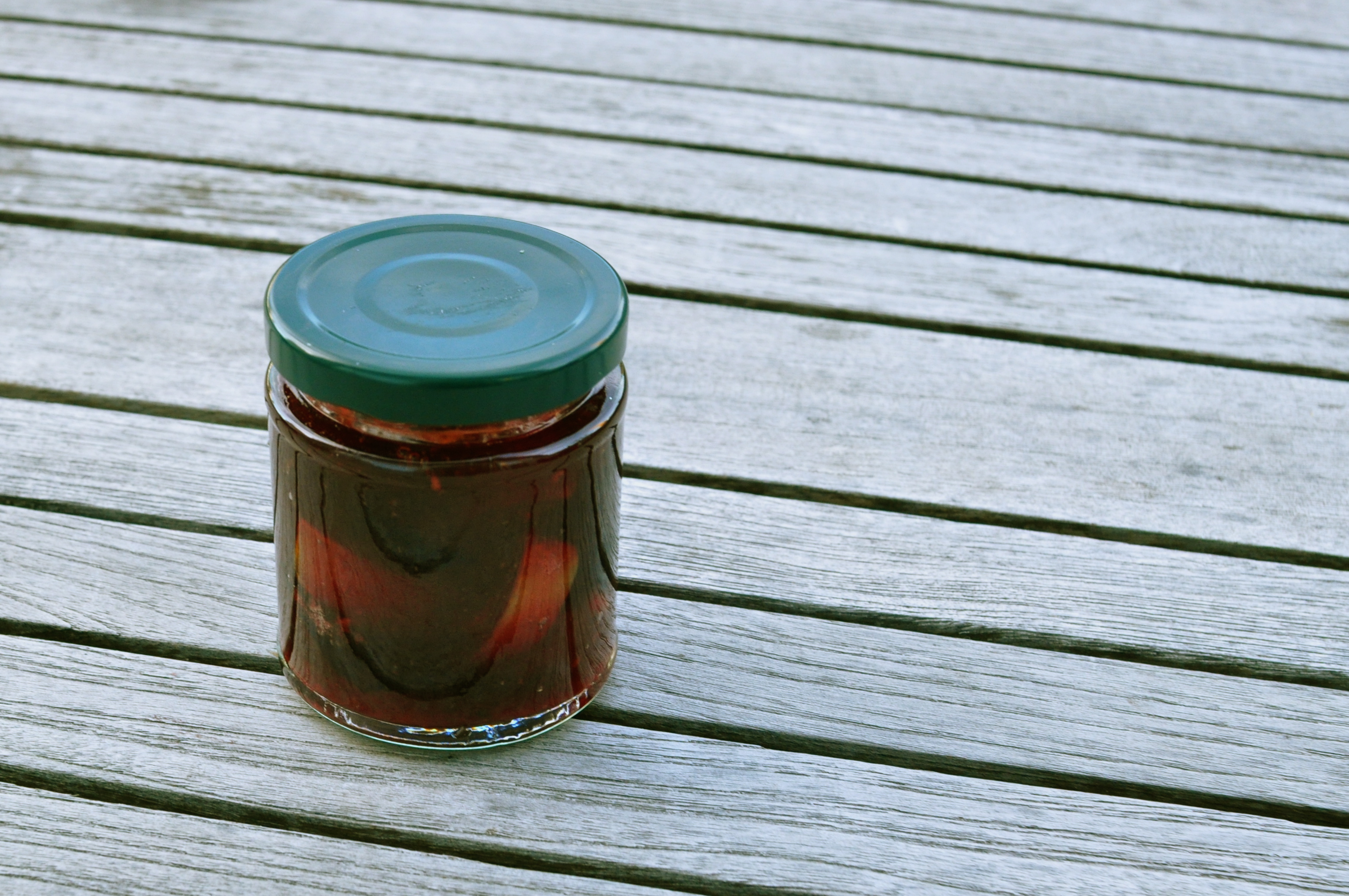
It’s about pickles. It happened by chance. I saw kirby cucumbers at the market, bought some with no plan in mind; days later when it was high time to use them, I went to this great resource for all things in jars, found this recipe, made it. It’s great.

***

Slightly adapted from Asian-Inspired Quick Pickles by Food in Jars. One-pint Mason jars are the perfect height for these pickles. Makes 2 one-pint jars.

2 one-pint Mason jars
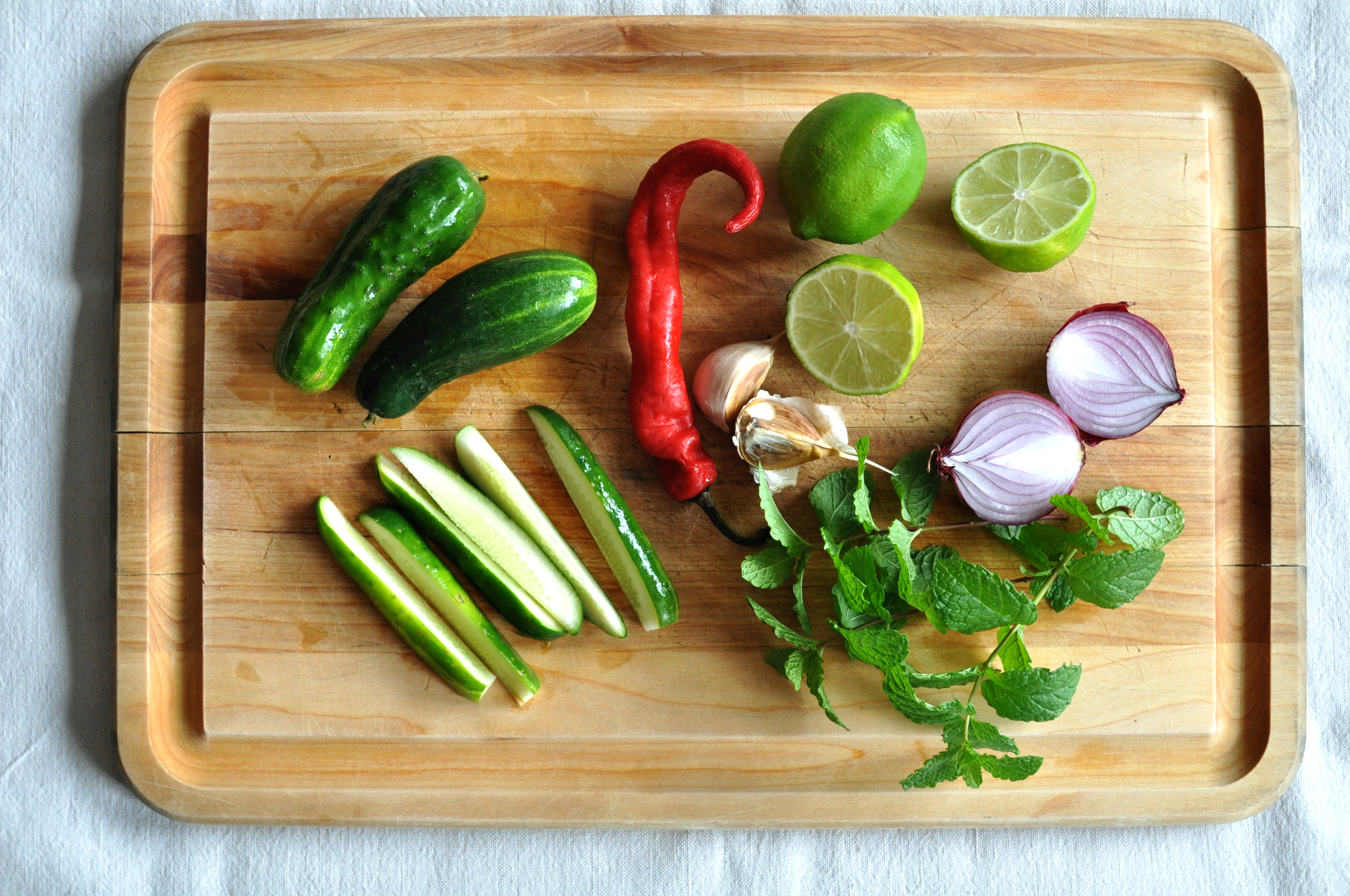
4 or 5 kirby (small pickling) cucumbers
1 chili pepper
1/2 small red onion or 3-4 scallions
2 garlic cloves
4 small sprigs fresh mint
4 small sprigs fresh coriander
1 cup rice wine vinegar
Juice from 2 limes
2 Tbsps sugar
1/2 teaspoon salt

*

Cut each cucumber into six spears. Cut the chili pepper in two lengthwise. Thinly slice the onion (or peel the scallions, cut then into kirby-length pieces, and slice them lengthwise) and garlic cloves. Wash the mint and coriander.

Dividing the ingredients equally between the two jars, pack the cucumber spears and slide in the chili pepper, onion (or scallions), garlic, mint and coriander.

In a small bowl, stir together the rice wine vinegar, lime juice, sugar, and salt. Pour the liquid over the cucumbers, close tightly, and carefully invert the jars to combine all the flavors.

Let the pickles sit in the refrigerator for at least 24 hours before eating.

Grilled pork chops with fennel, sage, and pimentón

13 September 2012

I have a dilemma, and it involves pork.

As I may have mentioned, a few years ago I discovered Flying Pigs Farm at Union Square market. Before then I never bought pork (ham and bacon excepted), but since I’ve become more than a little fond of the animal, largely encouraged by a pretty remarkable recipe for slow roasted shoulder.

As I may also have mentioned, last November a real local butcher, Harlem Shambles, opened in our neighborhood.

So I have a problem of fealty: where should I buy pork now?

Rather than resolve this question just yet I’ve embraced this sudden begging supply of excellent pork and expanded my pork-cooking horizon further; I’ve been making pork chops. We’ve grilled them and, due to uncooperative weather gods, have seared them in a pan. Both work very well; key are the quality of the pork, and seasoning that respectfully complements the flavor of the meat.

They were amazing, I thought. Whether here or there, another great reason to buy pork.

***

Serves 4, one pork chop per person

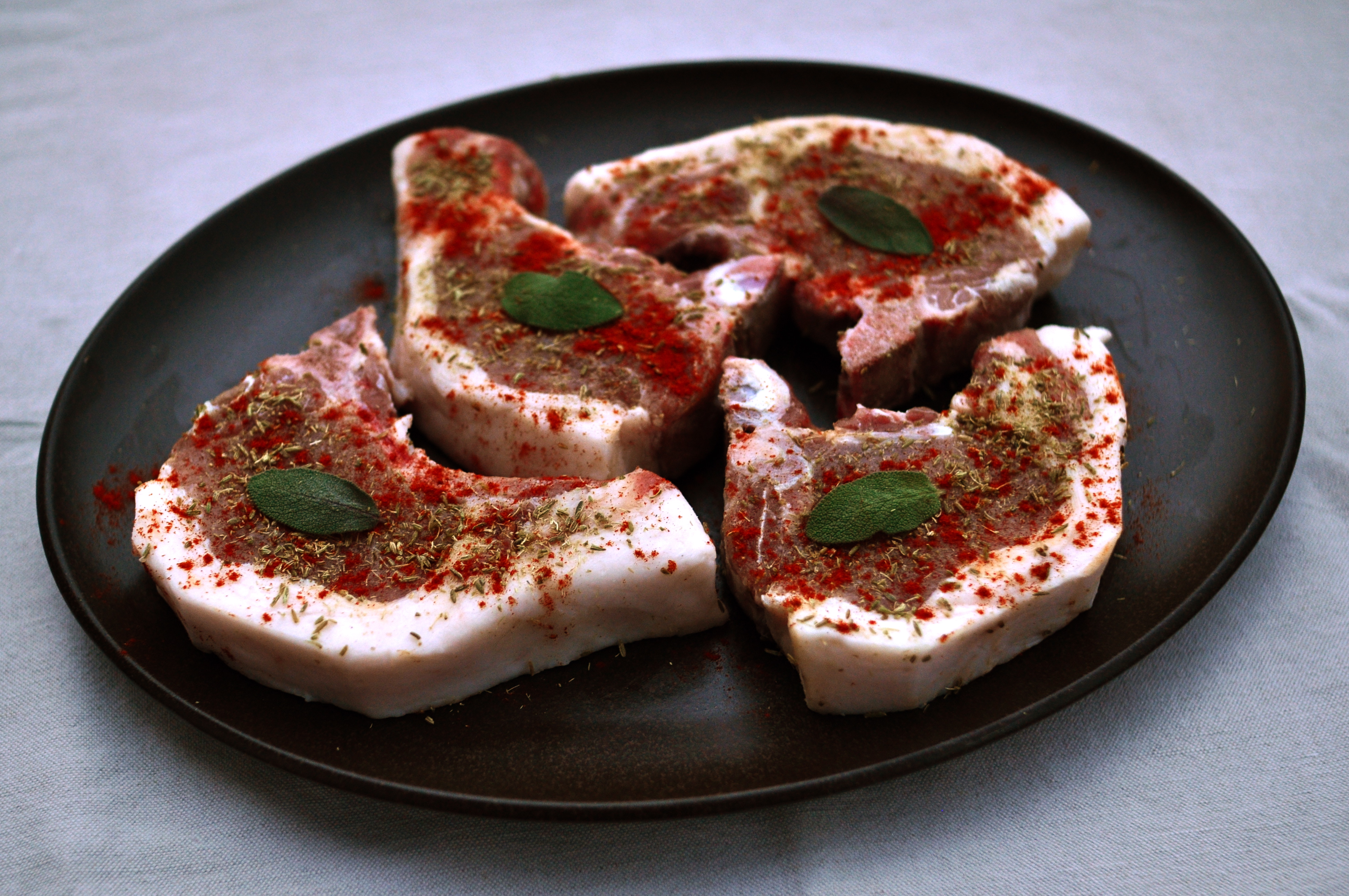
4 (1 inch-thick) all natural and preferably heritage breed pork chops
1  1/2 tsps fennel seeds
1 tsp coarse sea salt
8 sage leaves
Smoked Spanish paprika (pimentón)

*
Take the pork chops out of the refrigerator and prepare the rub at least 45 minutes before cooking.

In a mortar, crush the fennel seeds with the sea salt.

Rub the chops on each side with the spices and add a sage leaf in the middle. Let sit at room temperature. *Meat cooks more evenly if allowed to come to room temperature.*

Just before cooking — on a grill or in a pan faintly coated with olive oil — sprinkle some smoked Spanish paprika on each side of the chops.

Cook the chops over very high heat so they become beautifully brown on the outside without having time to dry up inside. It’s difficult to give an exact cooking time but it should be approximately 4 minutes on one side and 3 to 4 on the other.

As always, let the meat rest in a warmish place 5 to 7 minutes before serving. The chops should be faintly pink inside and very juicy.

*

Related posts

Slow-roasted pork shoulder

Pork rillettes

Ratatouille

Baked mackerel with mustard and thyme

26 July 2012

During the first couple of weeks the persistent Breton drizzle rarely abated, the rolling clouds swept from deep coal to lighter greys, with barely a glint of blue. We went on foggy walks through swampy fields, tore out weeds under the rain, wore thick sweaters, spent evenings by the fireplace. There wasn’t much outdoor cooking.

And when it is too wet to grill mackerel on an open fire, the next best thing is to slather the fish with mustard on both sides and bake it in the oven. This is how we always prepared mackerel in the family. Short of outdoor grilling, it is the best.

Fish is pretty easy going and doesn’t need much in terms of preparation; the tricky and single most important thing is the cooking time. It is very easy to overcook and that ruins everything. This is particularly acute with mackerel: well cooked it is succulent, overdone it becomes heartlessly dry.

I usually count one mackerel per person, but here we’ve found very small line-caught mackerel that were barely enough for one, and occasionally I’ve seen mackerel large enough to be shared. When I’m not sure I seek advice from the fishmonger.

One medium mackerel per person, whole but gutted
Sea salt
Freshly ground black pepper
Fresh thyme
Olive oil
Hot Dijon mustard

Preheat the oven to 375°F (190°C).

Season the gutted belly cavity of the mackerel with a pinch of salt and freshly ground pepper; stuff with a sprig of thyme.

Drizzle a little olive oil onto a baking dish large enough to hold all the mackerel.

Slather a thin layer of mustard on both sides of each fish, place into the baking dish and slide into the oven.

Bake for 10 to 12 minutes; this depends on the size of the fish, naturally, and larger ones could take a few minutes longer. **As it is absolutely essential not to overcook fish, rather risk having to pop it back into the oven for a minute if it is still raw inside (the flesh would still be slightly translucent).**

Serve immediately, preferably with mashed potatoes.

Spelt buckwheat buttermilk pancakes

5 June 2012

I expect everyone has an opinion about pancakes.

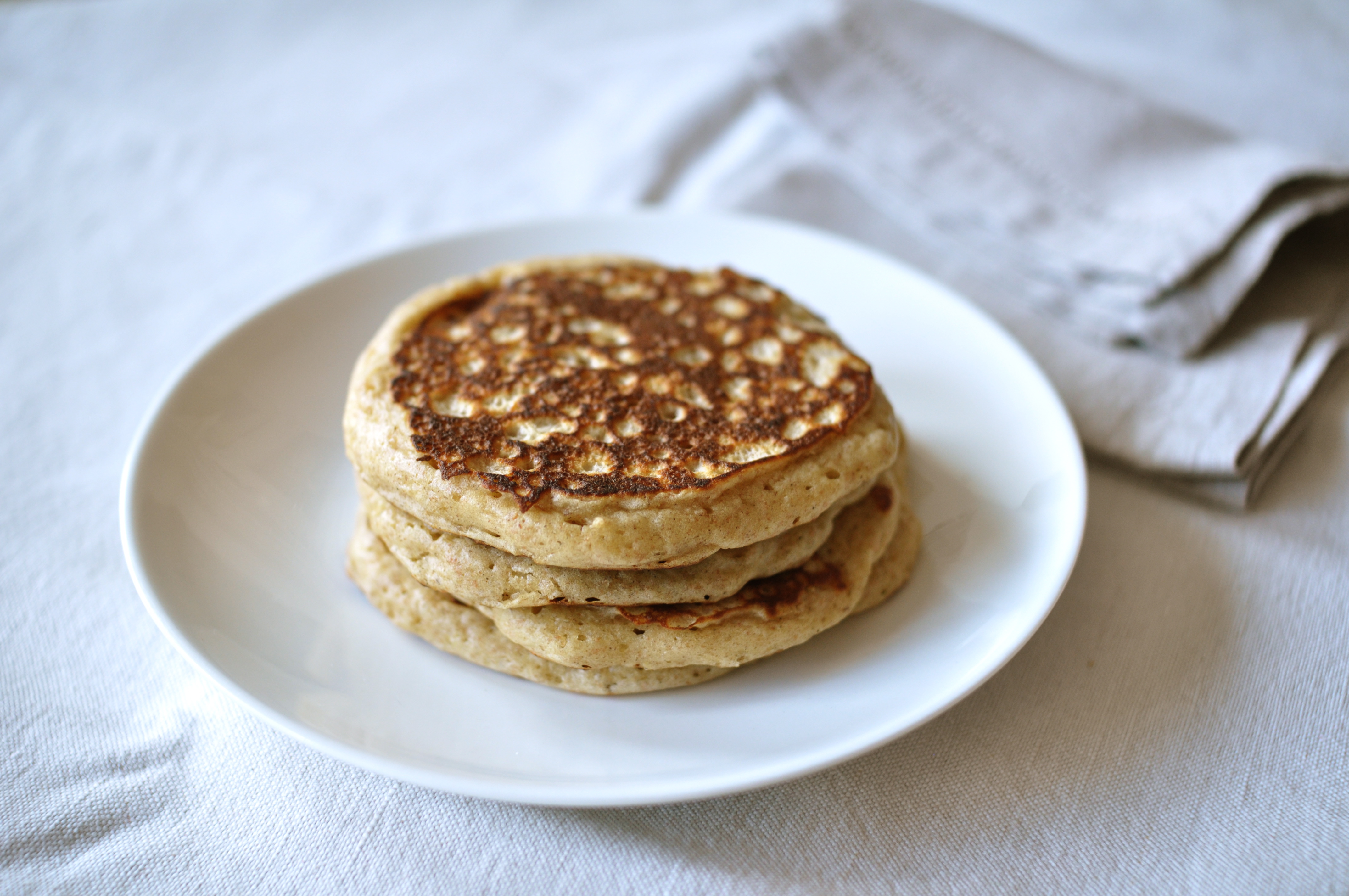
Pancakes must be light and fluffy, of course, but they must have character. I don’t make plain white flour/milk pancakes, if I can help it. Every Sunday (right, every Sunday *on which I make pancakes*), I experiment. Spelt, oat, whole wheat, buckwheat; buttermilk, yogurt, kefir, ricotta; orange and thyme; fruit, nuts, coconut; … . Some improvisations are better than others.

This recipe strikes just the right balance. There isn’t much buckwheat and that’s how it should be. Just a little heft, tempered by the tang of cultured milk.

***

I used white and whole spelt flours though regular wheat flours would also work. The key here is a small proportion of whole grain and a little buckwheat.

4 Tbsps butter

1 1/2 cups (175 g) white spelt flour

1/2 cup (75 g) whole spelt flour

2 heap Tbsps buckwheat flour

2 Tbsps sugar

1 tsp salt

2 tsps baking powder

1 tsp baking soda

2 eggs

2 1/2 cups (600 ml) cultured buttermilk

Coconut oil for the pan (I use coconut oil to cook pancakes. It works perfectly because it doesn’t burn.)

*

Melt the butter and let cool to room temperature.

Into a large bowl, sift the flours together with the sugar, salt, baking powder, and baking soda.

In another, smaller bowl, beat the eggs well with the fork before adding just 2 cups (500ml) of the buttermilk and finally the melted butter. (Add the rest of the buttermilk only if the batter is too thick.)

Pour the wet ingredients into the flour mixture, and mix swiftly, just enough to combine completely (a few bumps are nothing to worry about, it is important not to overstir the batter).

Grease griddle (non-stick pan) and place over high heat. Once the griddle is hot, pour little puddles of batter (the size is entirely up to you, but keep in mind that they will expand quite a bit), reduce heat to medium, and stay close, checking constantly until you start noticing bubbles popping up. Turn over the pancakes with a wide spatula and, within barely a minute, the pancake is ready. To make more pancakes, repeat process, adding a little oil every time to make sure they don’t stick.

The pancakes can be kept in a covered pan in a 250°F (120°C) oven for a little while if you want to make all the pancakes first and serve them at once.

*

Related posts

Orange thyme pancakes

Crepes

Banana cake

Cuban bread