Archive for the ‘Summer’ Category

Nettle soup aka ‘Stone Soup’

14 September 2018

I think of it as stone soup.

During our summer holidays in Brittany, nettle soup is always top of the list of meals we look forward to making. Still, the intent usually lies dormant until a fateful evening when we are caught off-guard with no dinner plan. There are always nettles about: in the bits of garden that haven’t been mowed, in the field at the bottom of the drive where a solitary horse used to live. The horse is long gone, the field remains ‘le champ du cheval.’ Armed with wellies, gloves, scissors, and a basket, it won’t take longer than ten minutes to gather dinner.

According to the folk tale Stone Soup, with just a soup kettle, water, a stone as decoy, and some craft, a clever traveller fools one mean farmer (or, depending on the version of the story, the inhabitants of a whole village) into relinquishing vegetables, one at a time, little by little, in order to make that initial ‘stone soup’ — a stone in a pot of water — taste better and better.

In my fairy-tale summer, the nettles are the stone, the nothing. Like that stone, they’ll need a bit of a boost in terms of depth and unctuousness. An allium of some sort, a couple of potatoes, a zucchini — all of which weren’t donated by villagers but are the neglected, long-term squatters of the vegetable crates in the cellar.

And in reality, nettle soup is the very opposite of stone soup. It has, it is true, sprung from nothing. But unlike the stone — ultimately discarded — the nettles are the very essence and raison d’être of the meal.

Nettle soup
Since the main idea of the soup is its fortuity, the ingredients and quantities are just indications. But the nettles must remain the focus, they should not be overpowered by the other vegetables.

A big bag of young nettle leaves
Butter
1 or 2 small onions or shallots, finely chopped
A few garlic cloves
2 medium potatoes, peeled and cut into chunks
Some chicken stock if available
Depending on season and availability, a few of the following:
Leeks, zucchini (courgettes), carrots, fennel, etc (all of which need to be washed well or peeled and cut into slices)
Crème fraîche to serve

With a pair of gloves to avoid getting stung, pick fresh young nettle stems (in season in spring and summer) especially the most tender part close to the tip.

(Still protected by gloves) pick the leaves off the stems and wash thoroughly in a large bowl of cold water. Drain and set aside.

In a large soup pot, melt a few tablespoons of butter. Add the chopped onions (or shallots). Sweat for a few minutes until translucent but not yet turning in color. Add a couple of garlic cloves and cook for a minute longer.

If using leeks, add to the onions and garlic now. Cook for about 3 to 5 minutes.

Add the potatoes and any other vegetables and immediately cover well with water or/and chicken stock (there should be enough liquid to account for the nettle leaves later). Bring to a slow simmer and cook for about 15 minutes until the vegetables are tender.

Add the nettle leaves and cook for just a few minutes, until they are wilted and soft but still bright green! (Add a little boiling water or stock to cover the leaves if necessary.)

Remove from the heat and purée the soup until unctuous using a hand mixer or, in batches, in a food processor.

Finally, a game-changing tip from my peripatetic sister — inspired by the Egyptian soup molokhia: Just before serving, smash or finely chop a couple cloves of garlic and cook in a puddle of butter in a corner of a skillet. Remove just as it turns golden and stir into the soup immediately before serving.

Garnish with crème fraîche if desired.

Fig leaf wine apéritif

1 September 2018

Some people will consider this the first weekend of autumn, but, succomb as I may to those plums and first apples, I am holding on firmly to summer for a few more weeks if I can.

I prepared this fig leaf apéritif about a week ago. As it only takes a few days to infuse, now is still the time to make a bottle for those last late summer evenings. There won’t be much of a thematic clash, September is fig season after all.

This recipe is particularly exciting for those of us who live in the North, as it just uses fig leaves. For all optimistic boreal gardeners and green city dwellers (many London gardens have a fig tree stretching its branches above the fence within reach of the sidewalk…), who monitor those trees with anxiety and trepidation, monitoring the evolution of each fruit, this is the solution.

Even if the figs never ripen there is a path straight to Provence with this apéritif.

The recipe comes from Thom Eagle via Diana Henry about two years ago. It bears repeating every year.

Fig leaf wine

10 fig leaves
One bottle (75 cl) dry white wine
160 g sugar
One giant glug of vodka

Crumple the fig leaves and place them in a clean jar with the white wine, sugar, and vodka. Stir or shake well, and leave to infuse for 3 to 5 days.

Strain out the leaves and pour into a bottle with a tight lid.

Serve over ice.

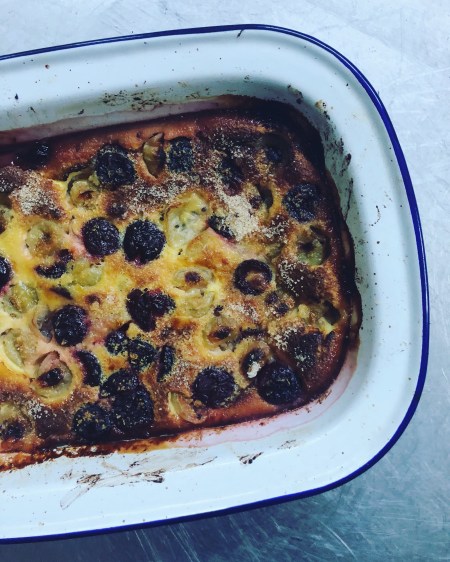
Cherry and gooseberry clafoutis

12 July 2018

These were the last of the gooseberries here this year but I had to write down the recipe for next summer — in the magical week (or two) when gooseberries and cherries have a chance to meet, make this clafoutis!

Last year by happenstance I mixed gooseberries and strawberries — in jam, and in cake (about which I finally wrote last week). What an incredible combination. And now this. Yesterday, by chance again, just because I buy much too much fruit at this time of year and actually had a forgotten bag of cherries and some gooseberries on the verge of shriveling, I made another cake.

I’m starting to believe that goosegogs are the berry equivalent of msg. They make everything more delicious. All at once they enliven and deepen the flavor of each fruit with which they are paired — dessert umami.

img_3109

Cherry and gooseberry clafoutis

About 500g each of cherries and gooseberries
2 Tbsp flour (one for the batter and one for dusting the fruit)
3 eggs
4 Tbsps light brown sugar plus one for dusting the clafoutis
250 ml (1 cup) milk
2 Tbsps ground almonds
Grated zest from 1 lemon
Pinch salt
1 Tbsp kirsch

Preheat oven to 375°F (200°C).

Wash and pit the cherries. Wash and rub off the fuzz from the gooseberries. Cut them in half if quite large.

Butter an ovenproof that will fit all the fruit snugly in double layers.

Place the fruit in the dish, sprinkle with a tablespoon of sifted flour, and toss gently to dust the fruit.

In a mixing bowl, whisk the eggs and sugar until frothy. Add the milk, then the flour and ground almonds, lemon zest, salt, and kirsch.

Pour the batter over the fruit and slip into the oven.

Bake for about 30 minutes, until the batter is set and the top nicely golden. In the last 5 or 10 minutes of cooking sprinkle a spoonful of sugar over the clafoutis.

Let cool before eating.

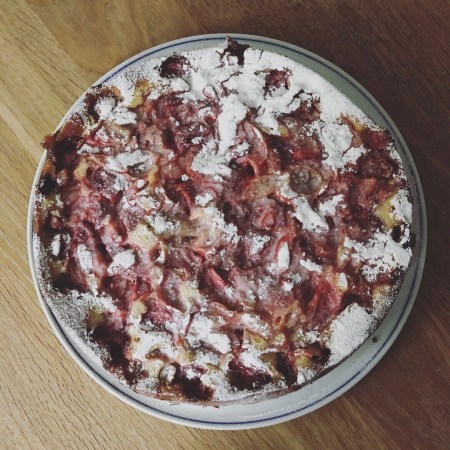
Strawberry and gooseberry yogurt cake

5 July 2018

Our season of birthdays has come and gone, and it was marked by a few disconcerting cake wishes. Our tradition is to celebrate birthdays, with presents and cake, at breakfast. This brought about some unsettling cake choices.

Crumbles. An apple crumble seemed like a humble birthday cake wish, but in March, it’s acceptable. In June, it is not. I was quite distressed about having to ask our local grocery shop for apples in June. (They did scoff. Or was I imagining it?) But birthday wishes are not open to veto.

Luckily, my other June birthday child was willing to give in to my gentle nudging — or was it open pleading — that I make him THIS cake. This perfect, easy, quintessentially June cake.

It is based on the classic French yogurt cake — easy as pie — about which I’ve spoken before. Yogurt cakes are the first cakes many French children learn to bake because all the measurements are calculated in volume, using a standard yogurt pot as the unit. [Read more about it here.]

I make it often because it is so easy, and also for the perfect light sponge texture. On popular demand, here is its early summer strawberry and gooseberry incarnation, the recipe translated for a country where 100ml yogurt pots are not ubiquitous.

Strawberry and gooseberry yogurt cake

2 pots (200 ml) plain unsweetened yogurt
2 pots (200 ml) melted butter
3 pots (300 ml) light brown sugar plus 2 Tbsps for the berries
3 pots (300 ml) flour plus one Tbsp for the berries
3 pots (300 ml) almond flour
4 eggs
2 tsps baking powder
Zest from 1 lemons
Strawberries and gooseberries about one cup each
Icing sugar (optional)

Preheat the oven to 350°F (175°C).

Line a 10-inch (26cm) baking tin with parchment paper and butter generously.

Stir all the ingredients together except the fruit in a large mixing bowl to obtain a smooth batter.

Wash and trim the berries. Cut the strawberries into halves or quarters, depending on their size, and the gooseberries in half. In a medium bowl, toss with 2 Tbsps sugar and one Tbsp sifted flour (this will prevent the fruit from falling to the bottom of the cake while baking).

Gently stir the berries into the batter. Pour into the baking tin, slide into the oven, and bake for 50 min to an hour, until the cake is set and a knife inserted in the middle comes out clean.

Remove from the oven. Once completely cool, sprinkle with icing sugar for decoration.

Gooseberry and strawberry jam

12 July 2017

IMG_3126


A happy accident, this spectacular combination, and one that has reconciled me with strawberry jam.

The last time I attempted to make strawberry jam, I chose a Christine Ferber recipe that requires to marinate the strawberries overnight, cook them once, let them macerate some more, strain the syrup, let it reduce, finally add the strawberries and boil until set. I followed the instructions, the infusion smelled divine, all was going very well. Until the final step. A few late evenings of jam prep, and the rest of life in between, and I actually fell asleep (!) as the strawberries were in their last phase of cooking. Having nurtured the sugary jewels, painstakingly, over the course of two days, I might have paid more attention.

That jam now sits somewhat abashedly on the shelf in the pantry with the incriminating label: ‘Burnt Strawberry Jam.’ It could have been intentional.

Here we are a couple of years later and, having made my favorite life-saving yogurt birthday cake with strawberries and gooseberries instead of raspberries, I had some berries left over. Forgotten overnight to marinate with some sugar for preservation until they might be consumed, I ended up cooking them. A tiny batch, two small jars and one additional tablespoon — we were all fighting for the scraps.

IMG_3425

And so I can’t stop making this jam. I’m hoping to build some stock so the jars may last beyond the season.

Strawberry and gooseberry jam recipe

1 kg strawberries and gooseberries (I used about half and half, but I leave the ratio up to your inspiration)
850g caster sugar
2 small lemons

Trim (top and tail) and wash the gooseberries. Wash, trim and cut the strawberries into quarters (or more if they are huge).

In a large bowl, mix the fruit with the sugar. Add the zest and juice from both lemons. Leave to marinate overnight in the refrigerator.

The next day, cook the berries for about 20 to 30 minutes, until the jam gives signs of beginning the set (place a spoonful of juice in the fridge and, once cold, check for the ‘gelling’ effect).

Sterilize jars for 5 minutes in a pan of boiling water. Fill the jars immediately and seal tightly.

IMG_3321