Archive for the ‘Vegetables’ Category

Yotam Ottolenghi’s tomato chutney

13 October 2020

This is the chutney that entered our life by accident and got stuck. I nearly didn’t make it when I decided to try Ottolenghi’s Tomato and Courgette Loaf published in the Guardian’s weekly food magazine Feast a couple of weeks ago. I often cut corners and simplify recipes, and, regardless of how tempting it was, I wasn’t sure I would have the time, until I realised it was part of the loaf recipe itself. And so the sideshow of Ottolenghi’s recipe became the star at my table.

The loaf was a great success, but the chutney is the recipe I will be making again and again. In fact, the kitchen has barely been without in a fortnight.

Tomato chutney from a recipe by Yotam Ottolenghi in Feast
The recipe calls for fresh tomatoes but I’m pretty sure I’ll try it with tinned ones in a few weeks when there is no other choice.

Olive oil
6 garlic cloves
45g fresh ginger
A large pinch of chilli flakes (or 2 red chillies)
About 2 Tbsps tomato paste
1 tsp turmeric
2 tsps garam masala
1 Tbsp sugar
750g tomatoes
Teaspoon sea salt
Freshly ground black pepper

Smash the garlic with the flat of a knife, peel, and chop roughly. Peel and finely grate the ginger. (Wash and finely chop the chilli if using.) Wash, core, and chop the tomatoes.

In a large heavy saucepan, heat a few tablespoons of olive oil over medium heat. Once hot, add the garlic, ginger, and chilli. Cook, stirring regularly, for a couple of minutes, until fragrant. Add the tomato paste, spices, and sugar, and cook, stirring, for another minute. Now add the tomatoes, the salt, and a good grind of pepper and mix well, scraping the pan to incorporate all the spices. Turn down the heat and simmer for about 45 minutes, until the tomatoes are thoroughly cooked and the chutney has thickened.

Before serving, drizzle a little olive oil over the chutney. It keeps in a closed jar in the fridge for about a week.

Chard gratin

8 October 2020

October 8th. I’ve developed quite a crush on this dish since this August, when our friends brought us a big bunch of chard from their garden. I made a gratin, Louise had SIX helpings, which echoed what everyone was feeling, though we were perhaps not as quick. It has now settled into our regular weeknights.

Chard gratin

750g chard
75g butter
3 Tbsps flour (I usually use spelt though a traditional béchamel would be with wheat, and white or wholemeal depending on my mood)
500ml milk
Sea salt
Freshly ground black pepper
Freshly grated nutmeg
1 garlic clove
A little olive oil or butter for the pan
Grated cheese, preferably gruyère

Preheat the oven to 175°C.

Trim the rough ends of the stalks and any bits of damaged leaves, chop the chard into roughly 2cm (3/4 inch) strips, wash in cold water, and dry thoroughly ( I use a salad spinner).

To make the béchamel: Melt the butter in a medium saucepan. Add the flour and stir continuously with a wooden spoon until the flour and butter lump together and create a mass. Continue cooking briefly, then add the milk, one large splosh at a time, stirring continuously, until all the milk is used up. If the béchamel still looks quite thick, add some water until the consistency is edging towards runny.

Now season the béchamel with a generous pinch of salt, pepper, and freshly grated nutmeg. Taste and adjust.

Rub an ovenproof dish with the garlic clove and grease the dish with a very little bit of olive oil (or butter). Add all the chard, it should seem as if it’s too much => It will reduce a lot while it cooks. Pour the béchamel over the chard as evenly as possible so everything is covered. Now sprinkle enough grated cheese to cover the whole gratin in a thin layer.

Slide into the oven and bake for 30 to 40 minutes, until the top is golden.

Goes well with good sausages or a sturdy fish such as salmon.

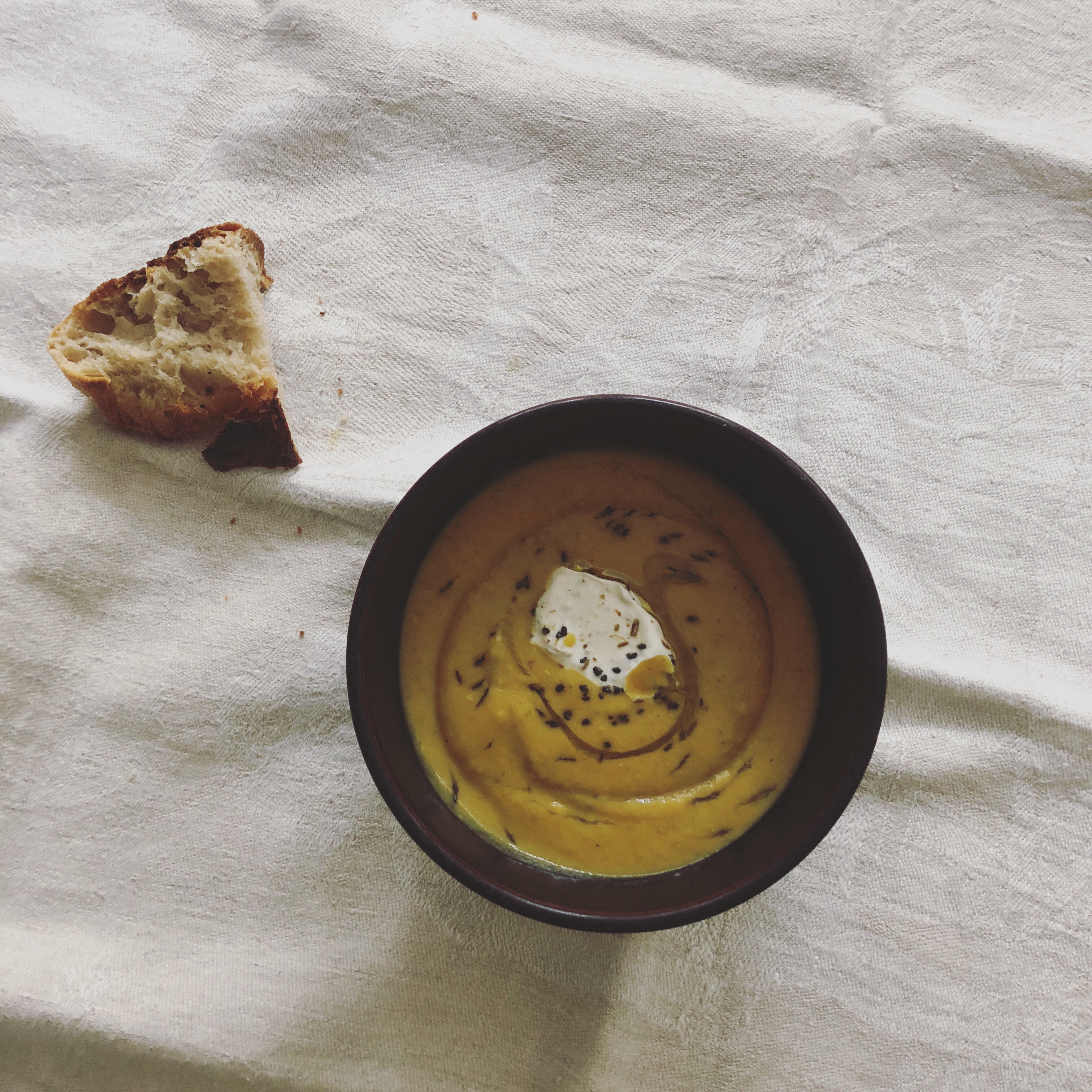
Creamy spiced lentil soup

8 November 2018

Balthasar and I bonded over soup.

It was an inset day, which means no school, and after a sunny autumnal swim in the nearby lido — outdoor swimming pool in British lingo, in this case heated year-round to a luxurious 25°C — we went to reap our effort’s reward: e5 Bakehouse. Breakfast was over, we shared a spicy lentil soup with mustard seeds, and cake — but it was the soup that caught our attention. We vowed to recreate it, paying particular heed to the mustard, and, in an decisive move against Thomas’s tyranny of chunky soups, solemnly swore to blitz it to a creamy smoothness.

It was practically a random recreation, with the available bits and pieces in the fridge. It was practically perfect.

Creamy spiced lentil soup

4 to 5 small onions
1 whole head of garlic
1 tsp brown mustard seeds
1 tsp cumin seeds
1 tsp fennel seeds
1 tsp ground turmeric
Sea salt
3 leeks
5 or 6 carrots
1 kg potatoes
3/4 of a large acorn squash
1 litre chicken or vegetable stock — or just water
175 g red lentils
A large handful of kale
Finishing touches: yogurt mixed with toasted ground cumin and fennel and lemon juice; a sliver of olive oil or chili infused oil; if available, black lava salt

Toast the mustard, cumin, and fennel seeds in a small pan until they start to become fragrant (this takes a few minutes only). Grind and set aside.

Prepare the vegetables —
Chop the onions.
Smash and peel the garlic.
Peel, thoroughly wash to remove all grit, and chop the leeks.
Peel and chop the carrots.
Peel and wash the potatoes and the acorn squash and cut them into small chunks.
Remove the kale’s tough stalks, wash thoroughly, and chop into strips.
Note: The size of the vegetable chunks is not crucial as the soup will be puréed, but the pieces should be fairly homogeneous in order to cook at a similar rate, and — if time is of the essence — the smaller or finer the pieces, the faster they will cook.

Cook the soup —
Brown the onions in lots of olive oil. Add the garlic and spices and cook, stirring continuously, for a few minutes. Season with salt.

Add the leeks, cover the pan, and let them cook for a few minutes. Add the carrots, potatoes, and squash. Season.

Add the stock and/or water so that the vegetables are covered generously and floating around comfortably when stirred.

After about half an hour of a gentle and constant simmer, add the lentils. Cook for another 15 to 20 minutes, checking on the level of liquid and adding some if necessary.

Check that the vegetables and lentils are cooked through, then add the kale and cook for about 5 to 10 minutes more until it has softened too.

Blend/purée the soup in batches until very smooth.

Serve immediately with one or all of the finishing touches.

Classic French tomato tarte with mustard

20 September 2018

img_5142

From memory, it was in Elle magazine; one of a sweeping collection of recipe cards, cut out along the dotted line, neatly organized, in a couple of bright orange bakelite boxes, color-coded and arranged by dish — starter, meat, dessert, etc. — most probably from the nineteen eighties. My mom’s.

This, at least, is how I remember it. Neither my mother nor my sister can recall where the recipe for this tarte — the clever combination of tomatoes with sharp mustard which mellows as it cooks — really comes from. In fact, it seems to be part of the French subconscious. As I was trying to corroborate the recipe’s origin I realized that according to the usual web search engines, in France ‘tarte à la tomate’ automatically defaults to ‘et à la moutarde.’

Regardless of whether it actually did once appear in Elle, there is no doubt that it is a French classic, and in my view firmly anchored in the 1980s. There are tomatoes, Emmental, mustard, a sprinkling of dried thyme at most. No fancy flours in the crust, no fresh herb flourishes.

I break these rules sometimes and add a few cut herbs, or substitute Comté for Emmental. But at heart the combination of tomatoes, mustard, and cheese remains. Its simplicity is testament to a recipe classic.

We make versions of it every summer, often on days when there isn’t a plan but always an enormous stash of tomatoes at different levels of tenderness that need rapid eating.

Tomato tarte with mustard

One uncooked savory pie pastry (see the basic recipe below or this unsweetened shortcrust)
Strong Dijon mustard
Hard cheese such as Emmental (or Comté), grated
Tomatoes, sliced
Sea salt and freshly ground black pepper
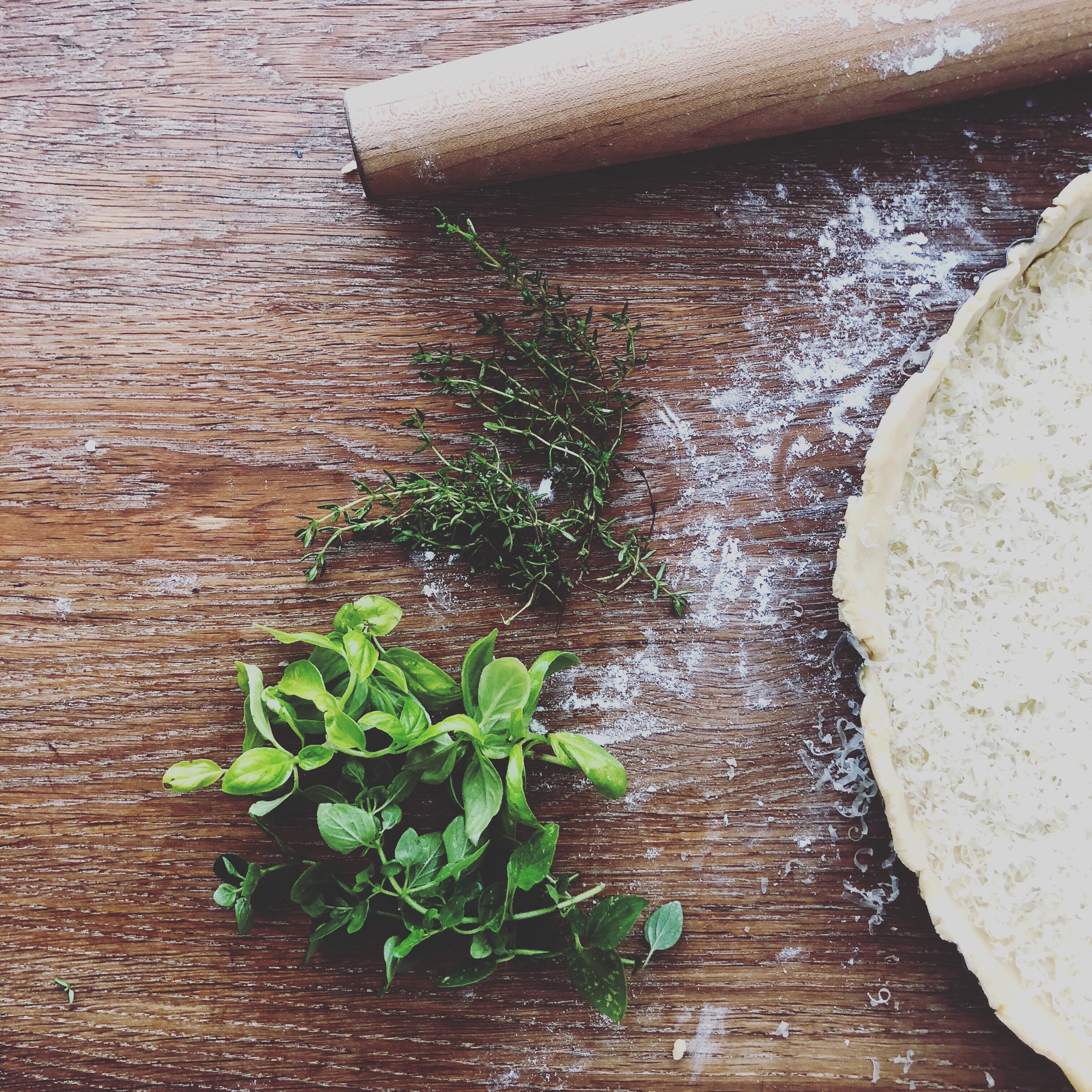
Dried or fresh thyme (also oregano, basil)

Preheat the oven to 400°F (200°C).

Roll out the pie crust and carefully transfer to a well-buttered pie dish. Poke the crust all over with a fork (so it won’t puff up as it bakes).

Spread a generous amount of mustard over the crust (like a shmear of cream cheese, the sharpness will mellow as it cooks). Sprinkle the grated cheese all over the crust. Arrange the tomato slices on top. Season with salt and pepper and thyme (or other herb).

Slide into the oven and bake for 20 to 30 minutes, or until the crust is golden, the tomatoes cooked, and the juices bubbling.

Serve immediately.

***

Quick savory pie pastry

100g cold butter
200g flour
A pinch of salt
A little ice-cold water

Cut the butter into 1/2 inch (1 cm) chunks.

Prepare the flour and salt in a large bowl. Mix in the butter with your fingertips, crumbling the butter and flour together until most of the butter chunks have become grains, but other larger bits remain. Add a little ice water, just enough to gather the crust into a smooth ball. (It’s important not to overhandle the dough, which will ensure that it remains flaky when cooked.)

Let the rest dough rest, covered, in the refrigerator, for at least one and up to 24 hours.

If the dough has been in the refrigerator for a few hours, allow a little time for it to soften before rolling it out.

Nettle soup aka ‘Stone Soup’

14 September 2018

I think of it as stone soup.

During our summer holidays in Brittany, nettle soup is always top of the list of meals we look forward to making. Still, the intent usually lies dormant until a fateful evening when we are caught off-guard with no dinner plan. There are always nettles about: in the bits of garden that haven’t been mowed, in the field at the bottom of the drive where a solitary horse used to live. The horse is long gone, the field remains ‘le champ du cheval.’ Armed with wellies, gloves, scissors, and a basket, it won’t take longer than ten minutes to gather dinner.

According to the folk tale Stone Soup, with just a soup kettle, water, a stone as decoy, and some craft, a clever traveller fools one mean farmer (or, depending on the version of the story, the inhabitants of a whole village) into relinquishing vegetables, one at a time, little by little, in order to make that initial ‘stone soup’ — a stone in a pot of water — taste better and better.

In my fairy-tale summer, the nettles are the stone, the nothing. Like that stone, they’ll need a bit of a boost in terms of depth and unctuousness. An allium of some sort, a couple of potatoes, a zucchini — all of which weren’t donated by villagers but are the neglected, long-term squatters of the vegetable crates in the cellar.

And in reality, nettle soup is the very opposite of stone soup. It has, it is true, sprung from nothing. But unlike the stone — ultimately discarded — the nettles are the very essence and raison d’être of the meal.

Nettle soup
Since the main idea of the soup is its fortuity, the ingredients and quantities are just indications. But the nettles must remain the focus, they should not be overpowered by the other vegetables.

A big bag of young nettle leaves
Butter
1 or 2 small onions or shallots, finely chopped
A few garlic cloves
2 medium potatoes, peeled and cut into chunks
Some chicken stock if available
Depending on season and availability, a few of the following:
Leeks, zucchini (courgettes), carrots, fennel, etc (all of which need to be washed well or peeled and cut into slices)
Crème fraîche to serve

With a pair of gloves to avoid getting stung, pick fresh young nettle stems (in season in spring and summer) especially the most tender part close to the tip.

(Still protected by gloves) pick the leaves off the stems and wash thoroughly in a large bowl of cold water. Drain and set aside.

In a large soup pot, melt a few tablespoons of butter. Add the chopped onions (or shallots). Sweat for a few minutes until translucent but not yet turning in color. Add a couple of garlic cloves and cook for a minute longer.

If using leeks, add to the onions and garlic now. Cook for about 3 to 5 minutes.

Add the potatoes and any other vegetables and immediately cover well with water or/and chicken stock (there should be enough liquid to account for the nettle leaves later). Bring to a slow simmer and cook for about 15 minutes until the vegetables are tender.

Add the nettle leaves and cook for just a few minutes, until they are wilted and soft but still bright green! (Add a little boiling water or stock to cover the leaves if necessary.)

Remove from the heat and purée the soup until unctuous using a hand mixer or, in batches, in a food processor.

Finally, a game-changing tip from my peripatetic sister — inspired by the Egyptian soup molokhia: Just before serving, smash or finely chop a couple cloves of garlic and cook in a puddle of butter in a corner of a skillet. Remove just as it turns golden and stir into the soup immediately before serving.

Garnish with crème fraîche if desired.