Archive for the ‘Year-round’ Category

Roast chicken with lemon and fennel seeds

6 January 2011

Some years ago I discovered that a chicken could be seasoned under the skin with salt, pepper, butter, and herbs. It makes for excellent roast chicken, and I decided it would be the only way to go in the future. But it is also a bit finicky, and somehow roasting a chicken became an unwieldy affair in my mind.

Until recently, when I came across good chickens from Epicurean Farms. They are fairly small, very tasty, and usually sold whole. So I started roasting again and rediscovered that it is actually probably the easiest way to cook these animals, especially if you are not chopping herbs and delicately stuffing them under the skin. Now roasting a chicken seems effortless like an afterthought; it can be done for lunch or dinner, or after dinner – at anytime, really, since it is excellent cold, especially with green tomato chutney.

Chickens can be stuffed with any combination of herbs, garlic, or onion on hand and I usually add a lemon, slashed so it releases its juices. This version with fennel seeds was a staple in our house when I was growing up.

***

1 whole chicken

Sea salt

Freshly ground black pepper

2 Tbsp fennel seeds

1 small lemon

2 small garlic cloves

Butter

***

Preheat oven to 425°F (220°C).

Pat the chicken dry with a paper towel. If you remember to do it in advance, let the chicken sit uncovered in the refrigerator for a few hours so the skin dries out before roasting.

Season the cavity of the chicken with salt, pepper, and fennel seeds.

Poke the lemon with a fork multiple times on all sides and stuff it into the chicken with the whole, skin-on garlic cloves. Truss or just bind the legs together with kitchen string. Massage the chicken all over with softened butter and season the outside again with salt and pepper.

Place the chicken on a roasting pan and into the oven for 10 minutes at 425°F (220°C) then lower to 375° (190°C) and roast for 40-50 minutes, depending on the size of the bird (large chickens may need to cook even longer — pull away one thigh and if the flesh at the joint is still translucent pink, cook a little longer).

Let rest 10-15 minutes before carving. Squeeze the lemon over the pieces of chicken before serving.

***

Related posts

Braised chicken legs with cherry tomatoes

Happy New Year! (Lentil soup with cumin)

4 January 2011

It’s not that I haven’t been cooking – or eating – since early December, but somehow all the feasting and visits from friends and family got in the way of writing. It was a productive period nonetheless, culinarily speaking, in which I unexpectedly improved a foie gras recipe and expanded my cookie baking horizon, all of which should make for a profuse Christmas season next year, if I am better organized.

But it’s 2011, and since I just learned that lentils are a New Year’s tradition in some regions of France and Italy – the way black-eyed peas and collard greens are here in the South – and because I will grab any excuse to make this soup, here it is at last, the deliciously simple lentil soup with cumin from Moro: The Cookbook, somewhat rewritten but barely altered.

***

From Moro: The Cookbook by Sam and Sam Clark

2 cups (400g) lentils (green, red, or yellow)

3 medium onions

6 garlic cloves

Olive oil

3 heap tsps cumin seeds

Sea salt

Freshly ground back pepper

Lemon, plain yogurt, and Harissa to serve (optional)

*

To wash the lentils, cover with cold water and drain in a fine mesh sieve.

Finely slice onions and garlic.

Heat enough olive oil to cover the base of a large heavy-bottom saucepan, add the onions and brown over medium heat, stirring occasionally (about 10 minutes). Meanwhile roughly grind the cumin seeds in a mortar. Once the onions are nicely golden, add the garlic and cumin and stir. Then add the lentils and stir to mix with the onion/cumin mix.

Cover the lentils with 4 times their volume of cold water (8 cups or 2 l), place lid on the pan, and let simmer gently until lentils are soft, about 40 minutes, checking occasionally to add water if necessary. (There should be some excess water in the pot otherwise it will be a purée rather than a soup, but not too much because the soup should be nice and thick.)

Season with salt and pepper and blend until smooth.

Squeeze some lemon and add a spoonful of good plain tart yogurt or some Harissa if desired.

*

Related posts

Baby food | le

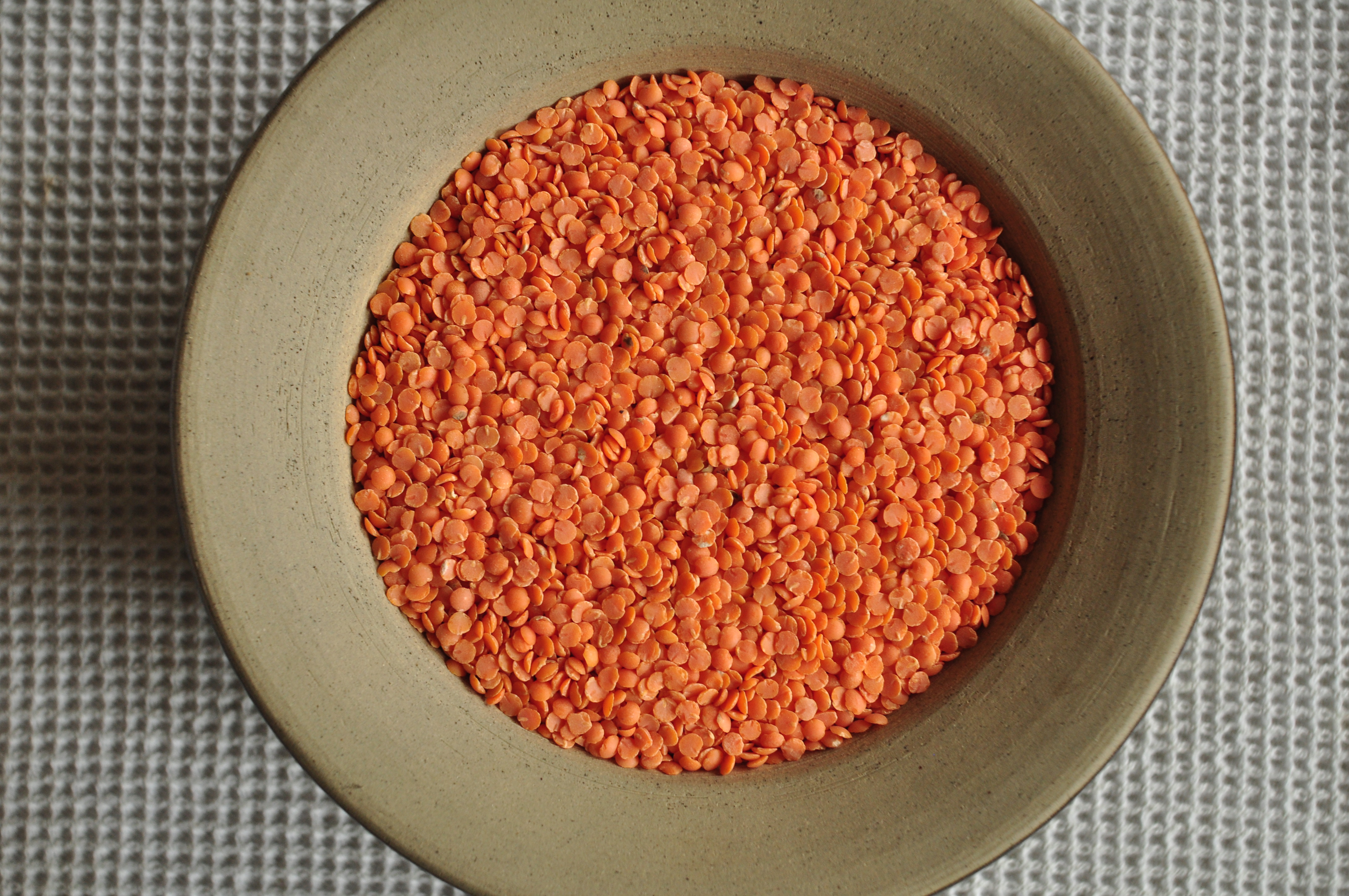
Lentils

Baby food* | Lentils

16 November 2010

The other day I decided to make one of my favorite recipes from Moro cookbook: lentil soup with cumin. It’s a wonderful recipe that requires little else besides lentils and cumin – with cumin, of course, being the key. We had friends over for dinner and I was quite excited about making this soup. It’s simple and delicious, and perfect just as it is.

But I must have underestimated how often I have made this recipe recently, because the guests had already arrived and I was about to start the soup when I realized that I had run out of cumin. Thomas went out to get the indispensable spice from a store close by and returned with deceptively labeled coarsely ground black pepper… So, I had to improvise – I used curry powder and fresh sage leaves instead.

Typically the story should end with a revelation, a new wonderful recipe discovered by necessity. But no, unfortunately, Moro’s lentil soup with cumin has no cause to envy my lentil soup with sage and curry. Sage did seem like a good idea, however, and since I cannot resist tweaking recipes, even those that need no tweaking, this week I made lentils with sage and cumin for Louise.

***

1 medium onion

Olive oil

1 garlic clove

1/2 tsp cumin seeds

2 sage leaves

1 cup (200g) red lentils

***

Slice onion finely. Heat a good drizzle olive oil in a small heavy bottomed saucepan, add onion and let sweat, stirring occasionally, over medium heat.

Thinly slice garlic clove, grind cumin seeds in a mortar, and wash lentils under running water through fine mesh sieve.

Once the onion starts to brown, add garlic, cumin, and sage leaves. Stir well and let cook for about a minute. Add lentils, stir well again. Add 3 cups (750 ml) water. Cover and cook at a lively simmer for about 30-40 minutes, until the lentils are soft.

Blend the lentils, squeeze a few drops of lemon juice before serving.

*This doesn’t have to be just for babies. Add Maldon sea salt, freshly ground black pepper, a drop of excellent olive oil, and a hint of harissa and it makes a very decent soup.

Chicken liver terrine

8 October 2010

I love this recipe for many reasons: it’s absolutely delicious, quick to make, can (or rather should) be prepared in advance, and, well, it’s liver. I find all sorts of excuses to make it. Tomorrow it will be lunch in the country; it’s been good for parties or Easter brunch; but more simply it is the recipe upon which I fall back when we have friends for dinner and I am undecided about what to make. It helps unlock my imagination and inspires the rest of the meal. Most often I serve it with baguette as a tapas-style apéritif together with olives and nuts, radishes or cherry tomatoes – depending on the season.

***

1 lb (450 g) chicken livers

3/4 cup (180 g) and 2 Tbsp (20 g) butter

1 small onion (or large shallot)

Olive oil

1 large sprig each sage and thyme

1 Tbsp Madeira wine (Marsala also works well)*

1 Tbsp brandy

Salt and pepper

***

Trim the fat from the chicken livers and set aside.

In a small saucepan, melt 3/4 cup butter over low heat. Once melted set aside.

Finely chop the onion (or shallot). In a large skillet, melt 2 Tbsp of butter together with a little olive oil (the oil prevents the butter from burning). Add the chopped onion, cook over medium heat, and as soon as it becomes translucent add the whole sage and thyme and stir to mix flavors. Immediately increase the heat to high and add the chicken livers. After a couple of minutes the livers should be slightly brown; turn them over. Sprinkle the Marsala and brandy over the livers and cook for a few minutes until the liquid has evaporated. Remove from the heat and season with salt and pepper.

When the livers are cool enough to handle, remove the sage and thyme, transfer to a cutting board, and chop finely. Place the livers in a bowl, add the scrapings from the skillet as well as the melted butter and mix well. Transfer the livers to a terrine dish (any bowl will do) and place in the refrigerator for a few hours and up to two days. It gets better after a day or so.

*The absence of Madeira or Marsala absolutely should not keep you from making this recipe. Just replace with a little brandy. On the other hand, it creates an opportunity to buy the wines, which deserve to be kept in your bar or pantry and will come in handy, for example when making stewed pears (recipe to come later this year).

Yogurt

29 September 2010

Making yogurt without a machine is very easy if you accept a slight degree of unpredictability, as yogurt cultures can be temperamental. The tricky part is keeping the yogurt at the right temperature while it sets, and this is where a yogurt maker helps, but it’s by no means indispensable (I don’t own one and I have been making yogurt for years).

Like many people interested in making yogurt at home, I knew it was easy – theoretically. But it wasn’t until I witnessed it that I realized how ridiculously simple it really is. The main steps are very straightforward: heat milk – let cool – stir in a spoonful yogurt  – let set; but of course, the devil is in details.

***
Step 1: Scald milk

In a saucepan, heat milk until bubbles begin to form. Remove from heat.

Step 2: Let milk cool to just above body temperature

Yogurt cultures are most active just above body temperature, at 110°F (43°C). A good way to gauge the temperature without a thermometer (I don’t own one, either) is to place your little finger in the milk and count to 10. It should feel warm but not burn. If the milk is too hot it will kill the yogurt cultures. If it is too cold the yogurt will take forever to set or not set at all.

Step 3: Stir in 1 tablespoon “starter” yogurt per quart (liter) milk

Any commercial plain yogurt works, as long as it contains live cultures (specified in the ingredients).

Using more “starter” yogurt will not help, on the contrary. Think of it as overcrowding; too many live cultures make the yogurt thinner and more sour.

Stir well so the starter yogurt dissolves into the milk.

Step 4: Pour milk into container(s)

Any container will do, large or small, jar, bowl, storage container, etc.

Preheat container(s) with hot water to maintain as much heat as possible. Cover with lid, cloth, or parchment paper (this makes a difference; left uncovered the yogurt doesn’t set as well).

Step 5: Let set in a warm place

The temperature should stay as close as possible to 110°F (43°C). This is the tricky part, the one for which the yogurt maker was invented, but there are a number of other ways to maintain heat. I have tried the following methods, they all work, it’s a question of choosing the one most practical for you:

  • Place containers in a cooler bag (space permitting, add a bottle of hot water to maintain heat)
  • Wrap a towel around the containers and place in the warmest place in the house
  • Preheat oven to 200°F (90°C), turn off oven (very important!), and place yogurt containers in the preheated oven. (Don’t forget the yogurt and accidentally turn the oven on for another use. I must admit it has happened to me. More than once…)

Do not disturb the yogurt until it is set – anywhere from 3 to 12 hours. (It happens that the yogurt doesn’t set, in that case the same milk can be reheated to repeat the process.)

Yogurt keeps in the refrigerator for weeks.