Posts Tagged ‘food’

Rhubarb almond cake

5 May 2017

IMG_9436

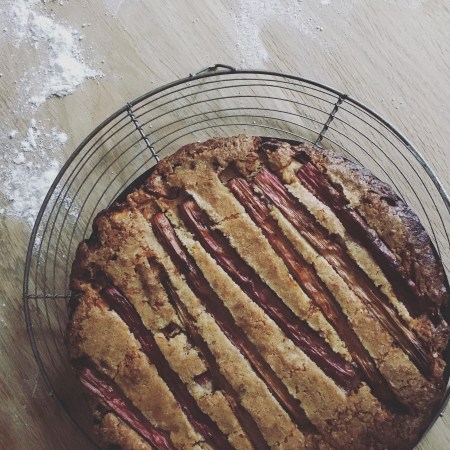
This is simply the best rhubarb cake, and possibly the best use of rhubarb in any form, in my opinion. (Hmm — on second thought, rhubarb ice cream is high in contention.)

The strands of rhubarb on top are striking, but this cake is much more than a pretty picture. It has excellent crunchiness on the outside; soft, near-cheesecake quality in the center; while the rhubarb’s tartness plays off a subtle sweetness. It is not exactly easy, but it’s certainly worth the — slight — effort.

Rhubarb almond cake recipe from Bon Appétit with just a few tweaks

225 g (1 cup) butter (plus a bit more for the pan)
175 g + 3 Tbsps (3/4 cup and a bit) sugar
450 g (1 lb) rhubarb stalks
150 g (1 1/4 cup) flour
100 g (3/4 cup) blanched almonds (or almond flour)
1 tsp baking powder
3/4 tsp coarse sea salt
1/2 vanilla bean (or 1 tsp pure vanilla extract)
Zest from 1/2 lemon
2 large eggs
60 ml (1/4 cup) plain thick Greek-style yogurt

Bring the butter to room temperature *Note: The batter needs to be beaten for a good length of time, so it is best to use a food processor. However if, like me, you do it all by hand, make sure the butter is very soft before you start, it will make things much easier.*

Preheat oven to 150°C (350°F).

Butter a cake tin (9″ in diameter), sprinkle some sugar and tap out the excess.

Wash the stalks of rhubarb, slice them in half lengthwise (in four parts if the stalks are very thick). Reserve about 8 of the prettiest strands to decorate the cake. Chop the rest of the rhubarb into 1 cm (1/2 inch) pieces.

In a food processor, pulse the flour, almonds, baking powder, and salt until the almonds are finely ground. *Alternatively, if using almond flour, mix all those ingredients thoroughly in a large bowl.*

In another bowl or electric mixer, beat together 225 g butter and 175 g sugar. And beat. And beat. If possible, beat for at least 4 minutes to get the lightest dough. Add the eggs, one at a time, fully incorporating the first before adding the second. Scrape the seeds from the vanilla bean into the batter (or add the vanilla extract), as well as the lemon zest. Beat again vigorously for a good 3 to 4 minutes.

Slowly (without any more beating from this point) incorporate the dry ingredients into the batter, and finally the yogurt. Once everything is combined, add the chopped rhubarb. The batter will be quite thick. Scrape it into the buttered cake pan, smooth the batter as best possible, arrange the reserved strands of rhubarb on top, and sprinkle with 3 tablespoons of sugar.

Place the cake in the oven and bake for 70-80 minutes until the cake is set and a knife comes out clean. It will have browned nicely on top.

Let the cake cool completely before removing from the tin.

This cake gets better overnight and it keeps for a few days well wrapped at room temperature or in the refrigerator.

Related recipes

Rhubarb ice cream  **  Rhubarb compote

Rhubarb raspberry crostata  **  Rhubarb rosemary jam

Rhubarb rosemary syrup

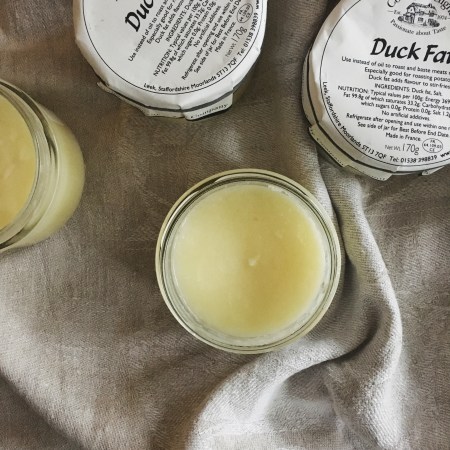
Surprisingly manageable duck confit

28 April 2017

IMG_6306

‘Why on earth make duck confit in the first place?’ Fair question. ‘Why on earth make duck confit again?’ Even more to the point. And again?! Because there is a happy ending.

Many moons and about a decade ago I made duck confit. Why? Well, I was in New York, where confit duck is not, as in France, available on every supermarket shelf. I must have been in an experimental mood. And I certainly had no idea what I was getting myself into. As I remember the experience — faintly (the worst ones fade) — I see endless vats of rendering, handling, splashing, filtering duck fat (it was actually probably goose fat). It took hours, days, perhaps weeks? In the end the thighs were much too salty.

And yet, I did it again. — Why?

IMG_0794.JPG

Perhaps because so much time had gone by that I had glossed over the experience? Because I was again/still in a country where duck confit is somewhat elusive? Because I don’t like to leave things on a frustrating experience?

Because in April Bloomfield’s book A Girl and Her Pig there is a duck confit recipe that fits on one page.

It works. It’s not that hard. It’s worth the adventure.

IMG_0793

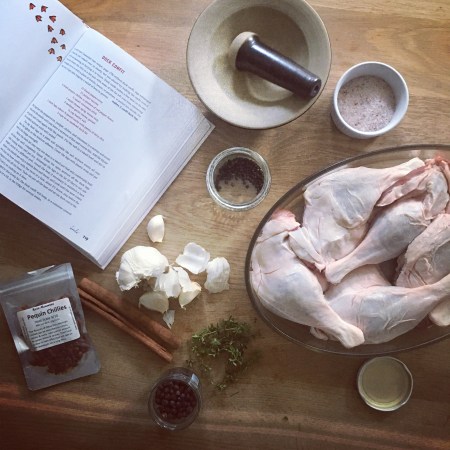
Duck confit recipe from A Girl and Her Pig by April Bloomfield adapted for 6 duck legs. The process takes 2 days and is best made some time in advance.

36 peppercorns
36 juniper berries
8 dried pequin chilies or pinches of red pepper flakes
1/2 small cinnamon stick
Small handfull fresh thyme
10 medium garlic cloves
1/3 cup coarse sea salt
6 duck legs
About 1.4 kg duck (or goose) fat

In a mortar, crush together the peppercorns, juniper, chilies, and cinnamon. There should be fine and coarse bits. Add the thyme leaves picked from the stems and the garlic and crush some more to obtain a coarse paste. In a small bowl, mix the spice mixture with the salt.

Place the duck legs in a shallow dish and rub the salt/spice mixture all over the legs. Cover with plastic wrap and leave in the refrigerator overnight.

The next day, very slowly heat the fat in a small pot that will perfectly fit the duck legs (I used a 10″/25cm pot). Rinse the duck legs and pat them dry with a paper towel, then carefully put the legs in the fat. The legs must be completely submerged — if they are not, use  a smaller pot or add a bit more fat. Cook on extremely low heat for about 2 1/2 hours. There should be barely a simmer. Adjust the heat as necessary.

Remove the pot from the heat and leave the duck legs in the fat to cool completely before placing in the refrigerator, covered with a lid. The legs submerged in fat will keep for a few weeks.

When ready to eat, remove the legs from the congealed fat, and carefully scrape off as much of the fat as possible. Thoroughly heat a heavy skillet/frying pan, add a few generous spoonfuls of the duck fat, and fry the legs over high heat, skin side down, until deliciously crispy. Turn around and fry the other side of the legs too. Serve immediately.

Crispy duck confit is best served with roasted potatoes and a salad of bitter greens (traditionally frisée, but also escarole, radicchio, arugula, etc…).

Baked apples

26 January 2017

img_8978

January is the time to huddle close, meet friends, have a pint, a meal, a whiskey nightcap. But after months of cooking and feasting, dim winter days call for easy comforts. Delicious meals that require barely any effort. Hardly a thought. Simple dishes that can be effortlessly adapted with whatever languishes in a pantry in the aftermath of holiday baking marathons.

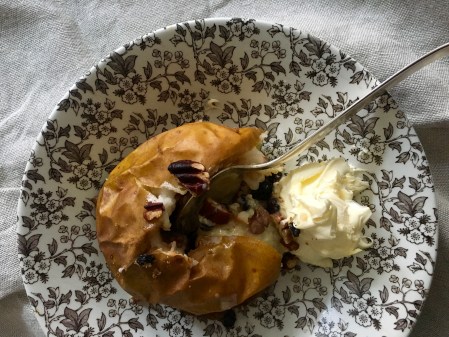
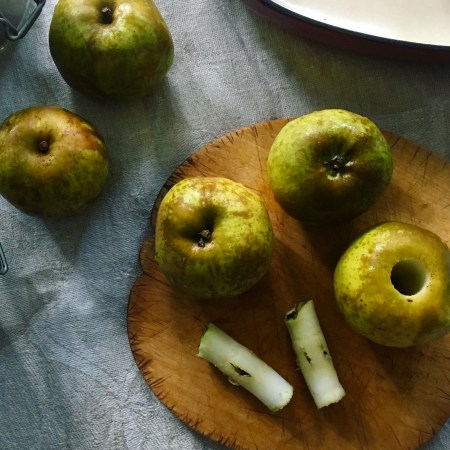
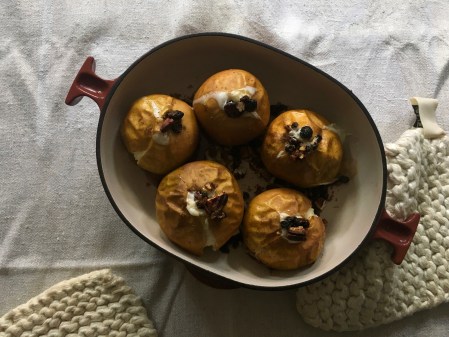
Baked apples for instance. The basics are simple, the variations many: wash an apple, core it, stuff it, bake it, eat it warm with a dollop of cream.

IMG_9213.jpg

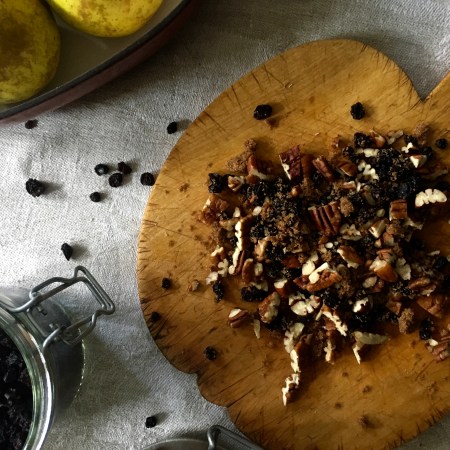
Any apple will do. Some hold their figure while others erupt into shapeless volcanoes; anything is fine by me. For the stuffing the elements might be dried fruits — for example raisins, chopped dates, cranberries; chopped nuts — pecans, walnuts, hazelnuts, almonds; some sweetness and spice — brown sugar, dark sugar, honey, maple syrup, cinnamon, lemon zest, ginger, allspice, cardamom. A splash of fortified wine. For serving, a generous spoonful of cream.

img_8904

Baked apples recipe

One whole apple per person
Currants (or raisins, cranberries, chopped dates or apricots)
Pecans (or walnuts, hazelnuts, almonds)
Dark muscovado sugar (or brown sugar, honey, maple syrup)
Ginger and cardamom (or cinnamon, allspice, lemon zest)
Sherry (or Marsala, Madeira)
Clotted cream (or crème fraîche, ice cream, yogurt) for serving

Preheat the oven to 375°F (180°C)

Wash and core the apples (leaving them whole)

Toss the nuts, dried fruits, sugar, and spices together. Stuff each apple with the mixture. Sprinkle with a dash of wine if using. Send into the oven for 25 to 40 minutes, until the apples are soft through.

Let cool just a little and serve warm with a spoonful of cream.

img_8932

Quinces poached with honey and bay

20 October 2016

img_7273

For someone who has named her blog after the fruit, I have far too few quince recipes on this site! So if you have made too much quince jelly, if you have no time for quince paste, if you are still waiting for the lamb and quince tagine promised some six years ago (blame this, like so much else, on Thomas), here, finally, is a recipe for poached quinces.

img_7293

Poached quinces recipe
Recipe inspired by Alice Waters’ poached quinces in Chez Panisse Fruit and Skye Gyngell’s baked quinces from A year in my kitchen

2 cups golden/caster sugar
4 medium quinces (about 2 lbs)
3 Tbsps flavorful honey
1/2 vanilla bean
One bay leaf (I used a fresh one)
1/2 cinnamon stick
1 untreated lemon

Make a syrup with the sugar and 6 cups (1.5 liters) of water. Bring to a boil and simmer briefly until the sugar has dissolved.

Meanwhile, wash, peel, core, and slice the quinces lengthwise into quarters then eighths (this must be done at the last minute as quinces tend to turn brown very quickly).

Slice one half of the lemon very thinly, and juice the other half.

Add to the simmering syrup the honey, the vanilla bean after scraping out the seeds into the syrup, the bay leaf, the cinnamon stick, the lemon slices, the lemon juice, and finally, the quince slices. Cover the liquid with a round of parchment paper and place a weight on top if possible to ensure that the pieces of quince are submerged in the liquid as they cook. Let the quince simmer for approximately 45 minutes until they are tender.

Once cooked, carefully strain out the pieces of quince and place them in a bowl or canning jars. Return the syrup without the quinces to the heat and simmer down for a good 20 to 30 minutes to concentrate the liquid (there must be enough left to cover the fruit!).

If preserving, sterilize the canning jars in boiling water for 5 to 10 minutes and close the jars immediately after pouring the reduced hot liquid on top of the fruit.

If using immediately, pour the hot liquid over the fruit and let cool to room temperature.

In both cases serve with thick Greek-style yogurt.

img_7271

French apple cake with rum

12 October 2016

img_7107

When fall sidles in with armloads of plums and bright warm days, it is easy to overlook that October has arrived and apples are at their crispest.

Of course, apples will stay with us for a while, resignedly softening in cool cellars, faithfully, to accompany us through the bleakest winter months. We’ll be grateful — if perhaps a little weary — for those last wrinkly fruits as we await spring.

A small part of me always wonders whether it wouldn’t be best to hold out just a little while longer before biting in, to prolong the novelty a few weeks more. But the truth is that I long for apples already in the summer, I miss them in August; something about the comfort of a familiar companion amid attention-grabbing summer harvests.

img_6981

Apples are remarkable fruit, and I love all the gnarly varieties (though I can never remember which is which). Smaller ones, tart and sweet, barely bigger than a large apricot are ideal to bite into — the perfect, well-packaged snack on the go. Bigger apples are less fussy when baking, and so versatile! Is any other fruit equally ideal in cakes, tartes, crumbles, and pies, but also able to stand deliciously independently, simply baked in the oven stuffed with raisins, nuts, and cream, or stewed into spicy compotes?

img_7104

This weekend I jumped into apple season with this perfectly lovely, easy cake that I discovered a few years ago and make regularly. The recipe, which I found on David Lebovitz’s blog, is originally by Dorie Greenspan. I love this cake because it feels very ‘French,’ in that it is un-fussy. While exported French cuisine is elaborate, French home cooking is usually quite straightforward, and, as Dorie Greenspan writes in her introduction to the cake, skilled French home cooks often don’t use recipes, even when baking. Also, the generous addition of rum is completely essential for this cake — we French do like a good dash of booze in our desserts.

img_7094

Apple cake by Dorie Greenspan via David Lebovitz
Here is the recipe, doubled, because I always seem to be feeding a crowd! I’ve reduced the sugar ever so slightly, and added a squeeze of lemon so the apple pieces don’t turn brown.

1 cup (225g) butter plus a little extra for the mold
1 1/2 cups (220g) flour (I usually use white spelt flour, which seems perfectly interchangeable with all-purpose white flour)
1 1/2 tsps baking powder
1/2 tsp sea salt
7-8 large apples (mix of varieties — once the apples are incorporated in the batter, there should be practically more apple than batter)
Juice from 1/2 lemon
4 large organic eggs
1 1/4 cup (250g) soft brown sugar
5 or 6 Tbsps dark rum (but no less, this is what makes the cake!)
1 tsp real vanilla extract

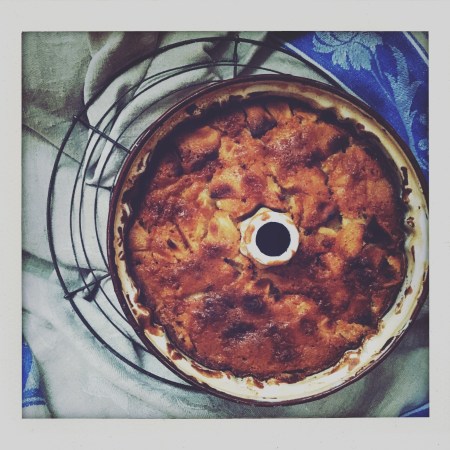
I’ve made this cake in round springform pans, as the recipe suggests, but also in long rectangular loaf tin, and, here, in a fancy bundt mold that I found this summer while scrounging through my grandmother’s old kitchenwares.

So … choose the desired mold (or two) line it (them) with parchment paper and butter the paper generously. [Parchment paper was impossible with my crinkled mold so I buttered it excessively and added a dusting of flour.] If using a springform pan, place it on a baking sheet, as it may ooze while baking.

Preheat the oven to 350°F (175°C).

Melt the butter and let it cool to room temperature.

Peel and core the apples, then cut each wedge into roughly 1/2 inch (1cm) chunks. Squeeze a little lemon juice over the pieces of apple so they don’t turn brown.

In a small bowl, whisk together the flour, baking powder, and salt.

In a larger bowl, whisk the eggs until foamy, add the sugar gradually, still whisking, then the rum and the vanilla.

Whisk in half of the flour, then half of the melted butter. Add the other half of the flour and finally the rest of the butter.

Use a spatula to stir in the apples, mixing until they are well coated. There will seem to be more apple than batter.

Scrape the batter into the cake pan. Tap the pan gently on the table to even out the batter, and smooth the surface with the spatula. Slide into the oven for a good 50 minutes to an hour. Test (as usual) with the tip of a knife or skewer that should come out clean. [The cake may pull away from the sides of the pan, it doesn’t necessarily mean it is overcooked, first check with a knife!]

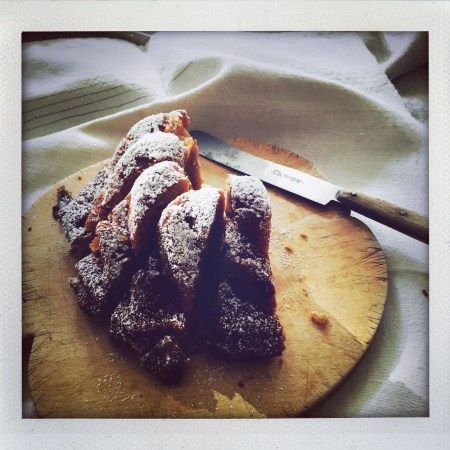
Let cool to room temperature before turning onto a serving plate.

I prefer to serve fruity cakes with crème fraîche or clotted cream, but by all means ice cream would be fine too.

Bon appétit!

img_6941