Archive for the ‘Summer’ Category

Fettucini with immediate tomato sauce

4 October 2012

The last of the summer’s ripe tomatoes may be a little soft, a little blemished, they may not warrant much attention as heads will be turned by the arrival of bright yellow squash and orange pumpkins. What these tomatoes want is this sauce exactly. It is so quick, so easy that it will barely distract from the anticipation of slow roasts and apple pies. It is so good that those blemished tomatoes may soon be missed, as the creeping cold leaves heaps of unripened green tomatoes in its wake, with no better prospect but to be transfigured into chutney.

The sauce sort of made itself one night, and I was taken aback by how easy it was to create such a good sauce in so little time. I’d always supposed that good tomato sauce needs to simmer gently and reduce patiently. On that evening there was no time and, temptingly, in the kitchen, some good fettucini and a few roma tomatoes.

All I did was cut the tomatoes lengthwise in sixths, slice a few garlic cloves, heat some olive oil in a large skillet, throw in the garlic for barely a minute, add the tomatoes, and wait until most of the juice had evaporated and the tomatoes hinged on golden and in some places brown. It took perhaps 10 minutes, just about the time to boil the pasta.

***

For two

5 ripe tomatoes

2 cloves garlic

Good olive oil

Sea salt and freshly ground black pepper

200 g good fettucini

Really good olive oil

Parmigiano-reggiano

Few basil leaves

*

Bring a large pot of heavily salted water to boil for the pasta.

Cut tomatoes in half lengthwise then in half in thirds. Peel and thinly slice the garlic.

Carefully slide in the fettucini. Cook in a heavy boil.

Heat a generous amount of olive oil in a large heavy skillet. **The skillet should be large enough so the tomatoes are in one layer only.** Cook the garlic for barely a minute over medium to high heat, until translucent, then add the tomatoes. Season generously with salt and pepper. Cook the tomatoes over high heat until a lot of the juice has evaporated and they start turning brown.

Start checking the pasta regularly after about 8 minutes (by carefully taking one out and eating it). Drain quickly in a colander as soon as the pasta is just al dente (or to desired consistency) and return immediately to the pot used for boiling the pasta (one could use another pot but it’s much simpler this way). **It is important not to overdrain the pasta. If it is too dry it will become sticky.** Quickly drizzle generously with good olive oil so the pasta doesn’t stick.

Transfer the pasta to individual bowls. Spoon over the tomatoes, add a drizzle of very good olive oil, tear up a few leaves of basil on each bowl, and grate some parmigiano to finish.

Children’s dinner | The ‘I wish it was cauliflower’ (but it’s not quite the season!) zucchini gratin

20 September 2012

Every morning I make lunch for Leo and Balthasar to take to school. When this began I thought I would use the opportunity to be terribly creative; in fact it has become the least inspired aspect of my cooking life. One day I make sandwiches, one day pasta. I alternate. I know the boys will eat this. The problem with school lunches is that I am not there, at the end of the table, frowning, admonishing, and — yes — forcing them to finish their grilled mackerel and ratatouille.

The children eat many things, and, if I may, I don’t think it’s because ‘we’ve been lucky’ but because I’ve made it an excruciating. daily. struggle. But not at school. At first I was just happy that they finished their meal; now I’ve become stuck in this pasta/sandwich routine. I am mindful of what goes into the lunchbox, of course, my mother‘s ever knowledgeable advice always chiming in my ears. But I leave the really good food, the fun food, and the mealtime fights for the evenings.

It seems to have payed off. Leo and Balthasar can be coaxed into eating practically anything; Louise, who is 2, is still in a tug of war. Some things need a bit more prodding, and, unhelpfully, it happens that onetime hits suddenly misfire. But there is some predictability. Naturally oftentimes I have little more patience than to throw some frozen peas into boiling water, serve that with a sunnyside egg, and call it dinner; but I know that practically anything that is diligently prepared, well seasoned, and cooked to the standards of something I would serve guests will be polished off.

Gratin for example. Actually, I don’t think I’ve ever made gratin for guests. But nonetheless, gratin is a great example.

It started out with cauliflower. Winter is not the most propitious season to get children excited about vegetables, and at some point I had to find new ways to prepare cauliflower. I personally like cauliflower best raw, but one day I decided it was time to tackle gratin. I say ‘tackle’ because I was intimidated by béchamel sauce. Many years ago on a skiing holiday I volunteered to make béchamel sauce. It was for lasagna, I think. I knew the basic ingredients and felt confident that, by virtue of being French, I was the person best qualified for the job. All I managed to do was create a giant, ever expanding monster of butter, flour, and milk, which probably wasn’t even any good. As it happened, I had to suffer some lessons in béchamel making from Thomas, who made copious fun of me. This was a very long time ago.

I’ve since gained some confidence in the kitchen, so a while ago I decided to tackle béchamel again to make cauliflower gratin, which, come to think of it, is now probably my favorite way of eating cauliflower.

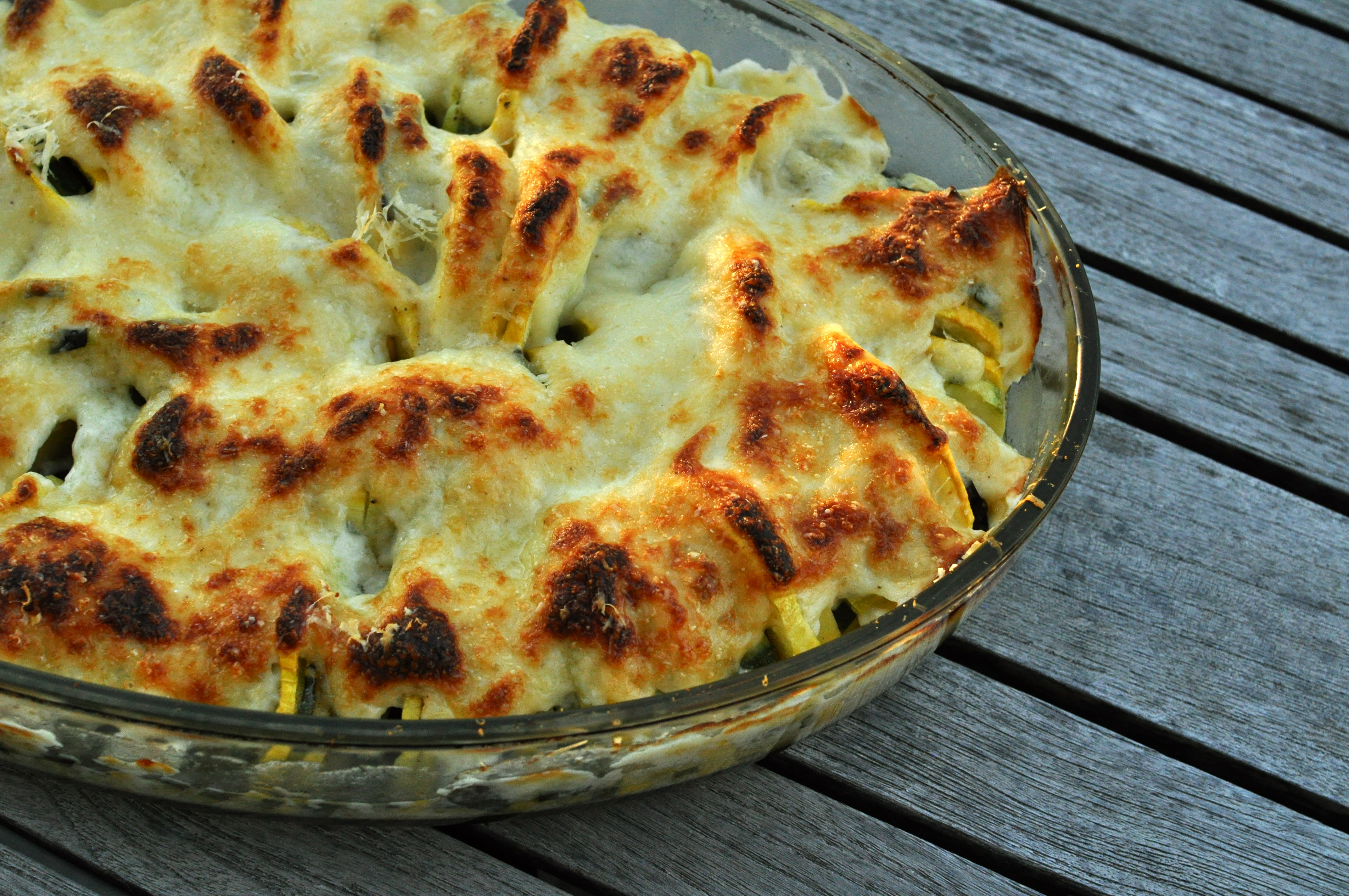
The punchline, of course, is that children love gratin. They also love anything that’s been simmered or stewed with onions, garlic, herbs, spices. They love ratatouille (they do!), they also love risotto (but weeknight dinners rarely enjoy the leisure of 45 minutes of undivided attention). So when I made this squash and zucchini gratin the other day, despite slight initial dismay that it wasn’t cauliflower, the children ate heartily, and asked for more.

***

Gratin is easy to make once the béchamel demon has been tamed. Ideally I’d make simple broiled or pan fried fish with this gratin, since fish and zucchini go so well together. On this particular day I was unprepared and just had some leftover rice, fried to crispiness in olive oil. That was good too.

Quantities are for a 9 x 13 inches (23 x 33 cm) oval dish.

6 medium-sized zucchini and/or yellow squash

Lots of basil leaves

Sea salt

Freshly ground black pepper

Good olive oil

About 3 1/2 cups (850 ml) béchamel sauce (this deserves its very own post and will be up soon, but in the meantime look here)

Freshly grated parmesan

*

Preheat oven to 375°F (190°C)

Wash and thinly slice the zucchini crosswise (into disks) approximately 1/4 inch (1/2 cm) thick. Wash the basil leaves.

Place the zucchini slices upright in the dish. Intersperse a basil leaf every 4 or 5 slices. Sprinkle with salt and pepper and pour a very thin drizzle of olive oil over the zucchini.

Pour the béchamel sauce evenly over the zucchini and grate lots of parmesan on top.

Bake the gratin for about 45 minutes, until nicely brown and bubbling. (Placing the rack in the upper half of the oven will help the gratin get a good color.)

*

Related posts

Children’s dinner | Cowboy food

Children’s dinner | Fake rabbit in the vegetable garden

Grilled pork chops with fennel, sage, and pimentón

13 September 2012

I have a dilemma, and it involves pork.

As I may have mentioned, a few years ago I discovered Flying Pigs Farm at Union Square market. Before then I never bought pork (ham and bacon excepted), but since I’ve become more than a little fond of the animal, largely encouraged by a pretty remarkable recipe for slow roasted shoulder.

As I may also have mentioned, last November a real local butcher, Harlem Shambles, opened in our neighborhood.

So I have a problem of fealty: where should I buy pork now?

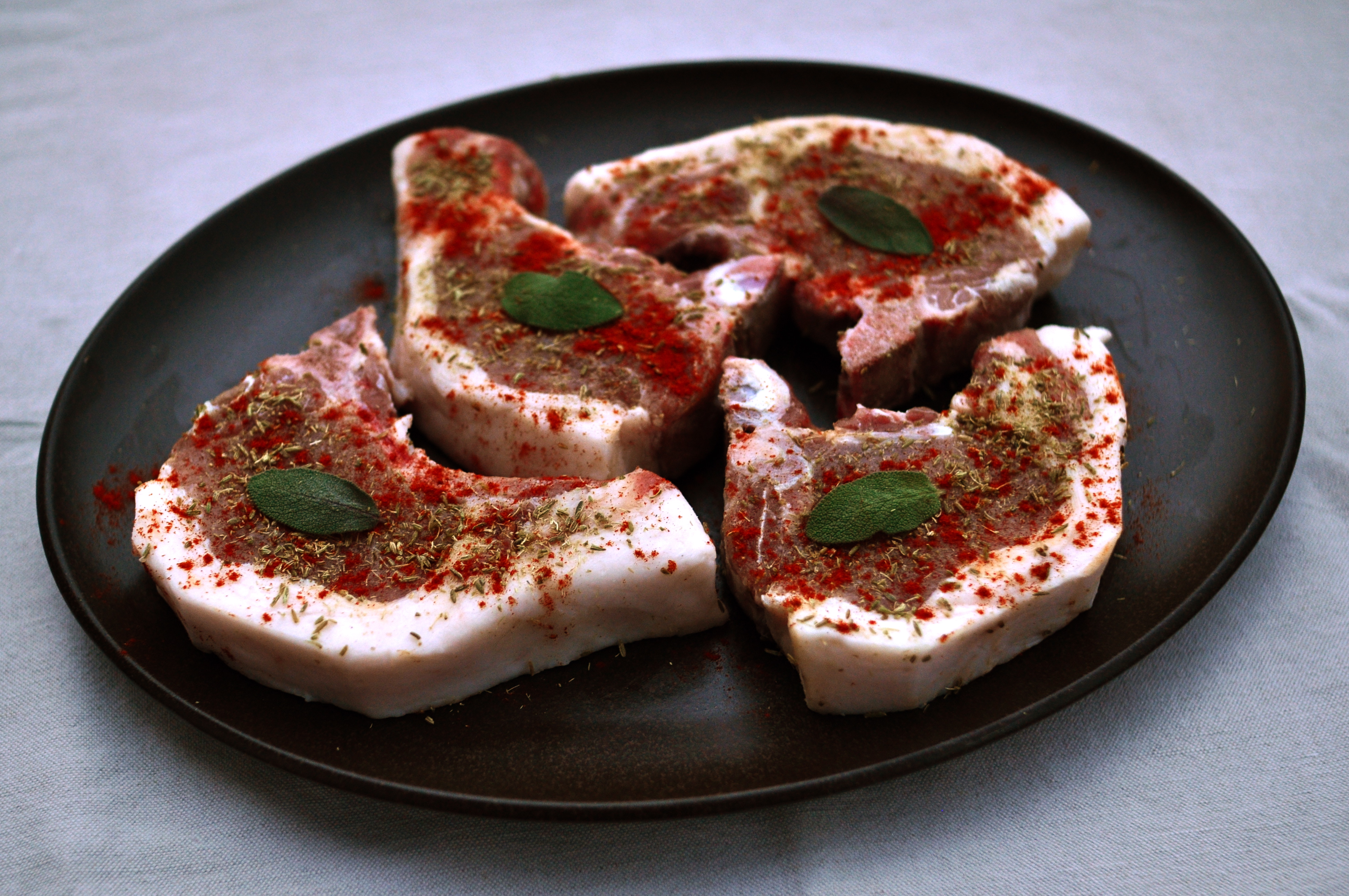
Rather than resolve this question just yet I’ve embraced this sudden begging supply of excellent pork and expanded my pork-cooking horizon further; I’ve been making pork chops. We’ve grilled them and, due to uncooperative weather gods, have seared them in a pan. Both work very well; key are the quality of the pork, and seasoning that respectfully complements the flavor of the meat.

They were amazing, I thought. Whether here or there, another great reason to buy pork.

***

Serves 4, one pork chop per person

4 (1 inch-thick) all natural and preferably heritage breed pork chops
1  1/2 tsps fennel seeds
1 tsp coarse sea salt
8 sage leaves
Smoked Spanish paprika (pimentón)

*
Take the pork chops out of the refrigerator and prepare the rub at least 45 minutes before cooking.

In a mortar, crush the fennel seeds with the sea salt.

Rub the chops on each side with the spices and add a sage leaf in the middle. Let sit at room temperature. *Meat cooks more evenly if allowed to come to room temperature.*

Just before cooking — on a grill or in a pan faintly coated with olive oil — sprinkle some smoked Spanish paprika on each side of the chops.

Cook the chops over very high heat so they become beautifully brown on the outside without having time to dry up inside. It’s difficult to give an exact cooking time but it should be approximately 4 minutes on one side and 3 to 4 on the other.

As always, let the meat rest in a warmish place 5 to 7 minutes before serving. The chops should be faintly pink inside and very juicy.

*

Related posts

Slow-roasted pork shoulder

Pork rillettes

Ratatouille

Watermelon, mint, and feta salad

11 September 2012

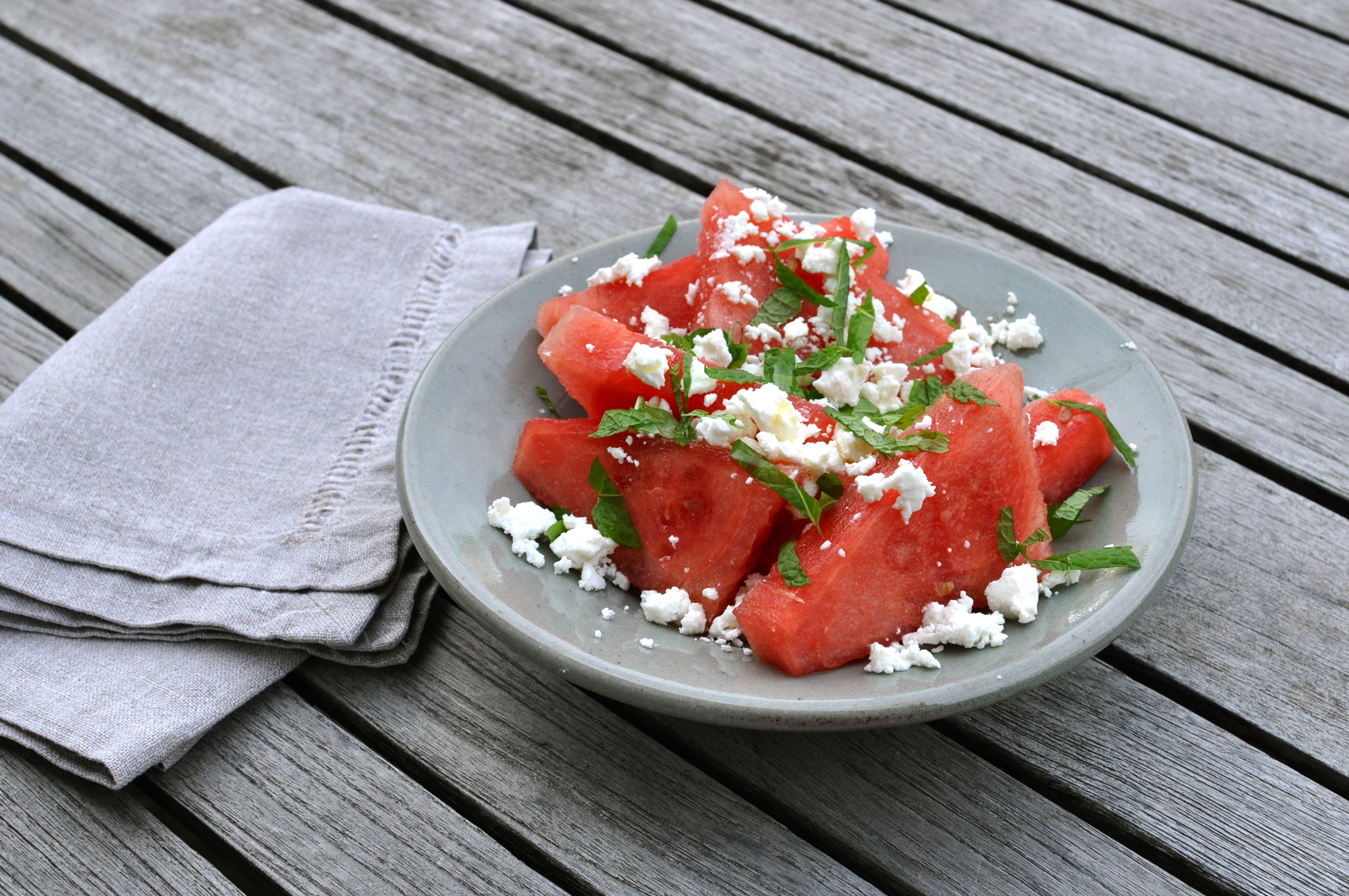
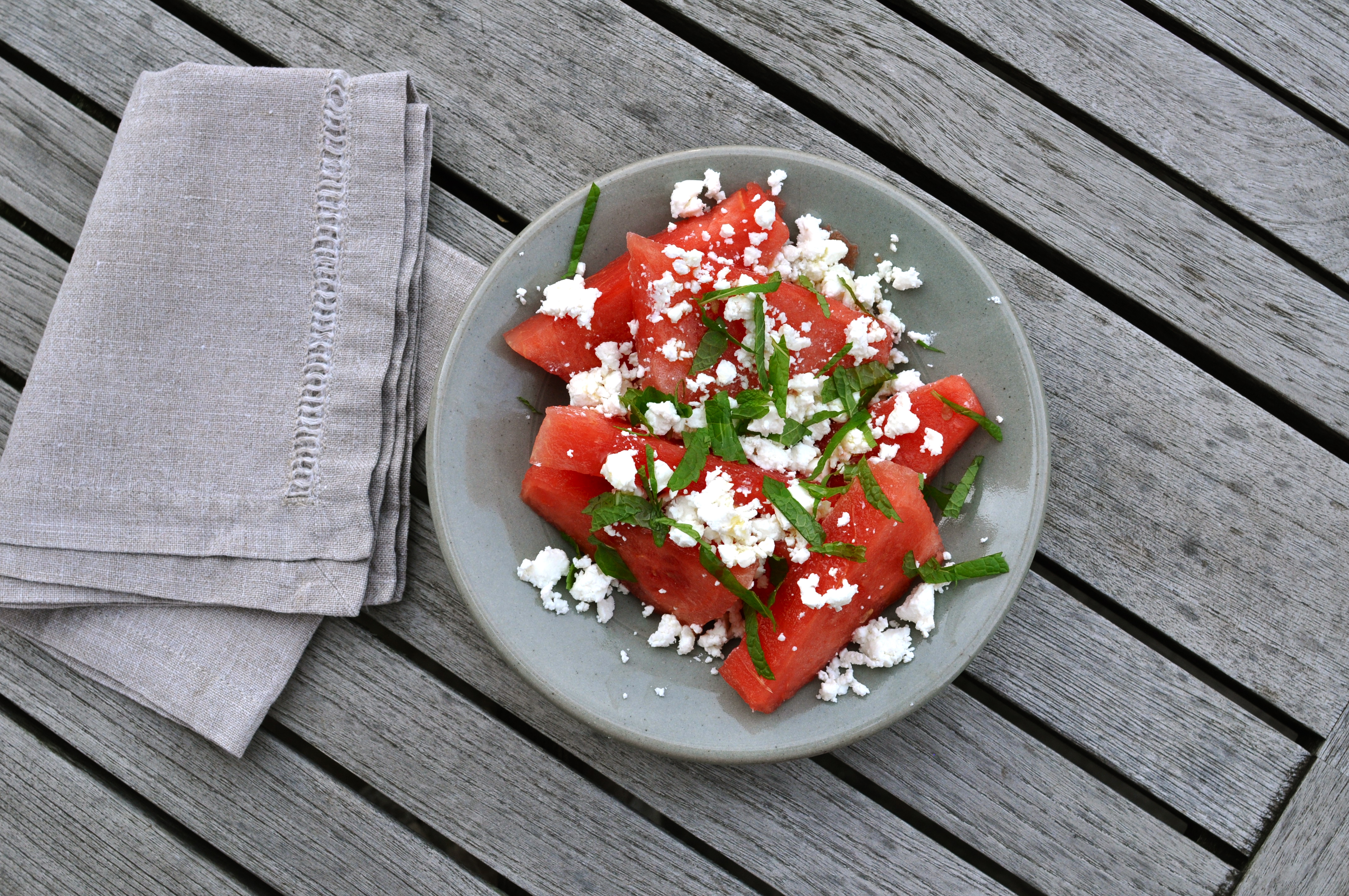
When my friend Tamara introduced me to this salad some years ago I was surprised at first, intrigued, and immediately smitten. I’ve made it often since and it usually elicits a similar reaction — surprise at the sight of feta, curious interest in the addition of olive oil, and prompt addiction to each salty sweet cool crunchy bite. It’s as simple as its four ingredients and magically transcends the sum of its parts, as they say.

I see it more often now, but in case you hadn’t yet crossed paths with this awesome combination, you must give it a try. It’s best eaten without utensils, just by picking up each watermelon wedge capped with feta and mint. Beware the juice.

***

Chilled watermelon

Good feta

Fresh mint

Best extra virgin olive oil

*

Cut the watermelon into approximately 2 inch (5 cm) wedges, and each long wedge into approximately 3/4 inch (1 cm) pieces. Place the watermelon pieces on a plate or shallow dish.

Crumble lots of feta on top of the watermelon.

Wash, pick through, and thinly cut the mint leaves. Sprinkle over the feta.

Finally, drizzle a thin ribbon of olive oil and serve.

*

Related posts

Avocado, cherry tomato, cucumber salad with red pepper and parsley

Baked mackerel with mustard and thyme

26 July 2012

During the first couple of weeks the persistent Breton drizzle rarely abated, the rolling clouds swept from deep coal to lighter greys, with barely a glint of blue. We went on foggy walks through swampy fields, tore out weeds under the rain, wore thick sweaters, spent evenings by the fireplace. There wasn’t much outdoor cooking.

And when it is too wet to grill mackerel on an open fire, the next best thing is to slather the fish with mustard on both sides and bake it in the oven. This is how we always prepared mackerel in the family. Short of outdoor grilling, it is the best.

Fish is pretty easy going and doesn’t need much in terms of preparation; the tricky and single most important thing is the cooking time. It is very easy to overcook and that ruins everything. This is particularly acute with mackerel: well cooked it is succulent, overdone it becomes heartlessly dry.

I usually count one mackerel per person, but here we’ve found very small line-caught mackerel that were barely enough for one, and occasionally I’ve seen mackerel large enough to be shared. When I’m not sure I seek advice from the fishmonger.

One medium mackerel per person, whole but gutted
Sea salt
Freshly ground black pepper
Fresh thyme
Olive oil
Hot Dijon mustard

Preheat the oven to 375°F (190°C).

Season the gutted belly cavity of the mackerel with a pinch of salt and freshly ground pepper; stuff with a sprig of thyme.

Drizzle a little olive oil onto a baking dish large enough to hold all the mackerel.

Slather a thin layer of mustard on both sides of each fish, place into the baking dish and slide into the oven.

Bake for 10 to 12 minutes; this depends on the size of the fish, naturally, and larger ones could take a few minutes longer. **As it is absolutely essential not to overcook fish, rather risk having to pop it back into the oven for a minute if it is still raw inside (the flesh would still be slightly translucent).**

Serve immediately, preferably with mashed potatoes.