Archive for the ‘Year-round’ Category

Children’s dinner | Fake rabbit in the vegetable garden

8 November 2011

or “How the Flopsy Bunnies tricked Mr. McGregor.”

I think the name initially devised was even more convoluted, but Leo and Balthasar helped me distill it down to this. This is what happens when Thomas isn’t around.

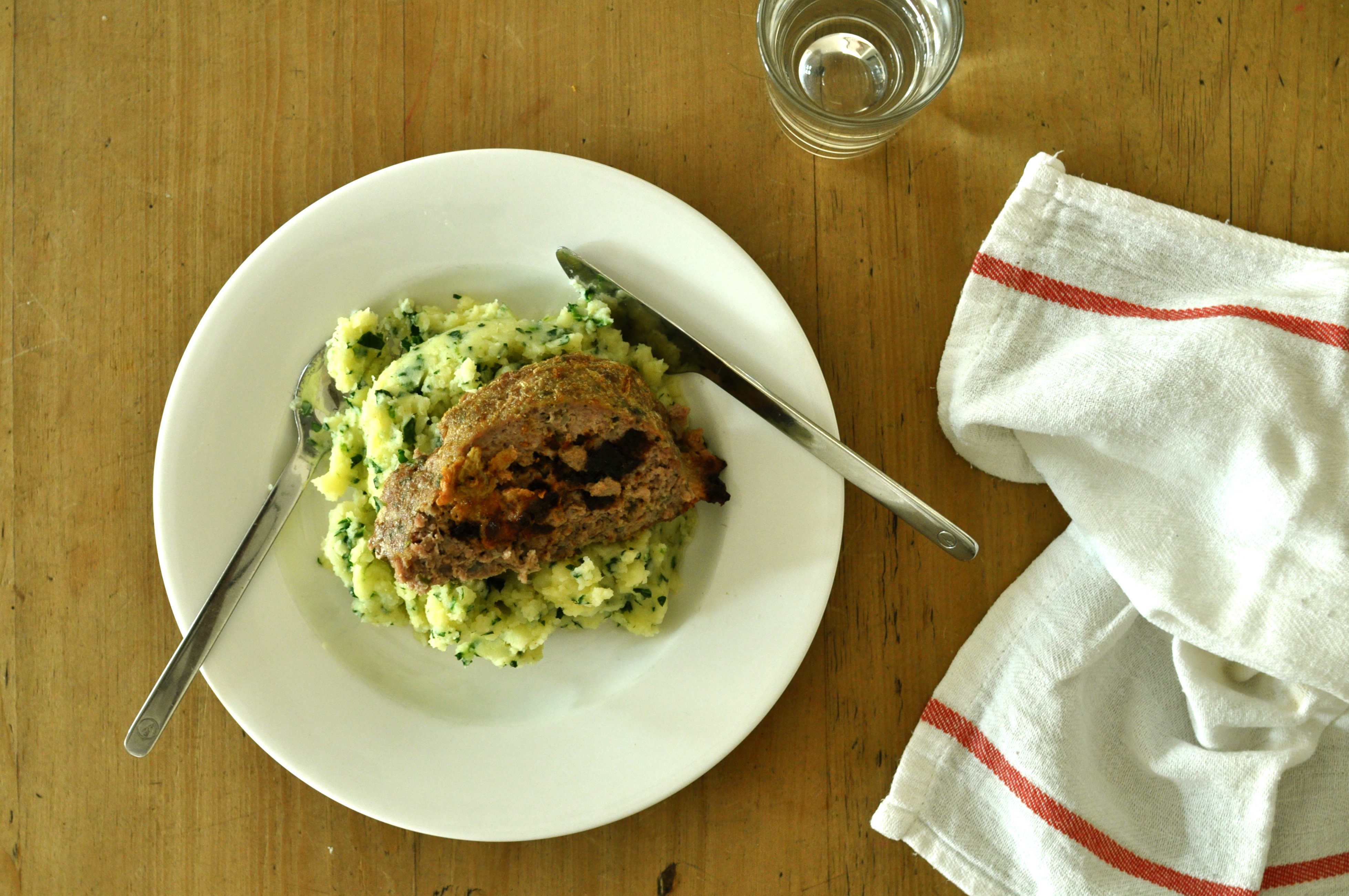
It’s really meatloaf with spinach mashed potatoes, so let me explain.

Fake rabbit (falscher Hase) is what the Germans call meatloaf, which, as flawed as it may be, is better than “meatloaf” — I imagine pretty much anything is better than “meatloaf.” So as I was looking for a name for this dinner – which isn’t exactly a speedy 20-minute meal, but much easier than it seems and always a great success — I erred into a world of bunnies, vegetable patches, and Beatrix Potter.

For anyone who didn’t grow up with stories of Peter Rabbit and Benjamin Bunny, Thomasina Tittlemouse and Jemima Puddle-Duck, the tale of the Flopsy Bunnies goes something like this: seven hungry bunnies venture onto Mr. McGregor’s rubbish (it’s an English story) heap, where they find a quantity of discarded overgrown lettuces. Victims to the soporific effect of lettuce, the bunnies all fall into a deep sleep, from which they are plucked by Mr. McGregor, and dumped into a sac for his dinner. Luckily the parents come by, find the sac, and, with the help of a friendly field mouse, free the bunnies from the sac then replace them with rotten vegetables. Unaware of the swap, Mr. McGregor proudly presents the sac to his wife, who doesn’t find the joke very funny.

Somehow, thinking of fake rabbits and children’s dinners reminded me of this story. And you know what? The name has caught on (not that the meal really needed selling, but still).
***

The fake rabbit

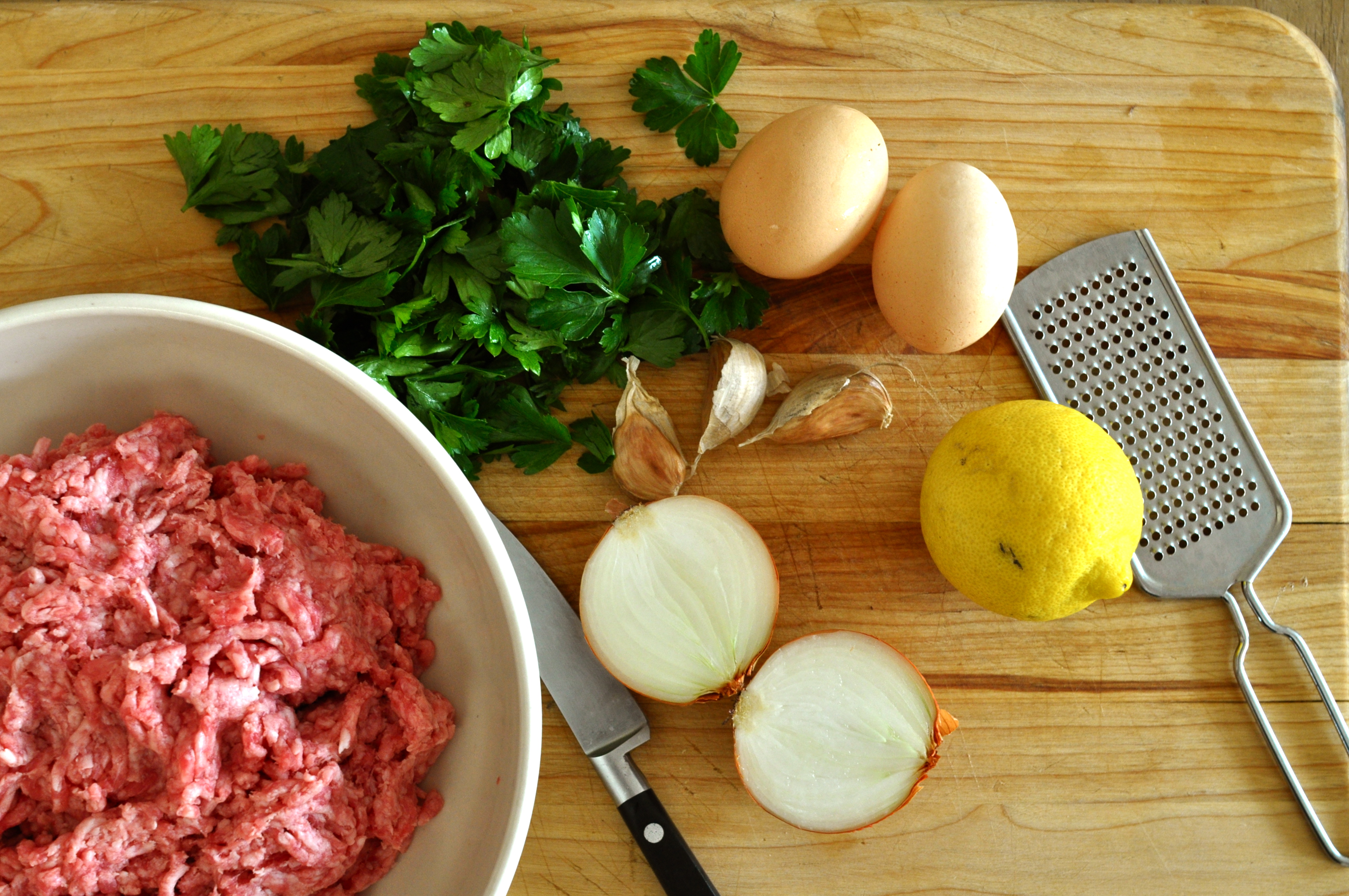
This fake rabbit is very moist, flavorful, and incidentally, bread-free. It takes a while to cook, but just a few minutes to prepare. The meat can be seasoned and prepared in advance and kept in the refrigerator for a few hours. 

2 lbs ground lamb or beef

1 small onion

1 garlic clove

Small bunch parsley

2 eggs

Zest from 1/2 lemon

1 Tbsp Dijon mustard

2 Tbsps good olive oil

1/2 Tbsp coarse grey sea salt

Freshly ground black pepper

*

Preheat oven to 425°F (220°C).

Place the meat in a large bowl.

Peel and finely chop the onion. Peel and finely chop the garlic. Wash, remove the stems, and finely chop the parsley.

In a small bowl, whisk the eggs briefly with a fork.

Add all the ingredients to the meat and mix thoroughly.

Pat the meat into an oblong shape and transfer to an ovenproof dish. Drizzle a little olive oil and rub over the meat.

Slide the meat into the oven and bake at 425°F for 10 minutes. Reduce the heat to 375°F and bake for another 30 minutes.

Remove from the oven and let rest for 5 minutes before cutting into 1 inch slices to serve.

*

The vegetable garden

Or quick mashed potatoes with spinach

5 or 6 medium potatoes

1 bunch spinach

3 Tbsps butter

Good olive oil

Freshly grated nutmeg

Sea salt

Freshly ground black pepper

*

Fill a pot with water, salt generously, cover, place over high heat, and bring to a boil.

Peel and cut the potatoes into halves (or quarters if the potatoes are very big). Carefully drop the potatoes into the boiling water, leaving the lid ajar so the water doesn’t overflow, and cook. (They will cook for about 20 minutes.)

Meanwhile prepare the spinach. Remove the damaged leaves, cut off the stems, wash the spinach leaves in cold water, and set aside.

Start checking the potatoes after about 15 minutes; As soon as a sharp knife slides easily into the flesh, the potatoes are done. Immediately add the spinach, blanch for 1 minute, and quickly drain the potatoes and spinach into a colander.

Place the potatoes into a large shallow bowl and the spinach on a cutting board. With a masher or fork, mash the potatoes with the butter, and good glug of olive oil. Season with nutmeg, salt, and pepper.

Now the spinach should be cool enough to handle. Chop it finely, add to the potatoes, and mix well.

Done.

*

Related posts

Children’s dinner | Cowboy food

Pork rillettes

20 October 2011

I’ve been in the mood recently to serve a somewhat more elaborate apéritif, tapas style, when we invite friends over for dinner. It’s convivial and frees up last minute cooking time since I then usually skip the first course.

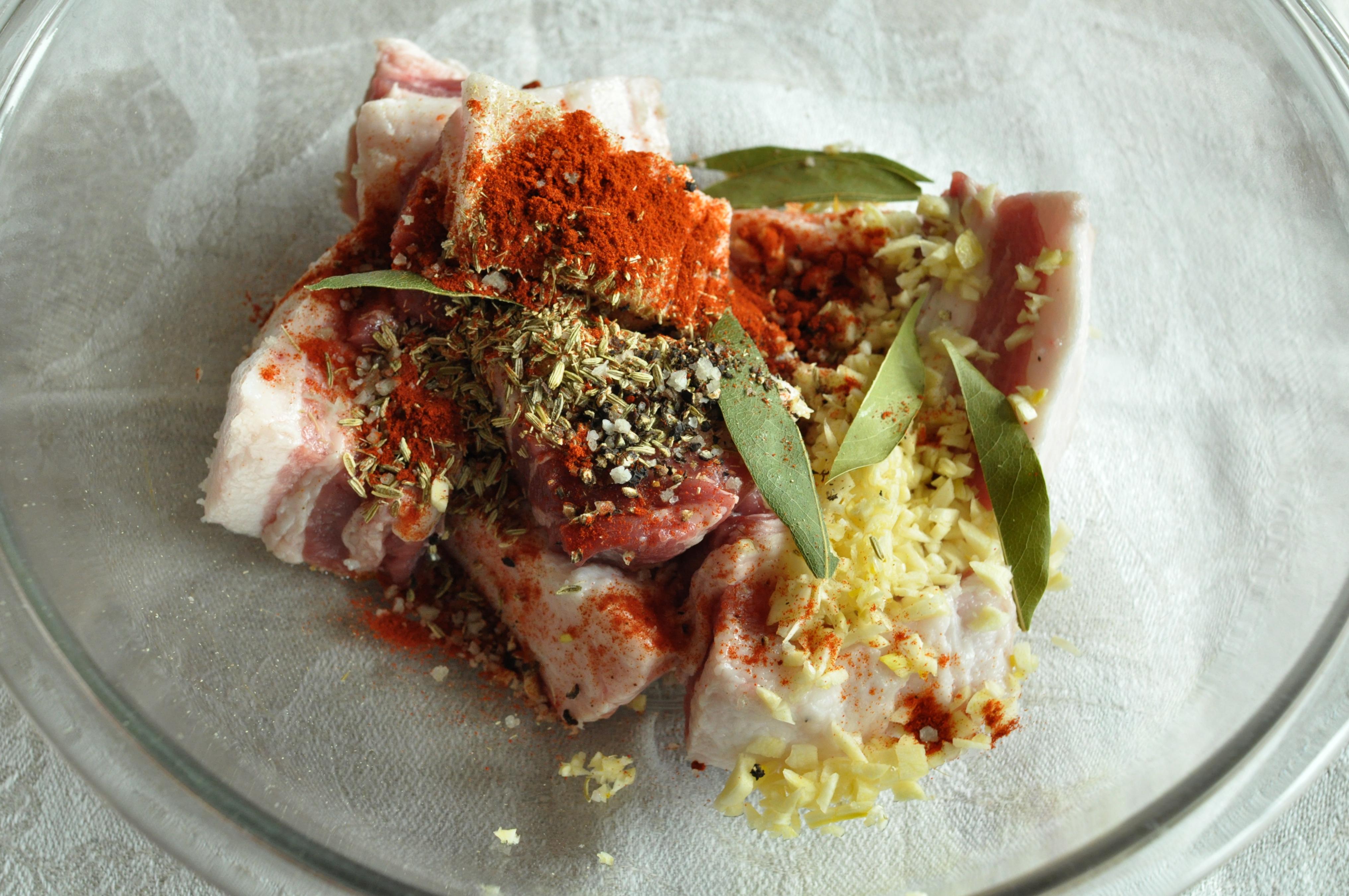
A typical apéritif includes marinated olives. Cherry tomatoes, radishes, or daikon radish depending on the season. Cashews or almonds, which I’ve just learned to dress up by roasting them with some spice. For something more substantial, I’ve often made salmon rillettes or chicken liver terrine. But as I was delving into Moro The Cookbook, I found this Spanish pork rillettes recipe.

French rillettes don’t usually include overt aromatics. They taste like pure, unadulterated pork, in fat. They are delicious. This recipe uses pimentón (Spanish paprika), fennel, and sherry alongside garlic and bay. It’s different from the rillettes I knew; it certainly is no worse.

***

I reduced the amount of pimentón for a more subtle flavor and added a note about the leftover pork fat, but otherwise the recipe is that of Moro the Cookbook.

2 lbs (1 kg) boneless pork belly

1/2 lb (225 g) pork back fat

6 garlic cloves

1 heaped tsp fennel seeds

1/2 tsp whole black peppercorns

3 bay leaves

1 tsp sweet smoked Spanish paprika (pimentón)

2/3 cup (150 ml) fino sherry

Sea salt and black pepper

***

Preheat oven the 275°F (140°C).

First trim the rind from the pork belly, then cut the meat and fat into roughly 2 x 1 1/2 inch (5 x 3 cm).

Prepare the aromatics by roughly chopping the garlic cloves; in a mortar, lightly crush the fennel seeds and peppercorns; halve the bay leaves.

Place the pork and fat in a large mixing bowl and add the garlic, fennel seeds, peppercorns, bay leaves, paprika, sherry, and a good pinch of salt, and toss well with your hands to combine. Transfer to a 2 quart  (2 liter) earthenware terrine or heavy cast-iron pot, seal tightly with foil so no steam can escape, and place in the oven for at least 4 hours, until the meat is very soft and can be shredded easily.

Remove from the oven and strain the meat in a sieve, pressing with a spatula or spoon to release the juice.

Put the liquid aside to cool, then in the refrigerator until the fat rises to the top and solidifies.

Once the meat has cooled enough to handle, shred between your fingers. **This is best done when the meat is warm rather than cold, as it will become more difficult to shred.** Set aside any pieces of fat that have not melted away (see note).

When the fat on top of the juice had somewhat solidified, spoon it off and set aside. Add all the juice and 2 tablespoons of fat to the shredded meat. Mix well, season with salt and pepper, and put the meat back into the terrine or other earthenware or glass jar. Pack the meat gently and seal with a layer of fat about 1/4 inch (1/2 cm) thick.

Keep in the refrigerator for at least a couple of hours before serving, and up to 2 weeks if well sealed with fat.

Note: You could discard the leftover fat, but it seemed a shame to do so, so I placed it in a small skillet over very low heat, letting it melt further. I then strained the fat and kept it in the refrigerator, to be used on bread instead of butter. The pieces of fat that remained solid, brown and caramelized, we ate — just like that.

*

Related posts

Cookbooks | Moro The Cookbook (Roasted almonds with Spanish paprika)

Chicken liver terrine

Cookbooks | Moro The Cookbook (Roasted almonds with Spanish paprika

14 October 2011

I think I own more than a hundred cookbooks, and yet often, when I look for inspiration, I am tempted to reach for the same one (or four): the River Café Cookbooks. I know them, I trust them. Over the years, with their reliable support, I have become confident in their flavor profiles.

I don’t know all my cookbooks so well. I often use them as a reference, comparing similar recipes for a dish — braised rabbit? — from which to distill a personal take. In many I have found a few recipes I like. Some I’ve made once, some I’ve repeated many times, some I plan to make one day. But I don’t feel I know these cookbooks intimately.

I want to get better acquainted.

So I am delving into my library. And Moro The Cookbook is where October led me. Moro is a restaurant in London opened by two former River Café chefs, Sam and Sam Clark. The cooking is familiar in its simplicity, but while the River Café is Italian in inspiration, the Clarks look to Spain, and the Southern Mediterranean, and therefore use herbs and spices very differently. I was already enamored with Moro’s lentil soup and have often served hard-boiled quail eggs dipped in cumin and salt, but that was about it.

So I have plunged. In the past few weeks I have made many dishes from this cookbook, and here are some of the things I’ve discovered.

Roasted almonds with Spanish paprika (method below) is an excellent complement to marinated olives for an apéritif.

It’s okay to cook loin of pork in milk with bay and cinnamon rather than, more traditionally, sage and lemon. It’s heady, subtle, surprising. It doesn’t taste like cinnamon. It tastes pretty great.

“Beets with yogurt” sounds deceptively innocuous for something quite as good as this. The beets are simply boiled then drizzled with olive oil and lemon juice. The yogurt is mixed with garlic. That’s it — but it’s incredible.

Given a great piece of pork belly you can make rillettes yourself, and flavor them with herbs and spices that are not French but completely addictive.

And the best mashed potatoes are cooked in milk.

The book’s 200-odd recipes are punctuated by personal anecdotes as well as history, and interspersed with information about Spanish ingredients such as pimentón (Spanish paprika), piquillo peppers, mojama (cured air-dried tuna), and the many different types of sherry.

In their introduction, the authors say: “We hope, like us, you will be excited by these flavours and enticed by the romance and tradition inherent in each dish. We […] want to impart something of the ‘language of spice,’ how a teaspoon of ginger or five allspice berries can speak of different continents. ” The book achieves exactly that.

***

Roasted almonds with Spanish paprika fromMoro The Cookbook

2 cups (250 g) whole blanched* almonds
1 tsp olive oil
1 tsp smoked sweet Spanish paprika
1 tsp sea salt

***

*To blanch the almonds, bring a small saucepan of water to a boil. Drop the almonds in the water and let sit for about 10 seconds, strain immediately and wash under cold water. The skins will have blistered and can easily be removed.

Preheat oven to 300°F (150°C).

Place the blanched almonds on a roasting tray at the top of the oven and dry-roast for about 15 minutes, stirring occasionally, until they just start to turn golden brown.

Meanwhile, in a mortar, grind the sea salt to the consistency of powdered sugar.

Remove the almonds from the oven and sprinkle with the olive oil, paprika, and salt. Return to the oven for just a couple more minutes.

Let cool before serving.

*

Related posts

Lentil soup with cumin   **   Pork rillettes

In Brittany | Home baked potato fries

8 August 2011

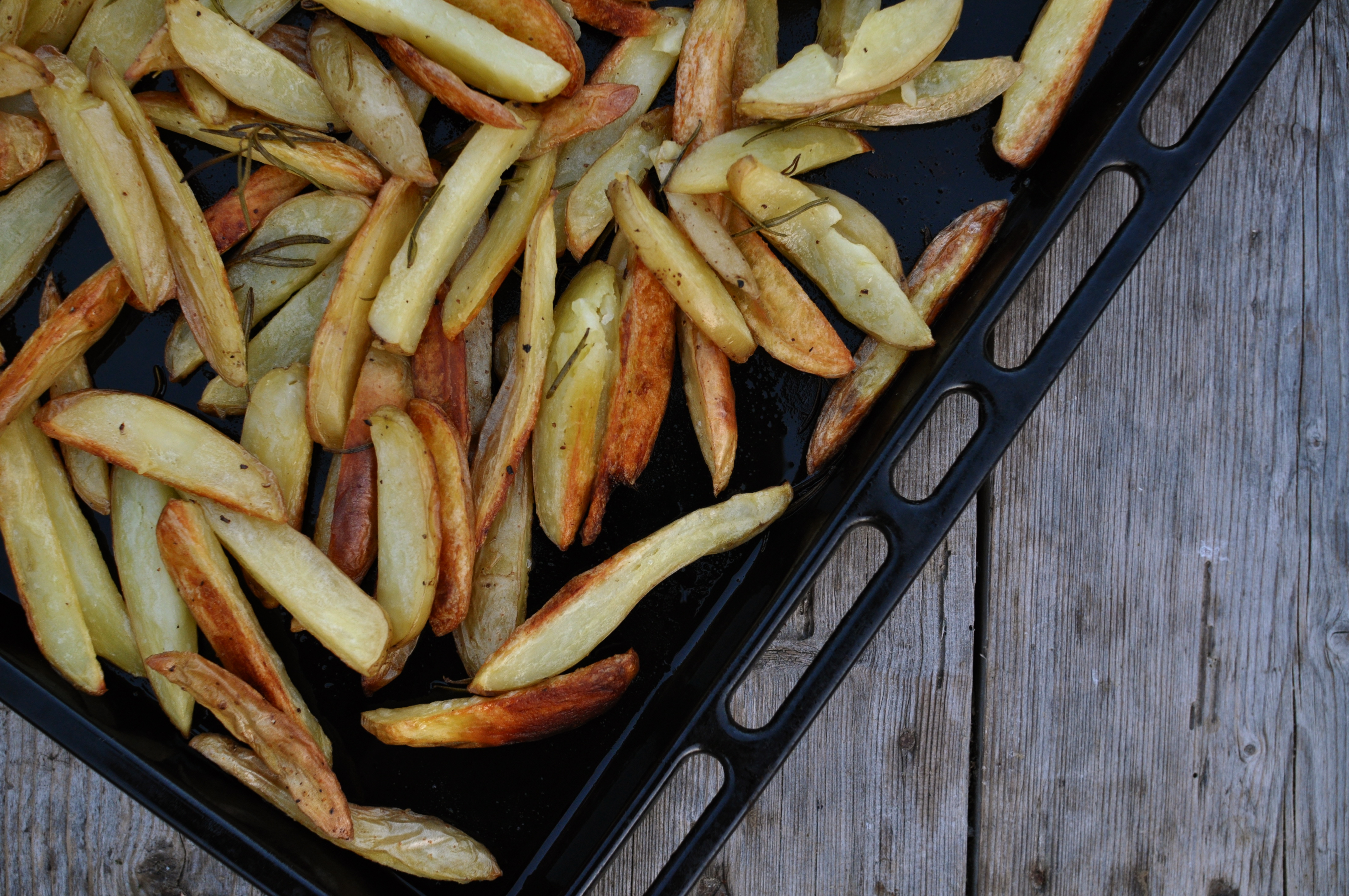
Although we are in Brittany and I don’t believe fries are the traditional Breton accompaniment for mussels, it seems this famous Belgian pairing has anchored itself so steadfastly in our subconscious that anytime I (we) think of mussels, I (we) think fries. So when we prepared mussels the other day, the other half of the meal seemed obvious.

It was the first time I made really good home-baked fries and I think it was thanks to a tip from my sister who suggested starting them low and slow so they would cook through without burning or drying out.

They were great.

***

Potatoes

Good olive oil

Flaky sea salt

Freshly ground black pepper

Rosemary

*

Preheat oven to 300F (150C).

Cut the potatoes in half lengthways, place each half cut side down, and slice into 1/2 inch (1 cm) pieces. Wash the potato pieces in cold water and pat thoroughly dry with a (clean) kitchen towel.

Place the potatoes on a large shallow oven pan. Drizzle generously with olive oil, season with salt, pepper, and sprigs of rosemary. Toss so all the pieces of potato are dressed with the olive oil.

Put in the low oven and cook for about 20 to 25 minutes. When the potatoes seem cooked through, increase the oven temperature to 425F (220C) and bake for another 10 to 15 minutes until gold and crisp.

Check for salt seasoning, adjust, and serve hot.

*

Related posts

In Brittany | Mussels with shallots and white wine

At the market in Brittany | Artichokes

In Brittany | Mussels with shallots and white wine

25 July 2011

I am in France spending a large part of the summer with my family at my sister’s beautiful, old, and very run down farmhouse in northern Brittany.

While New York was smouldering under the heat last week everyone in France complained about the cold, and here, too, temperatures have hovered around 18°C (65°F) and it rains more often than not. But no one complains. Northern Brittany is known for blustery weather and beautiful coastlines, and we’ve been enjoying both.

Food-wise, beyond crêpes and savory buckwheat galettes – Brittany’s most famous culinary exports – the region has fresh fish and seafood in abundance, is famous for artichokes and pink onions, breeds pigs, and bakes far and kouign amann for dessert. This of course being just a cursory list. We’ve been enjoying all of that, too.

But first, mussels.

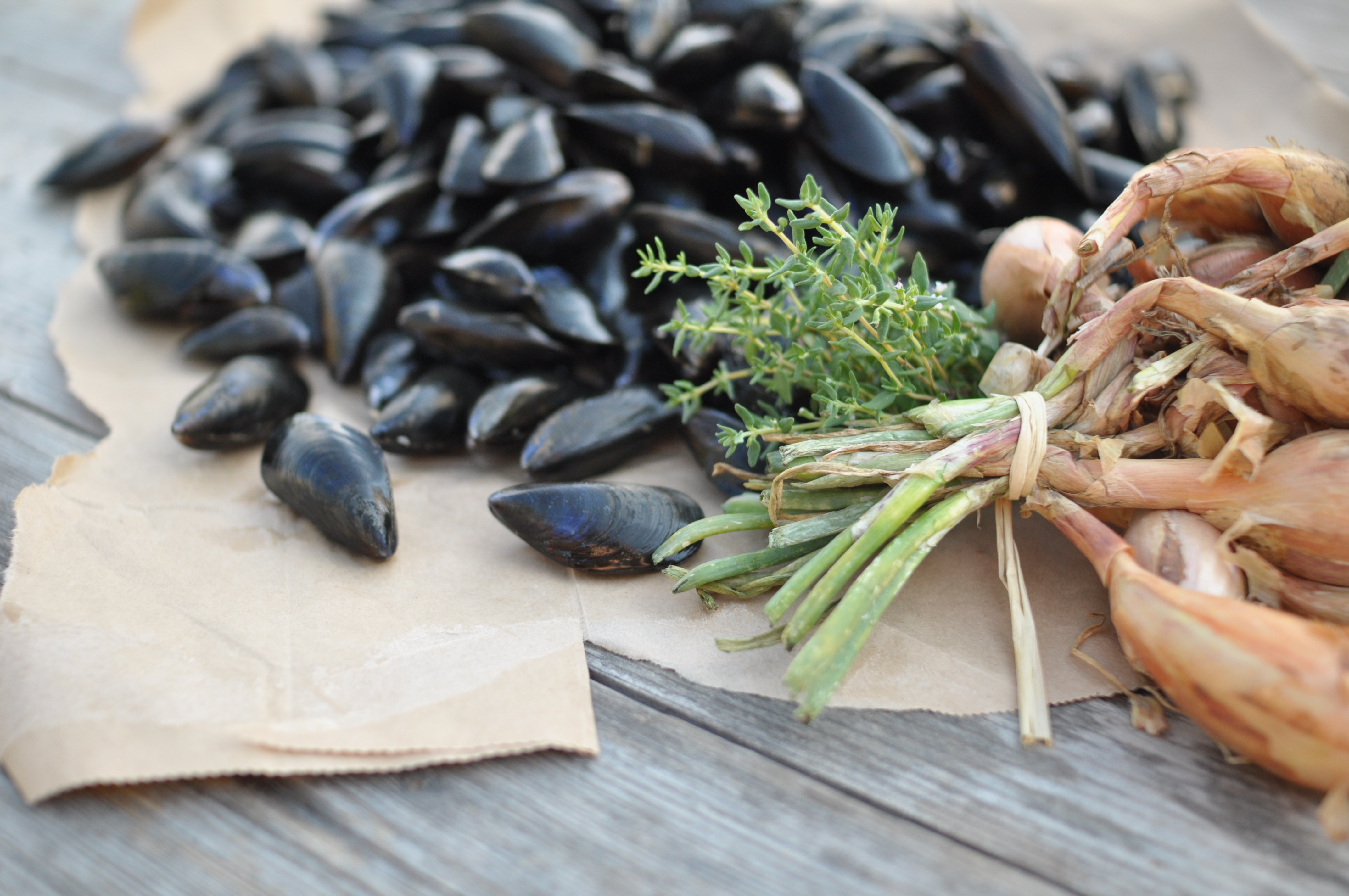
I forget how easy it is to cook mussels so I don’t make them often in New York, but here mussels are not only on every market but also on the beach, and on all of our minds. This is one of the most basic traditional French preparation: moules marinières, or sailor’s mussels, with shallots and wine wine. Add cream (as I do here) and they become ‘moules à la crème.’

Serves 4 as a main dish (count 1 lb of mussels per person)

4 lbs (2 kg) mussels*

4-5 shallots

2 cloves garlic

3 Tbsps butter

Olive oil

3-4 sprigs fresh thyme

2/3 cup (200 ml) crisp white wine such as muscadet

2-3 Tbsps crème fraîche

Freshly ground black pepper

Large bunch flat-leaved parsley

*

Thoroughly scrub the mussels clean, wash them under clear water, and drain.

Peel and thinly dice the shallots. Peel and thinly slice the garlic. Wash and finely chop the parsley and reserve for later.

In a large cooking pot, melt the butter with a dash of olive oil. Add the shallots, and cook until they become translucent. Add the garlic, stir, and cook for another minute. Throw in the sprigs of parsley and stir again to combine the flavors.

The shallots shouldn’t turn brown. As soon as they start to turn golden, pour in the white wine and bring to a boil. Simmer for 4-5 minutes.

Add the mussels, cover with a lid, and turn up the heat. As soon as the lid starts to let off some steam, take the pot off the fire and, firmly, with both hands, shake it with a few gentle jerks in order to turn the mussels inside the pot.

Place the mussels back onto the stove for a few minutes more. Most of the mussels should be open. If not, jerk the mussels again and return to the stove.

Once the mussels are open, transfer them carefully with a straining ladle to a warm pot or bowl for serving.

Place the coking pot with the shallot/wine sauce back onto the fire. Stir in the crème fraîche (I prefer the sauce to become milky and not creamy, but add according to taste), and some pepper.

Pour the very hot sauce over the mussels, sprinkle with lots of parsley, and serve immediately.

*At home, poke breathing holes into the bag of mussels and store in the refrigerator.

*

Related posts

In Brittany | Home baked potato fries

At the market in Brittany | Artichokes