Sunday reading | 29.06.2014

29 June 2014

photo(25)

London in June. There have already been more beautiful days of summer this month than I was ever led to believe were likely to occur here in an entire year. So let me mention two things I’ve learned these past few months: English weather is mild, pleasant, and no matter how much it rains the sun will come out at some point, if only for a minute, every day, usually at dusk. Also, no matter how relentlessly glorious all these lingering June days have been, somehow Londoners will still complain that it is sure to rain on the weekend.

One couldn’t hope for a prettier summer, and here are a few ways to celebrate:

I loved this post by the Wednesday Chef on roasting strawberries. I admit I am one of the uninitiated and have always been wary of cooked strawberries, but this has me convinced and I’ll be sure to buy a few too many overripe strawberries very soon to give it a try.

On the other hand who needs prodding to jump at anything that involves elderflower? Naturally this elderflower and coriander vodka by 101 Cookbooks has me swooning with envy.

I am the first to be overwhelmed by the onslaught of cookbooks; the sheer quantity of great-looking, amazing-sounding cookbooks, by people and restaurants I love. The list is dizzying, and the result is that I haven’t bought one in months. Part of me wants to pick up everything, the other is reminded of the many, little used tomes I have on my shelves. But once in while everything is just right, there is no question: here is a cookbook worth getting. Buvette, one of my favorite restaurants in New York, with beautiful photographs by Gentl and Hyers of Hungry Ghost Food and Travel. Can’t wait.

In the meantime I will, if I may, turn to one of my favorites, right here on Nettle & Quince. Rhubarb ice cream. Simple and spectacular.

Rhubarb rosemary jam

7 June 2014

photo(22)

This is me realizing that jam need not be a well planned out, day-long project. It can be, of course, and should, on occasion, because is there a better way to spend a day than whiling away the hours hunched over bubbling vats of sugared fruit? This is not about those days. This is about how making jam can be an afterthought, as easy as clearing out the fridge before a week-long holiday.

I was the first to consider jam making an incredibly laborious process. Carefully timed trips to the market to grab the last of the season’s fruit at an unbeatable bargain, endless kilos of berries to cut and trim and wash, giant jam pans boiling furiously for hours… I didn’t make jam very often. For one, market vendors in New York don’t usually sell off fruits for a good bargain, even as they pack up to leave  (I’ve tried); second, fruit at home often disappears so quickly I need to hide it to keep it safe (and I have); third, I don’t own a jam pan, giant or otherwise.

So I don’t (didn’t) make much jam. There were exceptions, naturally, few and far between, so noteworthy I usually recorded them, here, and here.

A few years ago my mother gave me Christine Ferber’s book (available only in French). Christine Ferber is a world re-known Frenchwoman from Alsace, widely described as the ‘fée des confitures’ (jam fairy). I’ve never actually eaten from one of her jars, but I have read so many tantalizing descriptions that I feel I might have. Taken literally, her technique is quite time-consuming, but using her inspiration, some latitude, and a little improvisation (she would be appalled), I’ve realized that making jam can actually fit quite snugly into my life.

Key is that the process in divided into two parts. In the evening, prep the fruit, mix it with sugar and lemon juice, and let it sit overnight in the refrigerator. The next day, cook the jam. Chances are, it’s easier to find 15 quick minutes in the evening and another 45 of mostly cooking time the next day, than scheduling a full long slot for the entire process.

Emboldened by this realization, last week I made jam, the easiest thing I found to save a few remaining bunches of rhubarb.

Rhubarb jam recipe

1 kg rhubarb

1 kg sugar

Juice from one lemon

Few sprigs rosemary

Wash the rhubarb, trim the ends, and chop the stalks into 1/2 inch (1 cm) pieces.

In a saucepan, mix the rhubarb, sugar, and lemon juice.

Let sit overnight in the refrigerator.

The next morning, cook the jam. Bring to a boil over medium heat and cook for approximately 30 minutes. At first it will bubble furiously, but as the jam jells it thickens, the bubbles slow down and burst at a more leisurely pace. To check whether the juice has “gelled,” take out a small spoonful and let it cool. Once cold, the juice should have thickened in the spoon, and when you try to pour it the drip is not liquid but heavy, as though it was sticking to the spoon. Cook longer if necessary and check again.

Meanwhile, sterilize the jars in boiling water for 5 to 10 minutes.

Once the jam is ready, stir in the rosemary to steep for about 5 minutes. Remove. Pour into sterilized jars and close tightly.

Jam is best stored for a few weeks (and up to a year at least) before eating.


Eating out | All the way across town to The Brackenbury

22 May 2014

photo(16)

I’d be hard pressed to find a restaurant less conveniently located from where I live. Try as I may, I couldn’t figure out a way to get there in less than an hour. Miraculously, the Picadilly line would take me all the way; I guess I could find less conveniently located places, after all.

This is something one learns quickly about London. As any experienced Londoner readily points out, the city is huge, travel is inconvenient and slow. Choose your neighborhood well, because that’s where your life will unfold, it’s where you’ll stay. I was determined not to get trapped by this insularism, at least hold out as long as I can.

I might admit that the friend who suggested The Brackenbury lives much closer to the restaurant. I could have lobbied for a more practical choice, somewhere half way; but I know her well, and I trust her hunch. This was the place she’s really wanted to try. And anyway, on principle, I am game.

On the way toward the tube I began questioning whether being so open minded really is such a good thing; after a good 40 minutes on the train I began grumbling that this place better be very good indeed; partially lost and sidling into deserted dimly lit streets I concluded this probably wasn’t such a great idea.

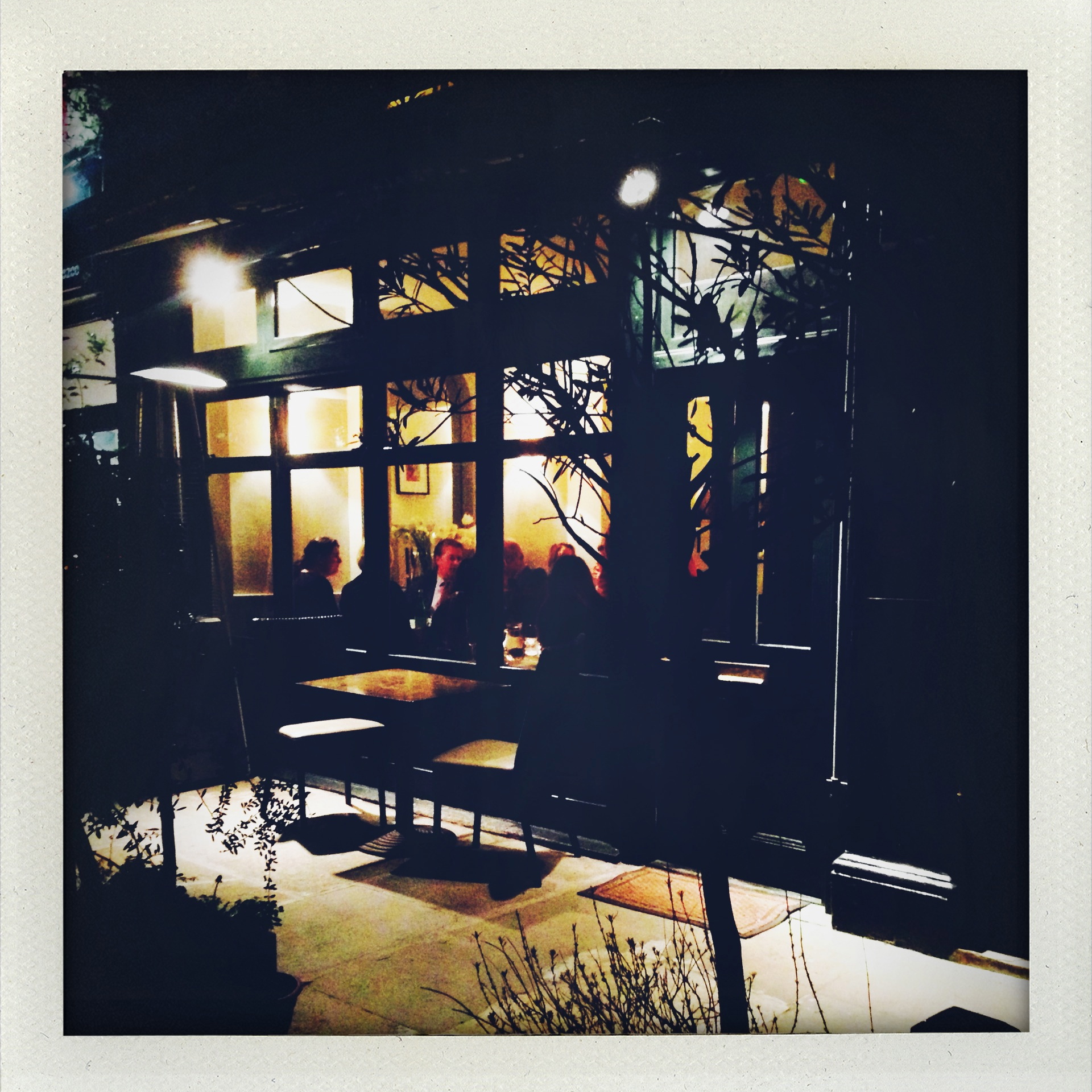
Finally I arrived. From the street it looked bustling and warm and inviting. I relaxed.

The Brackenbury feels very much like a neighborhood restaurant, and resolutely untrendy. The space is a bit drab. With carpeted floors, comfortable seating, and starched tables arranged in nooks up and down steps in adjoined rooms that resemble an expanded home.

Most importantly, the food is great. The calf’s liver was probably the best I’ve ever eaten; perfect texture, cooked beautifully, impeccably accompanied by the most delicious polenta and kale. The starter was a simple salad of bitter lettuces whose name I can’t recall and it was very good (though when my friend ordered the same later as a main course it was a bit sloppy and overdressed). For dessert there was sweet, tart, ethereal rhubarb Eton mess.

Simple, and one of the very good restaurant meals I’ve had in a while.

Would I try to convince someone to trek all the way across town, late at night, for dinner at the Brackenbury? Perhaps not. But if I lived a bit closer I’d go again in a heartbeat.

The Brackenbury

Open for lunch Fri-Sun 2.00-3.00 pm
Dinner Tues-Sat 7.00 -10pm
Closed Monday

http://brackenburyrestaurant.co.uk/

A good steak with anchovy and herb butters and shallot confit

15 May 2014

photo(18)

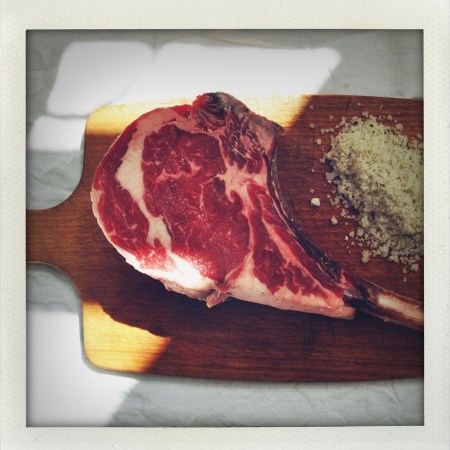
Key, of course, is the quality of the meat. Beef should be grass-fed and dry-aged. To say I choose my homes according to their proximity to a good butcher is exaggerated, but we’ve been lucky for a while now, with, for years, excellent meat just a few blocks away. There was Ottomanelli in the West Village, Harlem Shambles uptown, and, here in London, we live close to another great butcher, Godfreys.

The cut is important, too. Meat on the bone is typically more flavorful, and thick cuts (an inch and a half at least) are much easier to cook to perfection: very brown and crisp on the outside but perfectly rare in the center.

There are debates over whether steaks should be seasoned early or whether salt left on the meat absorbs some of the moisture. I’ve decided to settle into the camp that favors early seasoning, allowing the salt to seep into the cut. Since meat should be brought to room temperature before cooking, I take the steaks out of the refrigerator about one hour before dinner, season them generously with coarse salt and freshly ground pepper, and let them sit a while.

It is useless to try to give a cooking time. Every steak is different, depending on the cut, its thickness, its initial temperature. I’ve found that a cast-iron skillet works best, and it should be very hot before the meat is added. A combination of butter and olive oil in the pan is good, as the butter is delicious and won’t burn as quickly together with the olive oil. Ideally one could add herbs to the rendered fat and baste the steak as it cooks.

Sear the meat on very high heat, turning it over once the first side is evenly brown. The steak is perfect when the outside is brown and crisp, like a crust, and the meat has contracted, but just barely. Not too much or it is overcooked.

Like all meat, steak needs to relax a little before being cut; about ten minutes, just the time needed to get the rest of the meal on the table.

Serve the steak with the butters, shallot confit, and some strong mustard.
IMG_4120

IMG_4119

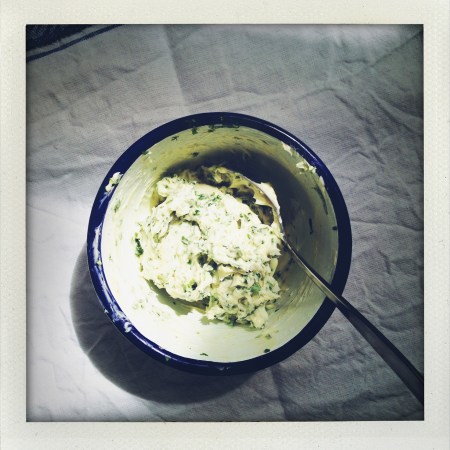
Herb and anchovy butter
These must be made a least an hour ahead, and easily the day before.
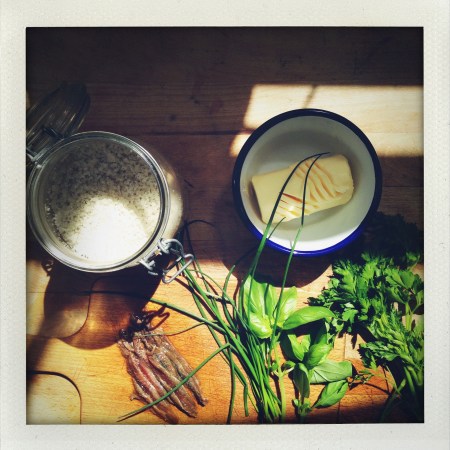
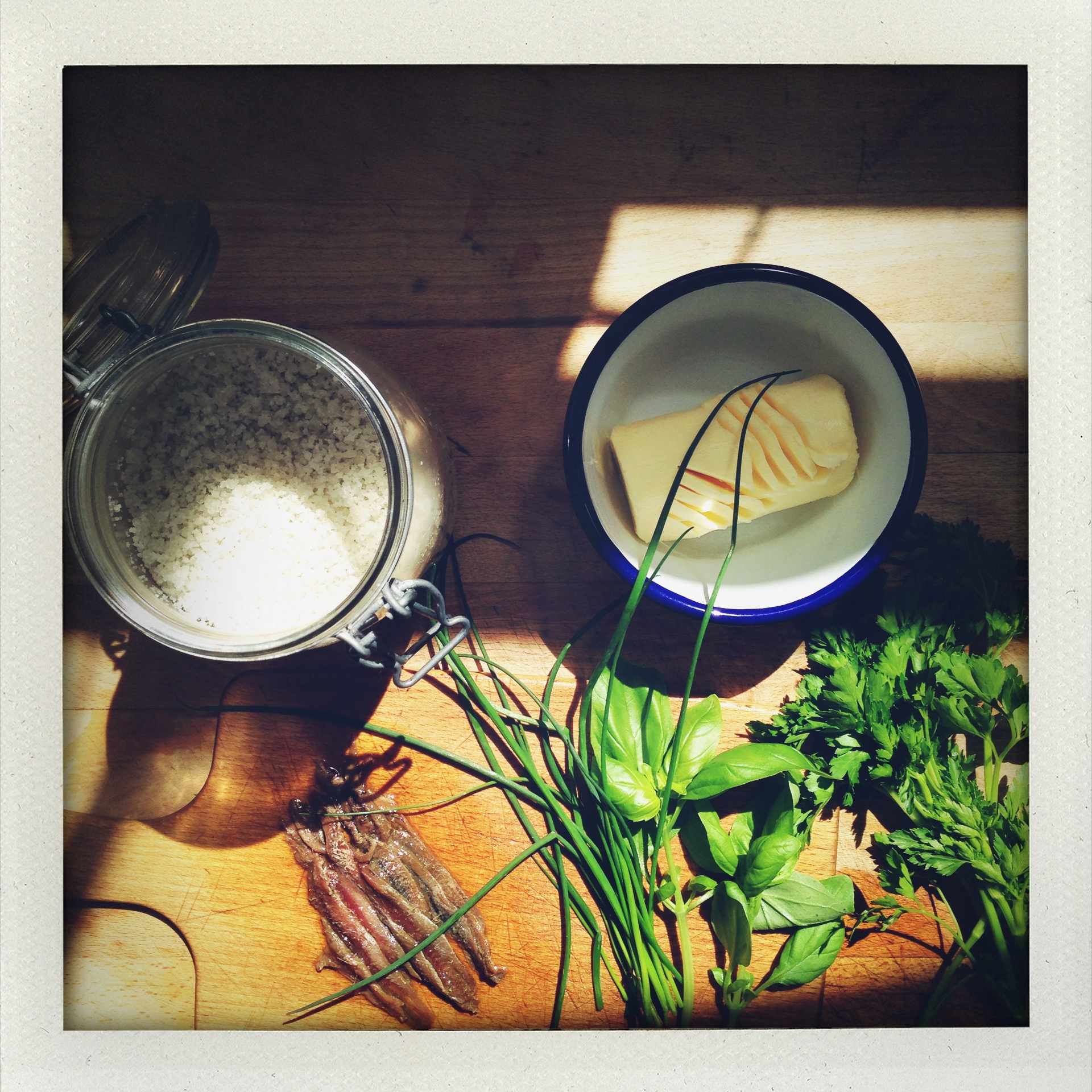
I make one butter with anchovies, parsley, and basil, and the other with just herbs and sea salt.

250g good unsalted butter

A generous handful of parsley

Small bunches each of basil and chives

A dozen anchovies in oil

1/2 teaspoon coarse grey sea salt

Cut the butter into two equal parts, place each in a small bowl, and let sit at room temperature until it becomes soft and easy to work with (probably about an hour).

Wash and shake the herbs dry. Pick the parsley and basil leaves from the stems.

Separate the herbs into two groups: one with half the parsley and a few basil leaves, the other with approximately equal amounts of parsley, basil, and chives.

Finely chop each group of herbs.

Drain as much oil from the anchovies as possible, and chop finely.

Using a fork, mix one of the softened butter with the anchovies, parsley, basil; the other with the parsley, basil, and chives, and the salt. Mix each well until the butter is homogeneously speckled with the herbs.

Transfer each piece of butter into a small serving bowl, even out the surface, and let cool in the refrigerator for at least an hour. The butter will keep for a while, though it will be best for a couple of days.

IMG_4134

Shallot confit

3-4 large shallots

Olive oil

Small sprig fresh thyme

Small sprig fresh rosemary

One bay leaf

Sea salt

Peel and slice the shallots into thin-ish slices. (The shallots can be cut either crosswise or lengthwise.)

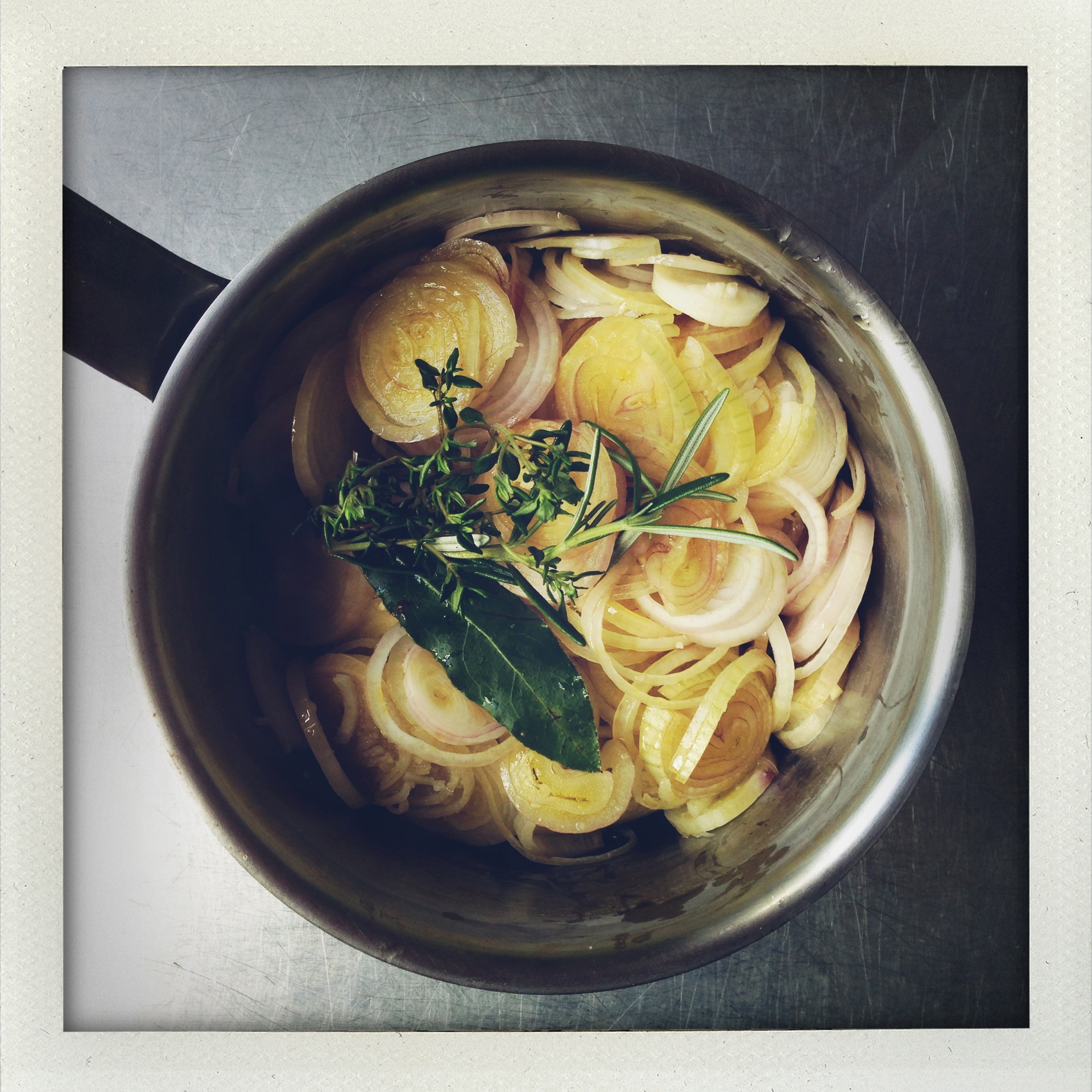
Place in a very small saucepan with enough olive oil to comfortably blanket the bottom of the pan. Add the herbs and a good pinch of salt.

Cook on very low heat, staying close and stirring regularly, until the shallots are a deep golden. **In case the bottom does burn, quickly transfer the rest of the shallots to a different pan so the burnt flavor doesn’t tarnish the confit.**

Let cool a little and remove the herb stalks before serving.

The confit can be made ahead and kept in the refrigerator but must be slightly reheated before serving, just beyond the point where the oil isn’t congealed to awaken the flavors.

Green asparagus salad with parmesan shavings

30 April 2014

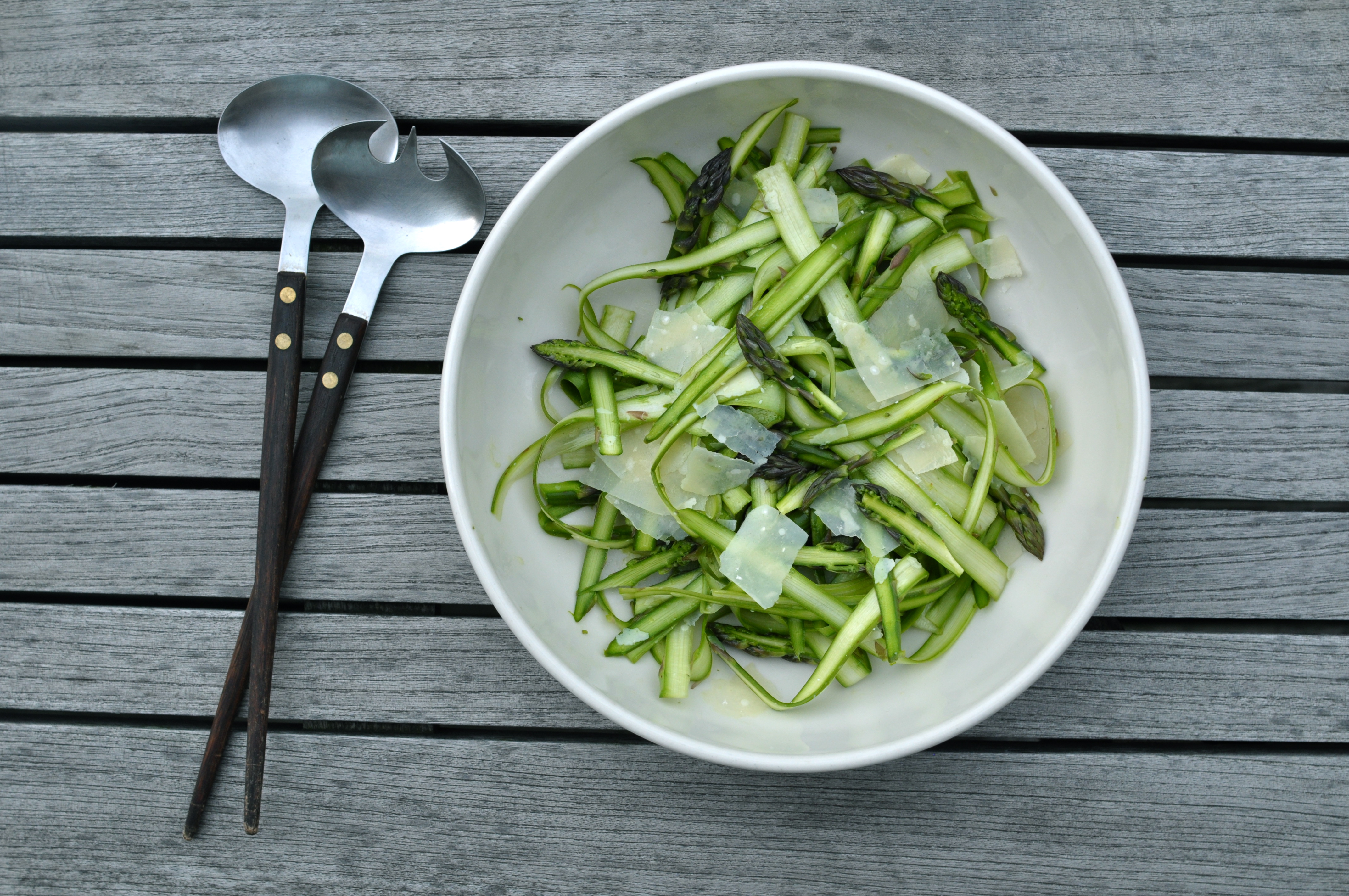
DSC_1286

When you grow up in France or Germany, asparagus is invariably white, steamed or gently boiled, and served with some variant of Hollandaise sauce. When you move elsewhere, say to New York, your view of the world will likely deepen, expand, diversify; you will notice that asparagus can also be green.

You will learn that asparagus is, in fact, always green, that white asparagus is manually ‘blanched,’ hidden in little mounds of earth as it grows to prevent the sun from wielding its photosynthetic magic. You will discover that green asparagus absolutely should be grilled on a barbecue as soon the weather permits, or braised with a little acidity in the oven on a wintry spring evening. And, indispensably, green asparagus must also be eaten raw, in a simple salad, just like this.

DSC_1348

The tricky aspect is slicing the asparagus very thinly, lengthwise, so a good vegetable peeler is a must. My personal favorite is this kind.

Green asparagus, it should be very fresh and taut

Extra virgin olive oil

Freshly squeezed lemon juice

Good quality balsamic vinegar

Sea salt

Freshly ground black pepper

Chunk of parmiggiano reggiano cheese

Wash the asparagus. With a knife, cut off the tough end of the stalks (about 1 inch) and discard.

Cut off the asparagus heads and slice these lengthwise in halves or thirds (depending how thick they are). For the stalks, use the vegetable peeler to shave them into long strands, beginning at the thicker end.

In a serving bowl, toss the asparagus with some olive oil, lemon juice, a few drops balsamic vinegar, and salt and pepper.

Add coarse shavings of parmiggiano reggiano, and serve.