Posts Tagged ‘vegetarian’

Fettucini with immediate tomato sauce

4 October 2012

The last of the summer’s ripe tomatoes may be a little soft, a little blemished, they may not warrant much attention as heads will be turned by the arrival of bright yellow squash and orange pumpkins. What these tomatoes want is this sauce exactly. It is so quick, so easy that it will barely distract from the anticipation of slow roasts and apple pies. It is so good that those blemished tomatoes may soon be missed, as the creeping cold leaves heaps of unripened green tomatoes in its wake, with no better prospect but to be transfigured into chutney.

The sauce sort of made itself one night, and I was taken aback by how easy it was to create such a good sauce in so little time. I’d always supposed that good tomato sauce needs to simmer gently and reduce patiently. On that evening there was no time and, temptingly, in the kitchen, some good fettucini and a few roma tomatoes.

All I did was cut the tomatoes lengthwise in sixths, slice a few garlic cloves, heat some olive oil in a large skillet, throw in the garlic for barely a minute, add the tomatoes, and wait until most of the juice had evaporated and the tomatoes hinged on golden and in some places brown. It took perhaps 10 minutes, just about the time to boil the pasta.

***

For two

5 ripe tomatoes

2 cloves garlic

Good olive oil

Sea salt and freshly ground black pepper

200 g good fettucini

Really good olive oil

Parmigiano-reggiano

Few basil leaves

*

Bring a large pot of heavily salted water to boil for the pasta.

Cut tomatoes in half lengthwise then in half in thirds. Peel and thinly slice the garlic.

Carefully slide in the fettucini. Cook in a heavy boil.

Heat a generous amount of olive oil in a large heavy skillet. **The skillet should be large enough so the tomatoes are in one layer only.** Cook the garlic for barely a minute over medium to high heat, until translucent, then add the tomatoes. Season generously with salt and pepper. Cook the tomatoes over high heat until a lot of the juice has evaporated and they start turning brown.

Start checking the pasta regularly after about 8 minutes (by carefully taking one out and eating it). Drain quickly in a colander as soon as the pasta is just al dente (or to desired consistency) and return immediately to the pot used for boiling the pasta (one could use another pot but it’s much simpler this way). **It is important not to overdrain the pasta. If it is too dry it will become sticky.** Quickly drizzle generously with good olive oil so the pasta doesn’t stick.

Transfer the pasta to individual bowls. Spoon over the tomatoes, add a drizzle of very good olive oil, tear up a few leaves of basil on each bowl, and grate some parmigiano to finish.

Children’s dinner | The ‘I wish it was cauliflower’ (but it’s not quite the season!) zucchini gratin

20 September 2012

Every morning I make lunch for Leo and Balthasar to take to school. When this began I thought I would use the opportunity to be terribly creative; in fact it has become the least inspired aspect of my cooking life. One day I make sandwiches, one day pasta. I alternate. I know the boys will eat this. The problem with school lunches is that I am not there, at the end of the table, frowning, admonishing, and — yes — forcing them to finish their grilled mackerel and ratatouille.

The children eat many things, and, if I may, I don’t think it’s because ‘we’ve been lucky’ but because I’ve made it an excruciating. daily. struggle. But not at school. At first I was just happy that they finished their meal; now I’ve become stuck in this pasta/sandwich routine. I am mindful of what goes into the lunchbox, of course, my mother‘s ever knowledgeable advice always chiming in my ears. But I leave the really good food, the fun food, and the mealtime fights for the evenings.

It seems to have payed off. Leo and Balthasar can be coaxed into eating practically anything; Louise, who is 2, is still in a tug of war. Some things need a bit more prodding, and, unhelpfully, it happens that onetime hits suddenly misfire. But there is some predictability. Naturally oftentimes I have little more patience than to throw some frozen peas into boiling water, serve that with a sunnyside egg, and call it dinner; but I know that practically anything that is diligently prepared, well seasoned, and cooked to the standards of something I would serve guests will be polished off.

Gratin for example. Actually, I don’t think I’ve ever made gratin for guests. But nonetheless, gratin is a great example.

It started out with cauliflower. Winter is not the most propitious season to get children excited about vegetables, and at some point I had to find new ways to prepare cauliflower. I personally like cauliflower best raw, but one day I decided it was time to tackle gratin. I say ‘tackle’ because I was intimidated by béchamel sauce. Many years ago on a skiing holiday I volunteered to make béchamel sauce. It was for lasagna, I think. I knew the basic ingredients and felt confident that, by virtue of being French, I was the person best qualified for the job. All I managed to do was create a giant, ever expanding monster of butter, flour, and milk, which probably wasn’t even any good. As it happened, I had to suffer some lessons in béchamel making from Thomas, who made copious fun of me. This was a very long time ago.

I’ve since gained some confidence in the kitchen, so a while ago I decided to tackle béchamel again to make cauliflower gratin, which, come to think of it, is now probably my favorite way of eating cauliflower.

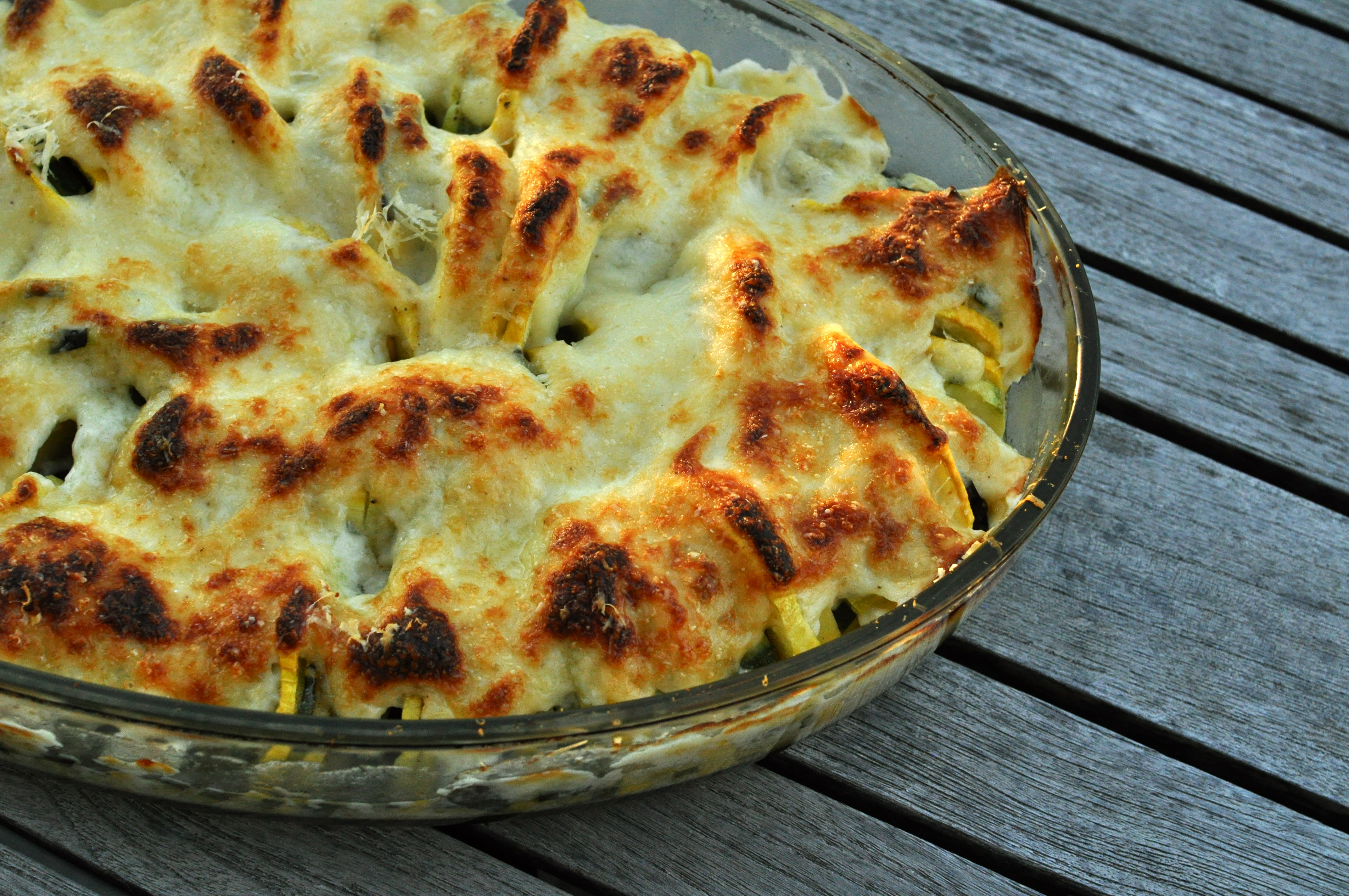
The punchline, of course, is that children love gratin. They also love anything that’s been simmered or stewed with onions, garlic, herbs, spices. They love ratatouille (they do!), they also love risotto (but weeknight dinners rarely enjoy the leisure of 45 minutes of undivided attention). So when I made this squash and zucchini gratin the other day, despite slight initial dismay that it wasn’t cauliflower, the children ate heartily, and asked for more.

***

Gratin is easy to make once the béchamel demon has been tamed. Ideally I’d make simple broiled or pan fried fish with this gratin, since fish and zucchini go so well together. On this particular day I was unprepared and just had some leftover rice, fried to crispiness in olive oil. That was good too.

Quantities are for a 9 x 13 inches (23 x 33 cm) oval dish.

6 medium-sized zucchini and/or yellow squash

Lots of basil leaves

Sea salt

Freshly ground black pepper

Good olive oil

About 3 1/2 cups (850 ml) béchamel sauce (this deserves its very own post and will be up soon, but in the meantime look here)

Freshly grated parmesan

*

Preheat oven to 375°F (190°C)

Wash and thinly slice the zucchini crosswise (into disks) approximately 1/4 inch (1/2 cm) thick. Wash the basil leaves.

Place the zucchini slices upright in the dish. Intersperse a basil leaf every 4 or 5 slices. Sprinkle with salt and pepper and pour a very thin drizzle of olive oil over the zucchini.

Pour the béchamel sauce evenly over the zucchini and grate lots of parmesan on top.

Bake the gratin for about 45 minutes, until nicely brown and bubbling. (Placing the rack in the upper half of the oven will help the gratin get a good color.)

*

Related posts

Children’s dinner | Cowboy food

Children’s dinner | Fake rabbit in the vegetable garden

Eating out | Shojin zen at Kajitsu

19 April 2012

When a couple of months ago I read that executive chef Masato Nishihara was leaving the vegetarian Shojin restaurant Kajitsu at the end of March I immediately booked a table.

I had wanted to go for a few years, ever since I’d read a dithyrambic comment by David Chang. Kajitsu had languished all this time on a putative restaurant wish list but the occasion never arose, or was never provoked. Suddenly there was some urgency.

Then, as these things sometimes will, it happened that on that long awaited Wednesday I was in the hospital with my son, who had just been operated for a nasty case of ruptured appendicitis (doctor’s words). Of course, I could have left Leo in his morphine-induced half-consciousness in the expert hands of the hospital staff, but my mind wasn’t exactly with it. So with great dismay I cancelled the reservation. I must have apologized half a dozen times, over-emphasizing how sorry I was to have to reschedule. Of course, I was sorry less about their booking concerns than my lapsed opportunity.

And when, having emerged from hospital limbo nearly a week later, I made a new reservation, I didn’t pay attention to the date. Unsuspecting last week Thomas and I went to Kajitsu.

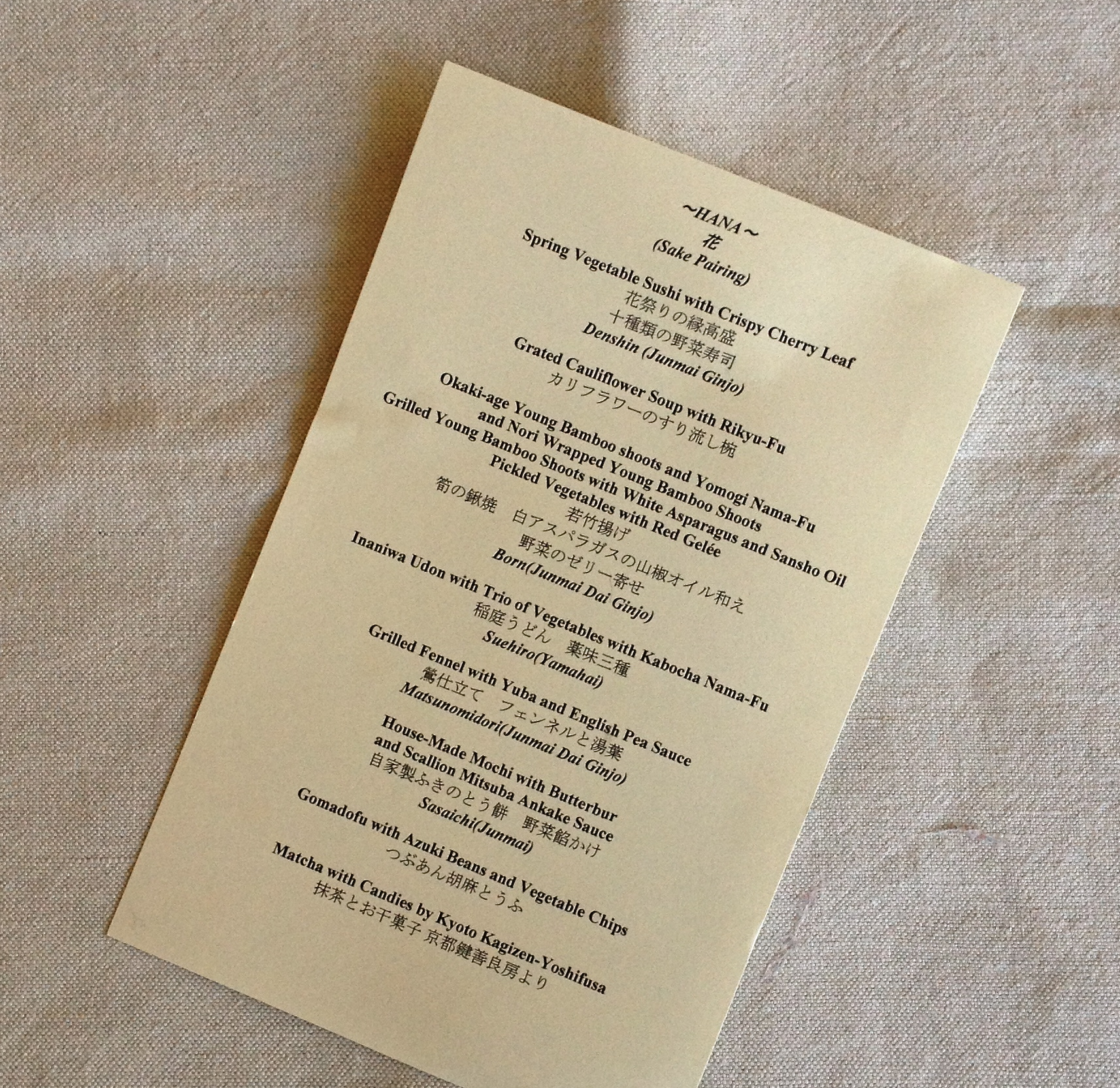
Kajitsu lives in a half-basement space that first intrigues by its clever impression of spaciousness despite the low ceilings, and its entirely bare dull ochre walls dusted with the odd speck of hemp. The space is divided into separate areas each with just one or two tables. We sat at the bar. And so the journey began into heretofore untraveled Shojin cuisine territory. (I didn’t take a picture but I kept the menu, if you can make much sense of it. I couldn’t.)

Every dish was surprising. Each element felt very pure, in a restrained way, and I couldn’t help but wonder whether my palate, used to bolder seasonings of garlic, herbs, vinegar, especially with vegetables, might be numb to the subtleties of this deliberate cuisine. Because although the meal was entirely enjoyable — and not least for the many great sakes paired with the food which ranged from mellow and practically sweet to almost peaty — it wasn’t wholly delicious to me.

Later as I began writing I realized that we were already in April; we had been feasted by the new chef Ryota Ueshima; Masato Nishihara had moved on. So now I can’t help but wonder whether Nishihara’s cuisine would have struck that spark of deliciousness. I hope I will not miss the next opportunity to find out.

Although I’ve not been craving the food and I am not exactly restless to go back, Kajitsu was a revelation. Would I go now had I never been? Definitely.

Kajitsu

414 East 9th St (betw. 1st Ave. & Ave. A)
New York, NY 10009

212-228-4873

Open Tues-Sun 5.30pm-10.00pm, closed Monday

www.kajitsu.com

*

Related posts

Eating out | Fall soba noodles at Sobakoh

Eating out | Thrice-cooked fries (but not only) at the Breslin

Eating out | Brunch at Blaue Gans

Parsnip and butternut squash soup with sage

14 December 2011

It’s about how easy it is to make soup, or rather — and I may be the one here most surprised at reading this — how easy it is to make soup with broth, when no broth is around.

I’ve mentioned before how I like soups that don’t require the use of broth, and I have already surreptitiously written about at least four soups that don’t require any broth because — at the risk of repeating myself — I’d rather not use store-bought broth if I can help it, and chicken broth doesn’t usually last long in this house. But somehow I had disregarded vegetable broth.

This soup has taught me that I can make great vegetable broth at a moment’s notice, pretty much simultaneously to making the soup.

All the broth requires is a few vegetables roughly chopped into chunks, thrown into a large pot, and generously covered with water. This takes no time at all. Then as the broth simmers away happily on its own, there is plenty of time to to pour a glass of wine, peel and chop the vegetables destined for the soup, and sweat them in some oil for a little while. By the time the broth needs to be poured in, it is ready.

***

The broth

The vegetables and quantities below are indications. I used rutabaga for the first time in this broth and loved the depth of flavor, but it’s by no need obligatory.

4 celery ribs

2 medium carrots

2 medium onions

1 medium rutabaga

Olive oil

Few sprigs parsley

2 bay leaves

3 quarts (3 liters) water

Trim the celery stalks and wash off the dirt; trim and wash the carrots. Cut the vegetables roughly into 1/2 inch (1 cm) pieces. Wash and trim the rutabaga and cut into pieces approximately the same size. Peel the onions and cut each half in three.

In a large saucepan, heat the oil, add the vegetables, and cook over medium heat until they begin to soften, about 5 to 10 minutes.

Add the parsley and bay leaves, cover with 3 quarts (3 liters) water, and bring to a boil. Reduce the heat and simmer for about 40 minutes, skimming off the foam as it rises.

Drain the broth through a fine mesh sieve before using.

*

The soup

The soup should be very creamy, though it contains no cream (in fact it’s vegan unless using crème fraîche as garnish). The key is to blend it thoroughly (a good 4 to 5 minutes) until it becomes perfectly smooth and velvety.

It is liberally adapted from the pumpkin, butternut squash, and parsnip soup in The New Low-Country Cooking by Marvin Woods.

2 medium onions

2 carrots

3 leeks

6 parsnips

1/2 butternut squash

Olive oil

2 quarts (2 liters) vegetable broth (recipe above)

Small handful fresh sage leaves

Sea salt, freshly ground black pepper

Freshly grated nutmeg

Crème fraîche, pumpkin seed oil, and more sage leaves to garnish (either one of these or all three – optional)

*

Peel, wash, and coarsely chop the onions, carrots, leeks, parsnips, and the butternut squash.

In a large soup pot, heat enough olive oil to cover the bottom of the pot. Add the onions and cook until they softens, stirring occasionally – about 10 minutes. Then add the leeks and the carrots. Cook, stirring occasionally, about 10 minutes longer. Add the parsnips for another 5 minutes, then the butternut squash.

Add enough hot vegetable broth to cover the vegetables by a good inch. Once the soup simmers, cook for about 30 to 40 minutes, until all the vegetables are soft.

Finely chop the sage leaves.

In batches, scoop the vegetables and most of the broth as well as the sage into a food processor or blender (fill it up to only about 2/3 and hold the lid down tightly, or the steam released will make it pop up). **Do not pour in all the broth with the vegetables, keep some to adjust the consistency of the soup once everything is blended.**

Season with salt, pepper, and a little freshly grated nutmeg.

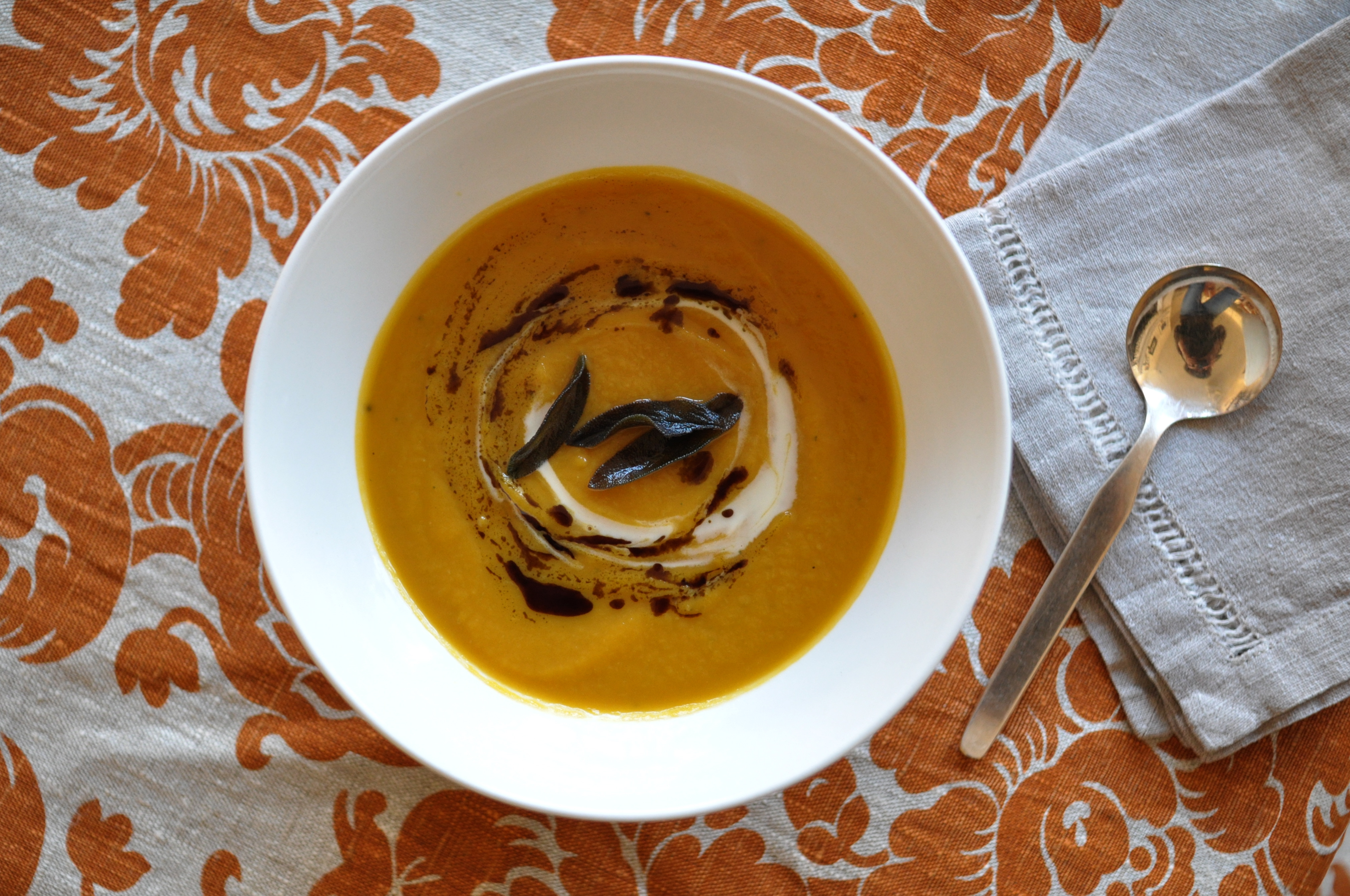
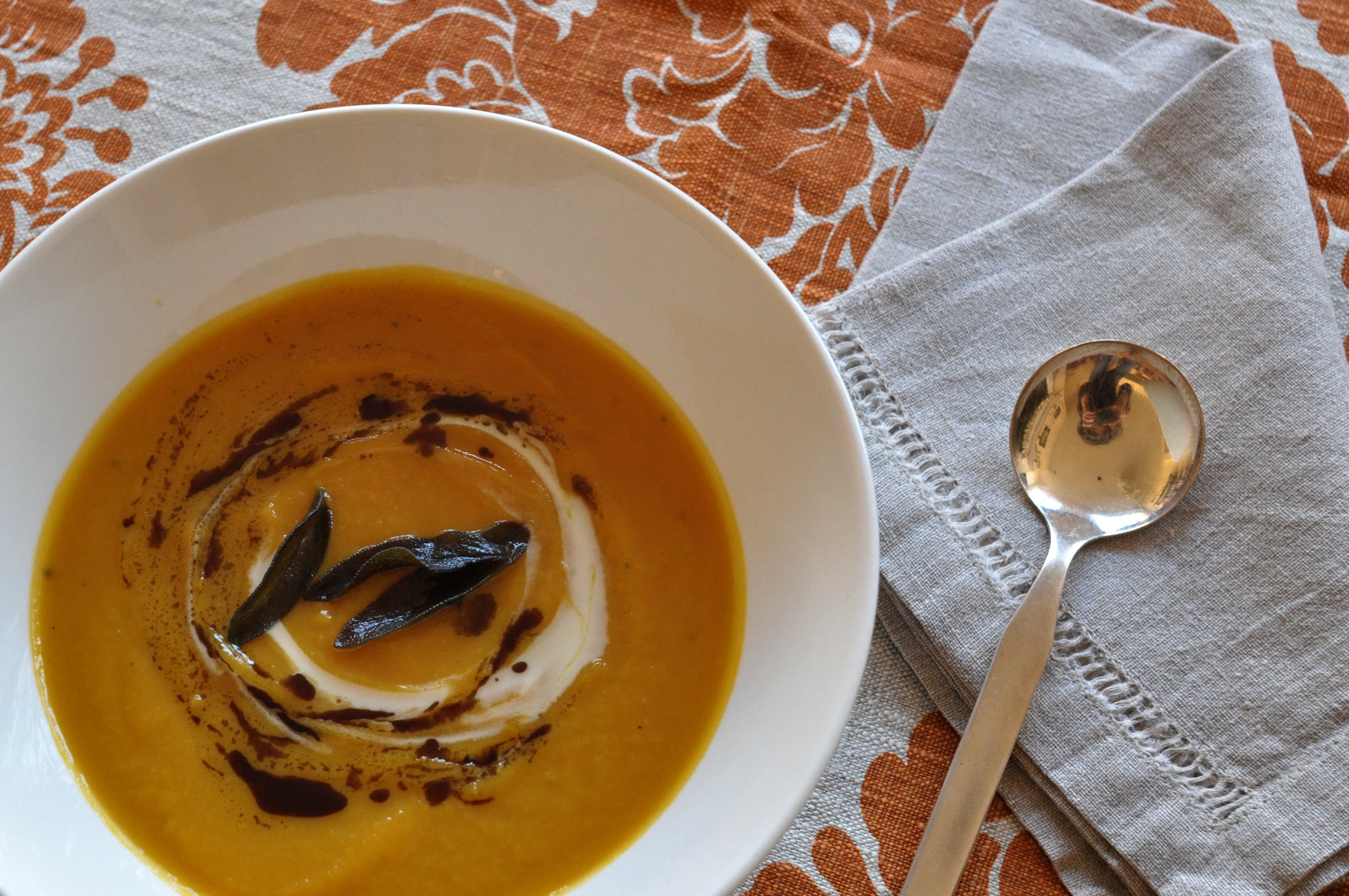
Serve garnished with crème fraîche and pumpkin seed oil, and a few sage leaves fried for 1 or 2 minutes in a little olive oil.

*

Related posts

Pumpkin leek soup

Cream of cauliflower soup with salmon roe

Happy New Year (Lentil soup with cumin)

The many dessert of Thanksgiving (Best award-winning pumpkin pie)

Cream of cauliflower soup with salmon roe

17 November 2011

The problem was, I couldn’t remember exactly how I had made this soup. I knew there was no milk or cream and no broth — no adulterating ingredient to distract from the delicate taste of the cauliflower. I looked in a dozen cookbooks most likely to have given me inspiration, but every recipe I found had milk, or cream. I was hesitant about the base: just onions and cauliflower, was that really it?

Then fortuitously, on 27 October, Mary Gorman-McAdams wrote her weekly column on TheKitchn about pairing wine with soup. In her column she mentions this very cauliflower soup, and solved my conundrum — the base is leeks, not onions.

This is a very simple soup; the salmon roe makes it sing. We served it with Chablis. Thanks, Mary.

***

Serves 6

4 leeks

8 Tbsps butter

2 small heads cauliflower

Sea salt

Freshly ground white pepper

A pinch of freshly grated nutmeg

6 small spoonfuls of salmon roe

***

Remove and discard the leeks’ tough outer leaves, then cut the leeks into thin slices. Wash well in cold water to remove any grit, and drain.

In a soup pot, melt 4 tablespoons of butter. Add the sliced leeks. Season with sea salt. Cook the leeks until soft being careful that they don’t begin to brown.

Meanwhile, cut the cauliflower into florets and wash in cold water. Add to leeks. Add 4 tablespoons of butter cut into small pieces. Let the butter fall through cauliflower and melt. Add just enough water to cover the cauliflower, and cook until the cauliflower is soft. About 20-25 minutes. **Overcooking gives the  cauliflower a strong cabbagy smell, so it is essential not to overcook it, but the cauliflower has to be soft enough to blend into a smooth soup without any hard gritty bits. As soon as a knife cuts through the stem of the cauliflower florets easily, it is ready.**

As soon as the cauliflower is cooked, remove from heat. Blend in batches (it is important not to fill the blender or food processor — it shouldn’t be filled more than up to about a third). Blend thoroughly until the soup is silky smooth. Leave out some of the liquid to be able to adjust the density of the soup.

Taste and adjust the seasoning with salt, pepper, and a restrained pinch of nutmeg.

Garnish with a spoonful of salmon roe added at the very last minute.

*

Related posts

Pumpkin leek soup

Lentil soup with cumin