Archive for February, 2022

Student food (or weeknight meal) | Chicken and broccoli

28 February 2022

This is one of my favourite weeknight meals, so good and very quick to make, but I’m placing it in the ‘student food‘ category because Leo, who is currently at university, immediately asked me how to make it when he saw a picture I’d posted on instagram. Laggard that I am — I was on holiday after all — it took me a few weeks to send the recipe, in a stream of whatsapp messages, and I am happy to report that the method has already been duly tested and approved.

Here it is, all in one, more easily accessible hopefully than those bits and pieces of a conversation.

Chicken and broccoli recipe
Note: I actually use 2 different types of soya sauce — ‘light soya sauce’ which is quite salty and good to use instead of salt and tamari which is dark (but not the same as ‘dark soy sauce’) and has a deeper taste.

Recipe for 2:
200g tenderstem broccoli (or broccoli which is cheaper)
2 boneless chicken thighs (or breasts, but thighs are juicier)
One 1/2-thumb-size piece of fresh ginger
2 garlic cloves
Oil (any vegetable oil works)
Soya sauce
Rice wine vinegar
Sesame seeds

Trim off the stem ends of the broccoli. If using regular broccoli rather than tenderstem, cut it into small florets. Wash it in cold water.

To blanch the broccoli (optional but better): Put some salted water to boil in a saucepan (like for pasta). Once the water boils, cook the broccoli for just 1 to 2 minutes, then drain the water and add lots of very cold water from the tap to cool off the broccoli quickly. Drain.

Cut the chicken into chunks.

Peel and cut the ginger into matchsticks (=> first into thin slices, then each slice into sticks)
Peel and finely chop the garlic.

Heat the frying pan well, add a little oil. Put in the pieces of chicken and fry on high heat for about three to five minutes until they are nice and brown. Stir occasionally but not too often or they won’t brown.

Now pour some soya sauce and rice vinegar into the pan, about 1 to 2 tablespoons of each, and stir everything together. Add the broccoli. Cook for a few minutes more. =>> If you didn’t blanch the broccoli this will take a few minutes longer.

Move the pieces of chicken and broccoli to one side of the pan to make a bit of space, add a little bit of oil, and fry the ginger and garlic just for a minute (be careful that the garlic doesn’t burn, or it will become bitter).
Stir everything together.

Taste. Add soy sauce and vinegar if you think it needs it.

Sprinkle some sesame seeds.

That’s it! 💚

Vin d’orange

2 February 2022

Making apéritif alcohol infusions isn’t the peak or culmination of proficiency and dedication in the kitchen. Just the opposite. Few things are as easy as cutting fruit, scooping sugar, and pouring over some strong alcohol. Everyone should try it, especially anyone who wouldn’t touch a kitchen appliance with a ten-foot pole. Unlike preserving or canning, which usually involves quite a bit of prep, macerating, simmering, and sterilising of jars, not to mention the faintest hovering threat of serious poisoning, here there is no risk attached, the combination of sugar and strong alcohol makes sure of it.

One of my oldest friends, who is possibly also one who cooks the least, has been infusing rum with fruits, spices, herbs — even, I think, vegetables! — for decades. Many start as experiments, none follow a measured recipe. She has a whole trunkful at home, dozens and dozens of bottles. For years, every time we saw her, she also brought along a bottle (or two or three) of prunelle (sloe liqueur), made by her mother, who wasn’t, I understand, a particularly enthusiastic cook either. She had quite a way with prunelle, though.

This is where I got the hint. When I want to make something but have neither much time, nor much patience, I seep fruit in alcohol. And so we have jars of fruit-seeped alcohol — and alcohol-seeped fruit — in every corner of the kitchen. I have now taken up the mantle of prunelle production, I’ve made Seville orange gin, I have a traditional rum pot macerating with summer fruit, and another with dried fruit. I’ve even experimented with quince, though the ratafia needs some fine tuning.

Vin d’orange, a delicately flavoured bitter-orange apéritif originally from the South of France, is just such a project — ridiculously quick and easy. All it needs is a bit of patience (a few weeks at least), and, later, someone with whom to crack open a bottle.

Vin d’orange recipe adapted from Samin Nosrat
I tried a couple of different recipes for vin d’orange last year. I like this one best with just rosé and vodka. I’ve adjusted quantities, the recipe remains pretty much the same.

A large, closeable glass jar with a capacity of 3 litres (and later 3 clean sealable 750ml bottles)

4 Seville oranges
1 orange
1/2 lemon
180g to 200g sugar
1 vanilla bean, cut in half lengthwise
1.5 litres (= 2 bottles) of rosé wine (cheap but drinkable!)
350ml (= half a bottle) of vodka

Wash and dry the jar with a clean cloth.

Rinse all the citrus, cut them it into smallish chunks.

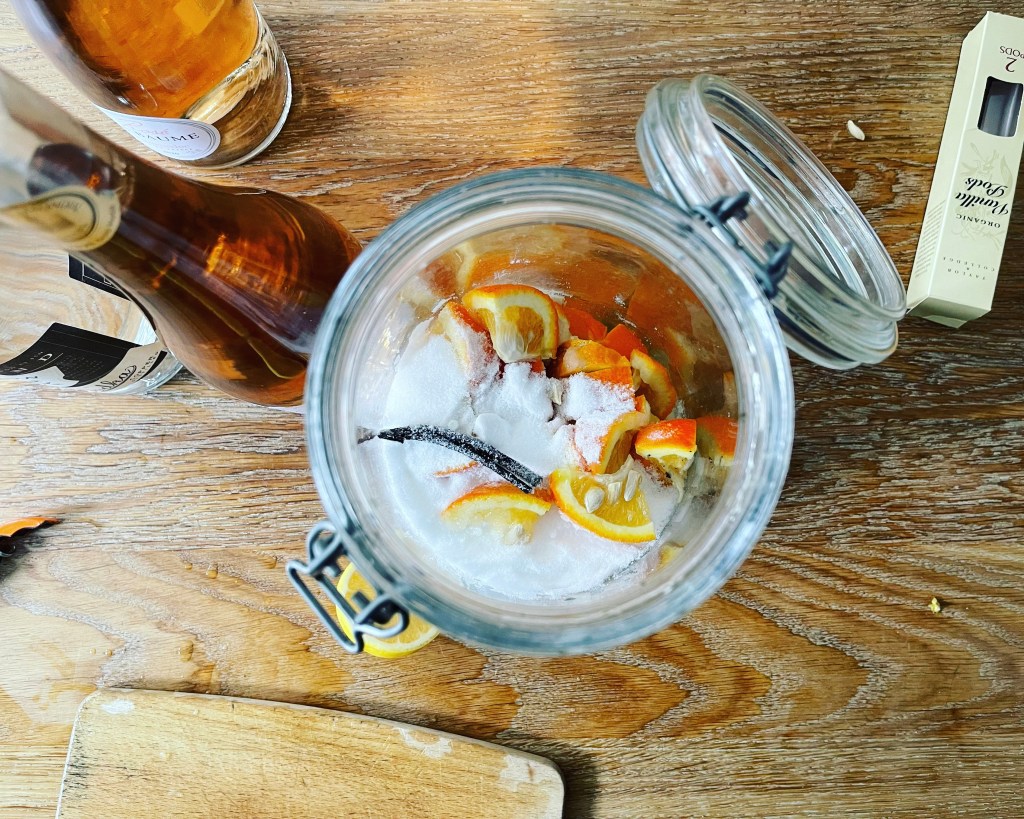
Place all the fruit into the jar. Add the sugar and vanilla bean, and pour in the alcohol. Mix well but gently until the sugar dissolves. Seal tightly and leave in a cool, dark place (or the fridge, if there is room!) for about a month. (Samin Nosrat suggests between 32 and 40 days, but I am pretty sure I left mine quite a bit longer last year. Whatever suits, it’s far from a perfect science!)

After about a month, when the vin d’orange has developed the right orangey and bitter taste, strain the liquid through a fine mesh sieve lined with two layers of cheesecloth into clean sealable bottles. The vin d’orange is now ready to drink, and will only get better and better.

Serve chilled, with friends.