Elisenlebkuchen (South German Gingerbread)

20 December 2018

For years, we had Lebkuchen shipped from Nuremberg to New York in a big, beautifully decorated silver box. Thomas chose that particular company because they had the best Elisenlebkuchen (the flourless kind), and because he and the owner’s children had been childhood friends. They were neighbors, went to the same school, and — I learn just as I  write this, as I ask Thomas and he reminisces — did some pretty foolish things together in their youth. Fraunholz is a family business in the fourth generation, now run by the younger brother.

Ordering them was, every year, in more ways than one, a time-warp experience. In a bite, the cookies propelled the dark, gnarly, sparkly streets of the medieval German city onto our Christmas plate. And, in an age of codes and passwords and multiple proofs of identity, here was a company that took an online order, shipped their wares halfway around the world, and sent a bill to be paid upon receipt. This in itself seemed reason enough to continue the tradition. That, and the added bonus of the ‘Dominosteine’!

I’d like to say that we still receive those big silver boxes every year — but no. After years of hemming and hawing and meaning to and not doing, I have finally started making my own. I thought it would take decades to find and refine the ideal recipe, with much trial and error, but, magically, all the trying and testing has already been done and an impeccable recipe exists! Luisa Weiss’s fantastic Classic German Baking is worth its weight in Lebkuchen, for that recipe alone (though there are many, many more). They are, as Thomas somewhat reluctantly admits, pretty perfect.

The one thing I have changed is the shape. There are, in my opinion, a few reasons to bake Lebkuchen as sheets rather than individual cookies: It is how I discovered them to be sold on the Christmas market in Nuremberg; it makes them so much easier and less fiddly to prepare for baking, and then to glaze; and the absence of individual edges during baking leaves more softness and moistness throughout.

Happy baking and a very merry Christmas!

Elisenlebkuchen from Classic German Baking by Luisa Weiss
Find the original recipe here

5 eggs
300g (1 1/2 cups) granulated sugar (I reduced the sugar from the original which called for 350g — or 1 3/4 cup)
200g (7 oz) almond paste¹ (see recipe footnote below)
3 Tbsps Lebkuchen spice² (see recipe footnote below)
1/4 tsp salt
Grated peel of 1 untreated lemon
100g (2/3 cup) candied citron peel, finely chopped
100g (2/3 cup) candied orange peel, finely chopped
200g (2 cups) hazelnuts, toasted, skinned, and ground
200g (2 cups) ground almonds
100g (2/3 cup) blanched almonds, finely chopped
Wafer sheets

For decoration (optional)
Blanched almonds, split lengthwise
100g (13 Tbsps) confectioner’s sugar
60ml (1/4 cup) water

Preheat the oven to 150°C (300°F) and line one 30cm x 36cm (12″ x 14″) roasting tray with parchment paper.

Place the eggs and sugar in a large bowl. Using the large holes of a box grater, grate the almond paste into the eggs and sugar. Whisk briskly for several minutes until the mixture becomes light and frothy. Add the Lebkuchen spice, salt, grated lemon peel, candied citron and orange peels, and all the ground and chopped nuts. Mix well until combined.

Place the wafer sheets onto the baking tray covered with parchment paper, making sure to cover all the way to the edges (if necessary cut the wafers into a patchwork to reach the sides). Scrape out the Lebkuchen dough onto the wafer sheets and spread out with a spatula until smooth and even. If using, place the blanched split almonds, smooth side up, in a pattern at regular intervals onto the dough — they should be spaced withe the view of cutting a lozenge-shaped Lebkuchen around each almond later.

Bake for 25 to 30 minutes until the Lebkuchen tray is puffed and golden.

Meanwhile, to make the glaze, place the confectioner’s sugar and water in a small saucepan over medium heat and boil down for a few minutes, until the glaze has thickened (stir or swirl the pan occasionally as it will bubble furiously).

As soon as the lebkuchen are out of the oven, glaze generously with a brush, making sure to reach every nook and cranny. Let cool completely before cutting the tray into individual Lebkuchen lozenges. Store in a tin box lined with parchment paper between each layer for up to 4 months.

¹ Almond paste [Marzipanrohmasse]

220g (1 1/2 cups) raw (or blanched) almonds
225g (1 cup and 2 Tbsps) granulated sugar
2 tsps almond extract
1 tsp rum
2 to 4 tsps water
Equipment: food processor

To blanch the almonds (unless using ones that are already blanched), soak them for a few minutes in bowl of boiling water until the peels can easily be squeezed off. Push the skin off each almond and lay them on a clean kitchen towel to dry.

In a food processor, blitz the sugar until powdery. Add the blanched almonds and process until a paste starts to form. This will take a while. Stop the motor occasionally and stir, and take care not to let your food processor overheat (mine did and shut off completely, which thankfully was just a failsafe, and I was able to resume grinding nuts the next morning after the machine had cooled completely).

Add the almond extract and the rum and continue to process, stopping and stirring every so often. Add a teaspoon of water at a time (probably somewhere between 2 and 4 tsps) and continue to process until the paste becomes completely smooth. Scrape the finished paste out of the machine and shape it into a brick, then store it in the refrigetator. The paste will keep for several weeks.

² Lebkuchen spice mix

For a most fragrant mix, the spices (except the ginger) can be freshly ground
30g (5 Tbsps) ground cinnamon
1 1/2 Tbsps ground cloves
1 tsp ground allspice
1 tsp ground cardamom
1 tsp ground ginger
1 tsp ground mace
3/4 tsp ground aniseed

Stir all the spices together and store in an airtight glass container away from the light. The spice mix will keep for a few months.

The Nettle & Quince Christmas baking page

2 December 2018

It’s the first Sunday of Advent, the time to pause, light a candle, and start baking!

I have created a Nettle & Quince Christmas baking page, where all the Stollen, cookies, and confections can be found.

You can access it by clicking HERE.

A direct link is also always available on the homepage on the right just below ‘Pages.’

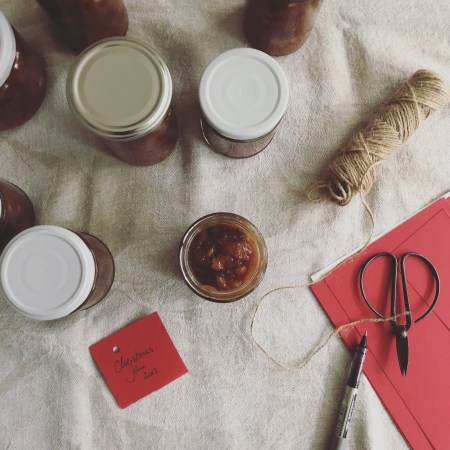
Edible gifts | Christine Ferber’s Christmas jam

29 November 2018

In her book Mes Confitures, Christine Ferber writes that her Christmas jam pays tribute to the tradition of berawecka, a fruit bread traditional in Alsace and neighboring German speaking countries during the holidays. It gives pride of place to the dried pears of the region and includes a plethora of other dried and candied fruits, nuts, and spices.

Indeed, this jam has no fewer than 21 ingredients! A fact that would ordinarily have me fleeing it like the plague. But in some instances, particularly around Christmas, my disposition mellows and I might find myself uncharacteristically drawn to somewhat tedious, day-long cooking challenges.

The reward, of course, is an unusual gift that unfurls in every bite, layer after layer, one fragrance after another, and which will hopefully, in an explosion of taste, convey all the affection (and time!) folded lovingly into each little jar.

Christine Ferber’s Christmas jam
Warning: this jam not only has 21 ingredients, it also takes 2 days to make!

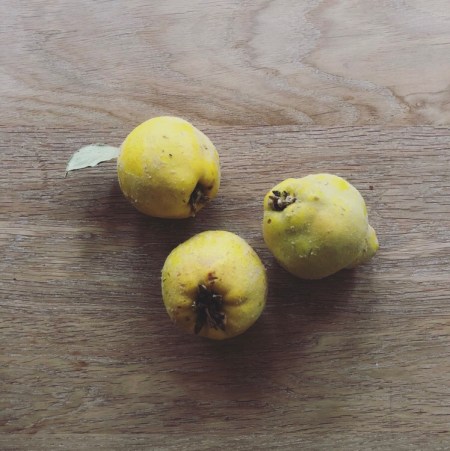
1.7 kg quinces
1.7 kg (170 cl) water
1 kg caster sugar
200 g dried pears, very finely sliced
200 g dried figs
100 g dates
100 g prunes
200 g dried apricots
100 g raisins
50 g candied lemon peel
50 g candied orange peel
Juice from 1 untreated orange
3-4 pinches finely grated zest from an untreated orange
Juice from 2 untreated lemons
3-4 pinches finely grated zest from an untreated lemon
Pinch ground cinnamon
Pinch ground cardamon
5 g aniseed
150 g shelled walnuts
150 g blanched almonds

Wipe the quinces to remove all fuzz. Rince the fruit with water, remove the stalk and flower, and cut into quarters (do not peel or core the quince).

Place the quince quarters into a large (jam) pan and cover with 1.7 kg (170 cl) water.

Bring to a boil and simmer gently for an hour, stirring the quince around occasionally. Strain through a fine mesh sieve to gather 1.3 kg of juice.

Slice the dried pears very thinly and let them soak in the quince juice overnight.

The next day, pit and cut all the dried fruit as thinly as possible: figs, dates, prunes, and apricots. Finely dice the candied lemon and orange peel. Finely cut the angelica if using. Chop the walnuts and almonds.

Pour the quince juice and marinated pears back into the jam pan (or large heavy-bottomed saucepan). Add the sugar, and all the dried fruits (figs, dates, prunes, apricots, raisins), candied fruits (lemon and orange and angelica), citrus juices and zests, and spices.

Bring the jam to a boil, stirring continuously. Skim any foam that comes to the surface. Leave at a lively boil for 5 to 10 minutes, stirring continuously and skimming if necessary. **Do not overcook! 5 to 10 minutes is sufficient. My batch was a bit too thick, I will be wary next time.** Add the walnuts and almonds and cook for another 5 minutes. Check that the jam is setting (place a spoonful of juice in the fridge and, once cold, check that the juice has ‘gelled’).

Sterilize the jars for 5 minutes in a pan of boiling water. Fill the jars immediately and seal tightly.

Notes from the kitchen | Monday chicken legs with spring onions and ginger

15 November 2018

Monday night. Eternal, tedious, domestic conundrum — what to make for dinner? Feeding six requires labour, always. The simplest thing — grating cheese for all the pasta — takes a while.

Forever torn between fantasies of heady stews and lack of time, I go into the butcher’s dreaming of oxtail and grab chicken legs instead. It’s the quickest path to a braised (style) dish. It requires little foresight or planning, barely a thought. There will at the very least be garlic and lemon in the house.

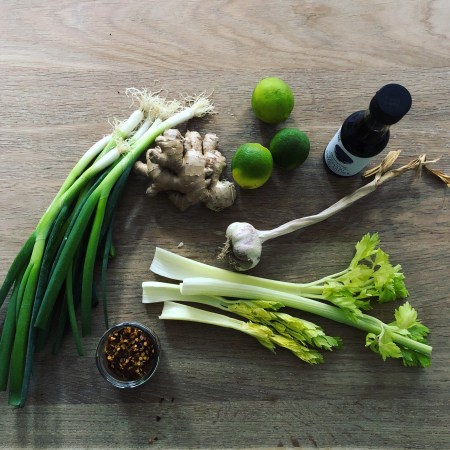
As it happens, today we also have spring onions and celery, ginger and tamari. What began as a resignation, an easy way to finish odds and ends at the bottom of the fridge, has become a legitimate meal, an instant favourite. And with Balthasar’s retro / disco playlist in the background, there may even have been some dancing around the kitchen table.

Chicken legs with spring onions and ginger
Serves 6

6 chicken legs (whole or separated into thighs and drumsticks)
A large chunk of ginger
One bunch — 6 or 7 — spring onions (scallions)
4 or 5 celery stalks
1 small lemon or lime
1 whole head of garlic
Neutral flavored oil
Toasted sesame seed oil
Light soy sauce (or salt)
Tamari soy sauce
Rice vinegar

Preheat the oven to 175°C (350°F).

Remove the chicken from the refrigerator so it has time to come to room temperature.

Prepare the ‘vegetables’:
Peel the ginger and slice it into matchsticks.

For the spring onions, cut off the ends, remove one outer layer, wash, and cut into three.

Top and tail the celery stalks, wash, and cut into pieces of similar length to the spring onions.

Wash, halve lengthwise, and thinly slice the lemon (or lime) into half moons.

Smash the head of garlic with your palm to open it up. Crush each clove with the side of a large knife and remove the skin, which will come off easily.

Roasting:
Pour some oil at the bottom of an oven dish large enough to fit all the pieces of chicken with space to spare. *The pieces should not be too crowded or the skin wil not become crispy.* Scatter all the vegetables at the bottom of the pan, toss with a little oil, and roast in the oven for about 15 minutes.

Coat the chicken legs with sesame sauce.

Once the vegetables have been roasting for about 15 minutes, add the chicken legs to the pan and season everything with a few hits each of light soy sauce, tamari, and rice vinegar.

Roast the chicken for 40 to 45 minutes, basting occasionally with the juice, until brown and crispy on the outside and fully cooked (i.e. juices run clear) inside.

If possible, let the chicken sit for a few minutes. Serve with rice.

Creamy spiced lentil soup

8 November 2018

Balthasar and I bonded over soup.

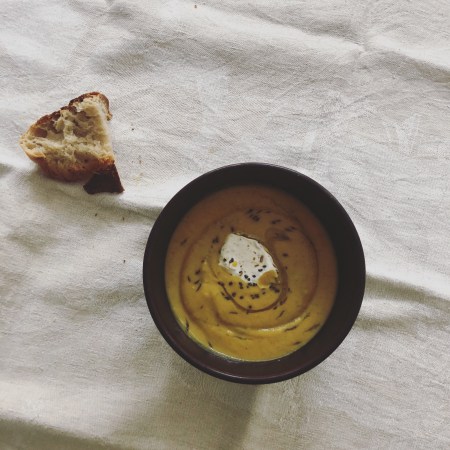
It was an inset day, which means no school, and after a sunny autumnal swim in the nearby lido — outdoor swimming pool in British lingo, in this case heated year-round to a luxurious 25°C — we went to reap our effort’s reward: e5 Bakehouse. Breakfast was over, we shared a spicy lentil soup with mustard seeds, and cake — but it was the soup that caught our attention. We vowed to recreate it, paying particular heed to the mustard, and, in an decisive move against Thomas’s tyranny of chunky soups, solemnly swore to blitz it to a creamy smoothness.

It was practically a random recreation, with the available bits and pieces in the fridge. It was practically perfect.

Creamy spiced lentil soup

4 to 5 small onions
1 whole head of garlic
1 tsp brown mustard seeds
1 tsp cumin seeds
1 tsp fennel seeds
1 tsp ground turmeric
Sea salt
3 leeks
5 or 6 carrots
1 kg potatoes
3/4 of a large acorn squash
1 litre chicken or vegetable stock — or just water
175 g red lentils
A large handful of kale
Finishing touches: yogurt mixed with toasted ground cumin and fennel and lemon juice; a sliver of olive oil or chili infused oil; if available, black lava salt

Toast the mustard, cumin, and fennel seeds in a small pan until they start to become fragrant (this takes a few minutes only). Grind and set aside.

Prepare the vegetables —
Chop the onions.
Smash and peel the garlic.
Peel, thoroughly wash to remove all grit, and chop the leeks.
Peel and chop the carrots.
Peel and wash the potatoes and the acorn squash and cut them into small chunks.
Remove the kale’s tough stalks, wash thoroughly, and chop into strips.
Note: The size of the vegetable chunks is not crucial as the soup will be puréed, but the pieces should be fairly homogeneous in order to cook at a similar rate, and — if time is of the essence — the smaller or finer the pieces, the faster they will cook.

Cook the soup —
Brown the onions in lots of olive oil. Add the garlic and spices and cook, stirring continuously, for a few minutes. Season with salt.

Add the leeks, cover the pan, and let them cook for a few minutes. Add the carrots, potatoes, and squash. Season.

Add the stock and/or water so that the vegetables are covered generously and floating around comfortably when stirred.

After about half an hour of a gentle and constant simmer, add the lentils. Cook for another 15 to 20 minutes, checking on the level of liquid and adding some if necessary.

Check that the vegetables and lentils are cooked through, then add the kale and cook for about 5 to 10 minutes more until it has softened too.

Blend/purée the soup in batches until very smooth.

Serve immediately with one or all of the finishing touches.