Posts Tagged ‘food’

Rhubarb rosemary jam

7 June 2014

photo(22)

This is me realizing that jam need not be a well planned out, day-long project. It can be, of course, and should, on occasion, because is there a better way to spend a day than whiling away the hours hunched over bubbling vats of sugared fruit? This is not about those days. This is about how making jam can be an afterthought, as easy as clearing out the fridge before a week-long holiday.

I was the first to consider jam making an incredibly laborious process. Carefully timed trips to the market to grab the last of the season’s fruit at an unbeatable bargain, endless kilos of berries to cut and trim and wash, giant jam pans boiling furiously for hours… I didn’t make jam very often. For one, market vendors in New York don’t usually sell off fruits for a good bargain, even as they pack up to leave  (I’ve tried); second, fruit at home often disappears so quickly I need to hide it to keep it safe (and I have); third, I don’t own a jam pan, giant or otherwise.

So I don’t (didn’t) make much jam. There were exceptions, naturally, few and far between, so noteworthy I usually recorded them, here, and here.

A few years ago my mother gave me Christine Ferber’s book (available only in French). Christine Ferber is a world re-known Frenchwoman from Alsace, widely described as the ‘fée des confitures’ (jam fairy). I’ve never actually eaten from one of her jars, but I have read so many tantalizing descriptions that I feel I might have. Taken literally, her technique is quite time-consuming, but using her inspiration, some latitude, and a little improvisation (she would be appalled), I’ve realized that making jam can actually fit quite snugly into my life.

Key is that the process in divided into two parts. In the evening, prep the fruit, mix it with sugar and lemon juice, and let it sit overnight in the refrigerator. The next day, cook the jam. Chances are, it’s easier to find 15 quick minutes in the evening and another 45 of mostly cooking time the next day, than scheduling a full long slot for the entire process.

Emboldened by this realization, last week I made jam, the easiest thing I found to save a few remaining bunches of rhubarb.

Rhubarb jam recipe

1 kg rhubarb

1 kg sugar

Juice from one lemon

Few sprigs rosemary

Wash the rhubarb, trim the ends, and chop the stalks into 1/2 inch (1 cm) pieces.

In a saucepan, mix the rhubarb, sugar, and lemon juice.

Let sit overnight in the refrigerator.

The next morning, cook the jam. Bring to a boil over medium heat and cook for approximately 30 minutes. At first it will bubble furiously, but as the jam jells it thickens, the bubbles slow down and burst at a more leisurely pace. To check whether the juice has “gelled,” take out a small spoonful and let it cool. Once cold, the juice should have thickened in the spoon, and when you try to pour it the drip is not liquid but heavy, as though it was sticking to the spoon. Cook longer if necessary and check again.

Meanwhile, sterilize the jars in boiling water for 5 to 10 minutes.

Once the jam is ready, stir in the rosemary to steep for about 5 minutes. Remove. Pour into sterilized jars and close tightly.

Jam is best stored for a few weeks (and up to a year at least) before eating.


A good steak with anchovy and herb butters and shallot confit

15 May 2014

photo(18)

Key, of course, is the quality of the meat. Beef should be grass-fed and dry-aged. To say I choose my homes according to their proximity to a good butcher is exaggerated, but we’ve been lucky for a while now, with, for years, excellent meat just a few blocks away. There was Ottomanelli in the West Village, Harlem Shambles uptown, and, here in London, we live close to another great butcher, Godfreys.

The cut is important, too. Meat on the bone is typically more flavorful, and thick cuts (an inch and a half at least) are much easier to cook to perfection: very brown and crisp on the outside but perfectly rare in the center.

There are debates over whether steaks should be seasoned early or whether salt left on the meat absorbs some of the moisture. I’ve decided to settle into the camp that favors early seasoning, allowing the salt to seep into the cut. Since meat should be brought to room temperature before cooking, I take the steaks out of the refrigerator about one hour before dinner, season them generously with coarse salt and freshly ground pepper, and let them sit a while.

It is useless to try to give a cooking time. Every steak is different, depending on the cut, its thickness, its initial temperature. I’ve found that a cast-iron skillet works best, and it should be very hot before the meat is added. A combination of butter and olive oil in the pan is good, as the butter is delicious and won’t burn as quickly together with the olive oil. Ideally one could add herbs to the rendered fat and baste the steak as it cooks.

Sear the meat on very high heat, turning it over once the first side is evenly brown. The steak is perfect when the outside is brown and crisp, like a crust, and the meat has contracted, but just barely. Not too much or it is overcooked.

Like all meat, steak needs to relax a little before being cut; about ten minutes, just the time needed to get the rest of the meal on the table.

Serve the steak with the butters, shallot confit, and some strong mustard.

IMG_4120

IMG_4119

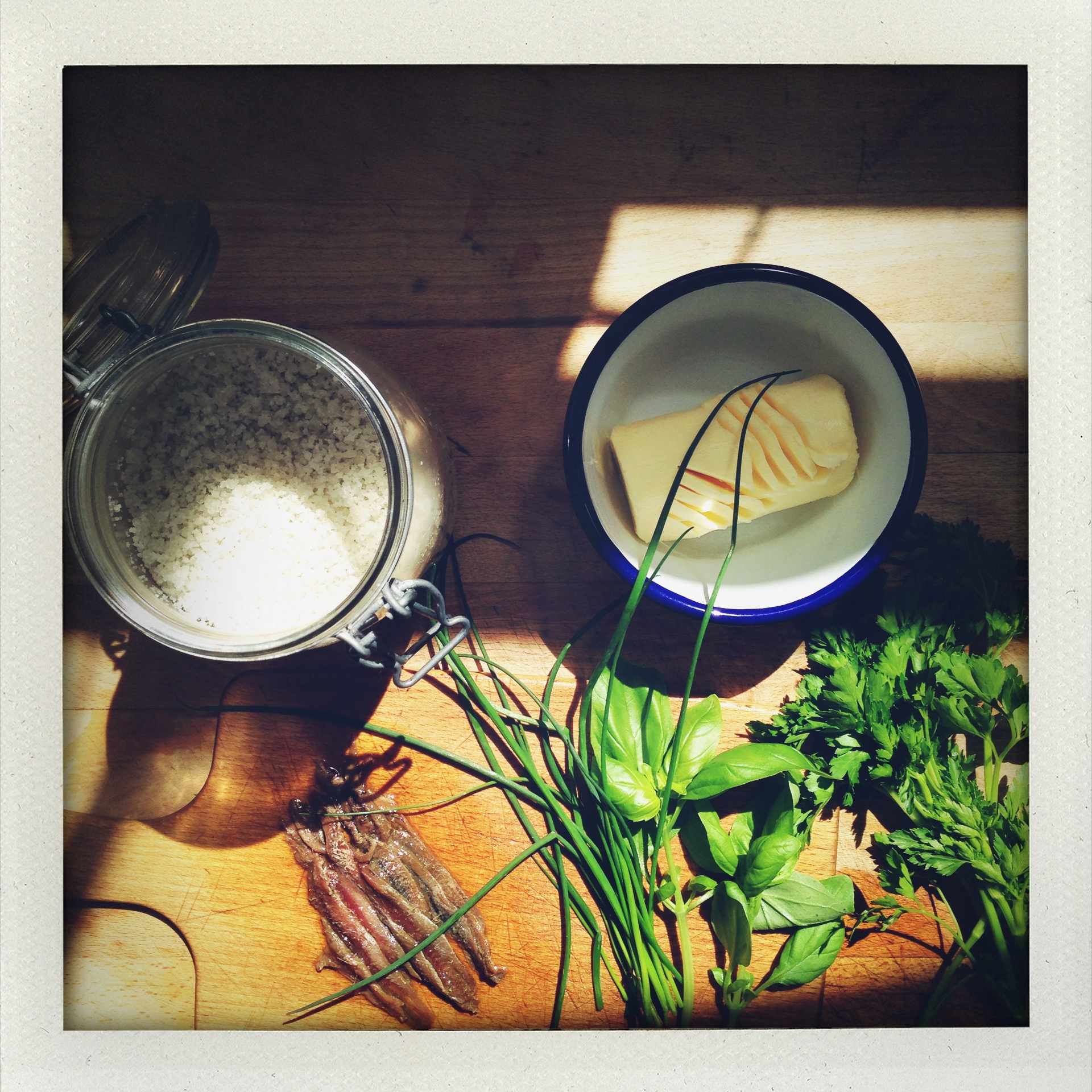
Herb and anchovy butter
These must be made a least an hour ahead, and easily the day before.
I make one butter with anchovies, parsley, and basil, and the other with just herbs and sea salt.

250g good unsalted butter

A generous handful of parsley

Small bunches each of basil and chives

A dozen anchovies in oil

1/2 teaspoon coarse grey sea salt

Cut the butter into two equal parts, place each in a small bowl, and let sit at room temperature until it becomes soft and easy to work with (probably about an hour).

Wash and shake the herbs dry. Pick the parsley and basil leaves from the stems.

Separate the herbs into two groups: one with half the parsley and a few basil leaves, the other with approximately equal amounts of parsley, basil, and chives.

Finely chop each group of herbs.

Drain as much oil from the anchovies as possible, and chop finely.

Using a fork, mix one of the softened butter with the anchovies, parsley, basil; the other with the parsley, basil, and chives, and the salt. Mix each well until the butter is homogeneously speckled with the herbs.

Transfer each piece of butter into a small serving bowl, even out the surface, and let cool in the refrigerator for at least an hour. The butter will keep for a while, though it will be best for a couple of days.

IMG_4134

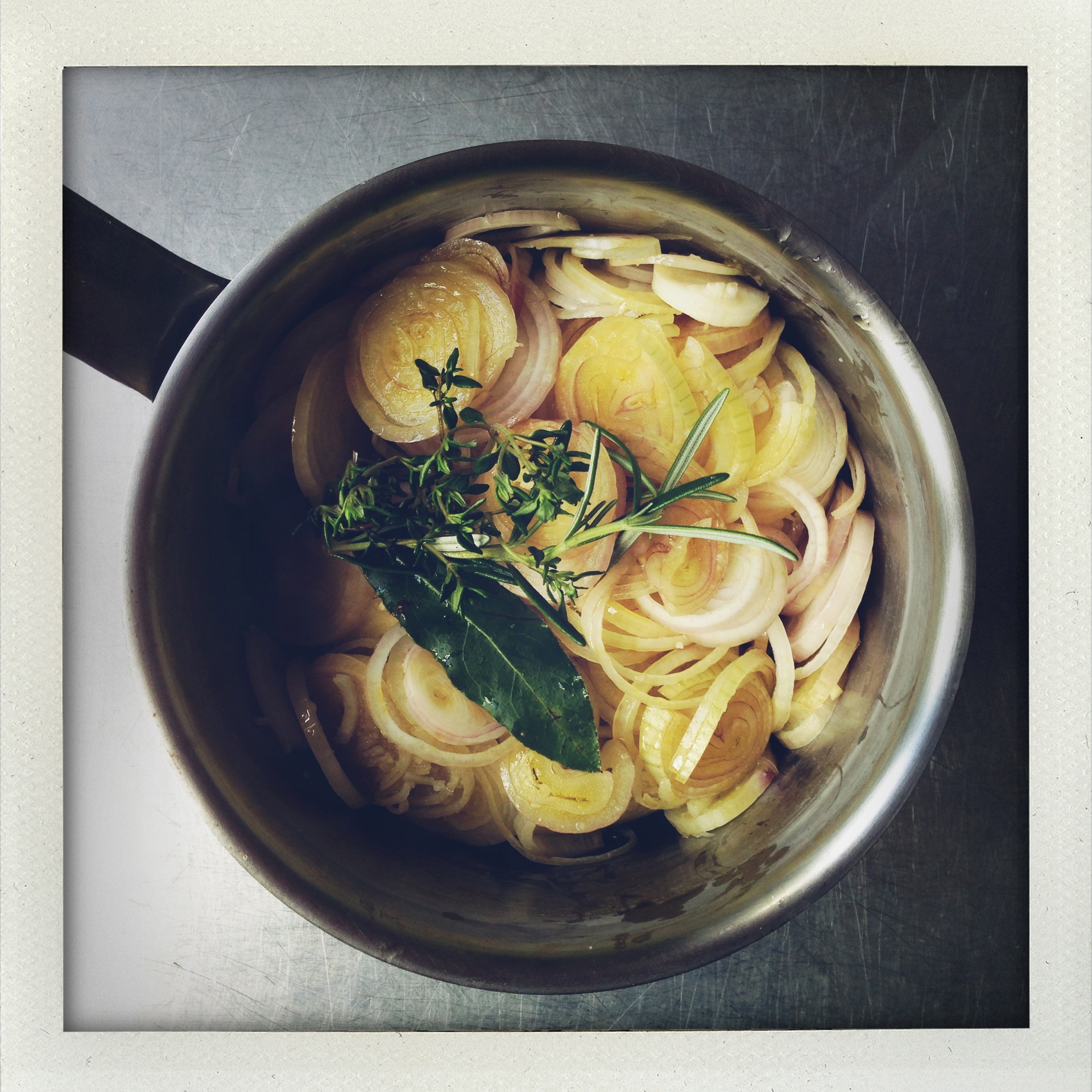
Shallot confit

3-4 large shallots

Olive oil

Small sprig fresh thyme

Small sprig fresh rosemary

One bay leaf

Sea salt

Peel and slice the shallots into thin-ish slices. (The shallots can be cut either crosswise or lengthwise.)

Place in a very small saucepan with enough olive oil to comfortably blanket the bottom of the pan. Add the herbs and a good pinch of salt.

Cook on very low heat, staying close and stirring regularly, until the shallots are a deep golden. **In case the bottom does burn, quickly transfer the rest of the shallots to a different pan so the burnt flavor doesn’t tarnish the confit.**

Let cool a little and remove the herb stalks before serving.

The confit can be made ahead and kept in the refrigerator but must be slightly reheated before serving, just beyond the point where the oil isn’t congealed to awaken the flavors.

Mackerel rillettes

15 May 2013

DSC_0016

Sometimes food happens without much forethought or planning. I could have pondered it for weeks, in fact I’ve been wanting to make these for years, but when I bought mackerel fillets at the market last week I had no plan; a quick weeknight dinner at best. Rillettes were far from my thoughts, lurking behind the distant corner of a hazy summer memory. But as I contemplated dinner for friends and something that could easily be made ahead, I found myself searching for mackerel rillettes recipes.

So this is adapted from one by Annie Bell, modified to suit what I had on hand. It was delicious.

*

Recipe adapted from Mackerel Rillettes by Annie Bell

8 small mackerel fillets

2 bay leaves

2 stems fresh garlic (or 3 garlic cloves)

Few sprigs fresh thyme

100 ml dry white wine

100 ml water

1 lemon

3 Tbsps very good olive oil

Fleur de sel or sea salt and freshly ground black pepper

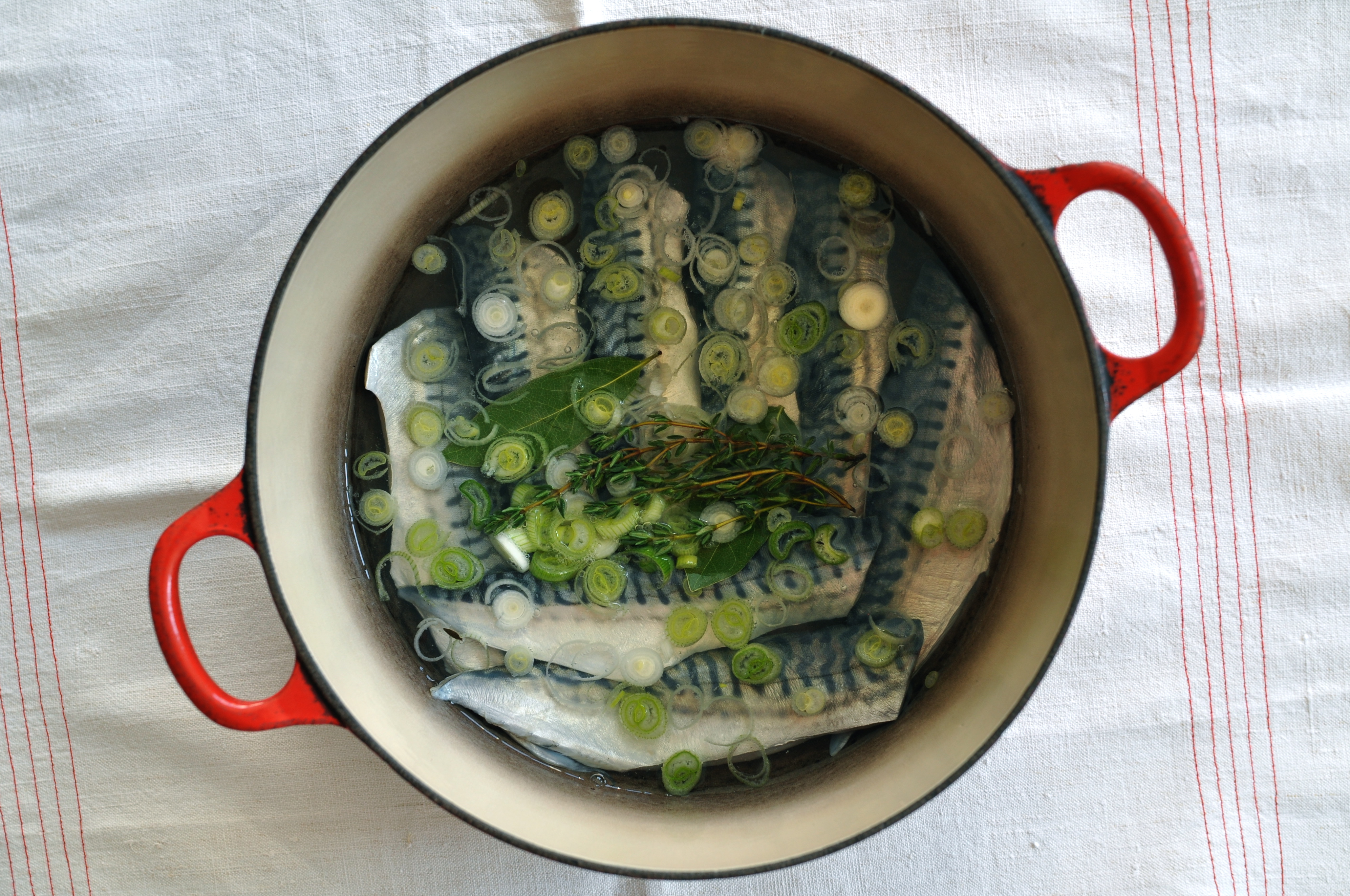
Place the mackerel fillets flat at the bottom of a pan, add the bay leaves, garlic, thyme, wine, and water. Bring to a gentle boil, simmer for 1 minute and remove from heat. As soon as the liquid is cool enough, take out the fillets and flake the fish, taking care to remove any remaining bones.

Place the cooking liquid back onto the stove, cook for a few minutes until ireduced to a couple of tablespoons.

In a medium bowl, combine the mackerel gently with the reduced liquid, the juice from 1/2 lemon (the other half for serving), and 3 Tbsps very good olive oil. Season with fleur de sel or sea salt and fresh ground pepper.

Transfer to a serving bowl or jar and place in the refrigerator for at least an hour and up to 2 days.

Serve with bread and butter, and a generous squeeze of lemon.

DSC_0014

Related posts

Cheat’s potted crab

Baked mackerel with mustard and thyme

Pork rillettes

Children’s dinner | The ‘I wish it was cauliflower’ (but it’s not quite the season!) zucchini gratin

20 September 2012

Every morning I make lunch for Leo and Balthasar to take to school. When this began I thought I would use the opportunity to be terribly creative; in fact it has become the least inspired aspect of my cooking life. One day I make sandwiches, one day pasta. I alternate. I know the boys will eat this. The problem with school lunches is that I am not there, at the end of the table, frowning, admonishing, and — yes — forcing them to finish their grilled mackerel and ratatouille.

The children eat many things, and, if I may, I don’t think it’s because ‘we’ve been lucky’ but because I’ve made it an excruciating. daily. struggle. But not at school. At first I was just happy that they finished their meal; now I’ve become stuck in this pasta/sandwich routine. I am mindful of what goes into the lunchbox, of course, my mother‘s ever knowledgeable advice always chiming in my ears. But I leave the really good food, the fun food, and the mealtime fights for the evenings.

It seems to have payed off. Leo and Balthasar can be coaxed into eating practically anything; Louise, who is 2, is still in a tug of war. Some things need a bit more prodding, and, unhelpfully, it happens that onetime hits suddenly misfire. But there is some predictability. Naturally oftentimes I have little more patience than to throw some frozen peas into boiling water, serve that with a sunnyside egg, and call it dinner; but I know that practically anything that is diligently prepared, well seasoned, and cooked to the standards of something I would serve guests will be polished off.

Gratin for example. Actually, I don’t think I’ve ever made gratin for guests. But nonetheless, gratin is a great example.

It started out with cauliflower. Winter is not the most propitious season to get children excited about vegetables, and at some point I had to find new ways to prepare cauliflower. I personally like cauliflower best raw, but one day I decided it was time to tackle gratin. I say ‘tackle’ because I was intimidated by béchamel sauce. Many years ago on a skiing holiday I volunteered to make béchamel sauce. It was for lasagna, I think. I knew the basic ingredients and felt confident that, by virtue of being French, I was the person best qualified for the job. All I managed to do was create a giant, ever expanding monster of butter, flour, and milk, which probably wasn’t even any good. As it happened, I had to suffer some lessons in béchamel making from Thomas, who made copious fun of me. This was a very long time ago.

I’ve since gained some confidence in the kitchen, so a while ago I decided to tackle béchamel again to make cauliflower gratin, which, come to think of it, is now probably my favorite way of eating cauliflower.

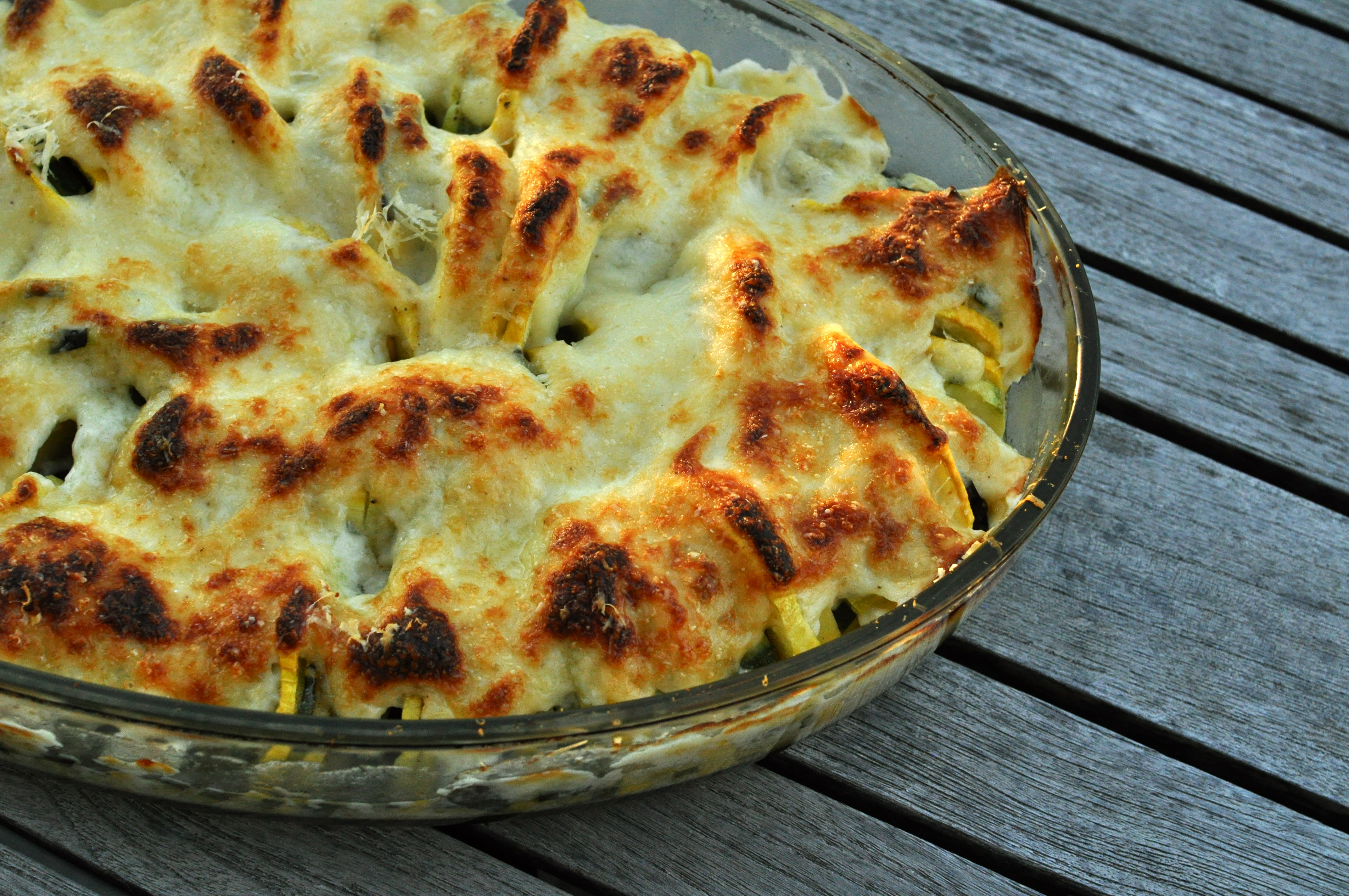
The punchline, of course, is that children love gratin. They also love anything that’s been simmered or stewed with onions, garlic, herbs, spices. They love ratatouille (they do!), they also love risotto (but weeknight dinners rarely enjoy the leisure of 45 minutes of undivided attention). So when I made this squash and zucchini gratin the other day, despite slight initial dismay that it wasn’t cauliflower, the children ate heartily, and asked for more.

***

Gratin is easy to make once the béchamel demon has been tamed. Ideally I’d make simple broiled or pan fried fish with this gratin, since fish and zucchini go so well together. On this particular day I was unprepared and just had some leftover rice, fried to crispiness in olive oil. That was good too.

Quantities are for a 9 x 13 inches (23 x 33 cm) oval dish.

6 medium-sized zucchini and/or yellow squash

Lots of basil leaves

Sea salt

Freshly ground black pepper

Good olive oil

About 3 1/2 cups (850 ml) béchamel sauce (this deserves its very own post and will be up soon, but in the meantime look here)

Freshly grated parmesan

*

Preheat oven to 375°F (190°C)

Wash and thinly slice the zucchini crosswise (into disks) approximately 1/4 inch (1/2 cm) thick. Wash the basil leaves.

Place the zucchini slices upright in the dish. Intersperse a basil leaf every 4 or 5 slices. Sprinkle with salt and pepper and pour a very thin drizzle of olive oil over the zucchini.

Pour the béchamel sauce evenly over the zucchini and grate lots of parmesan on top.

Bake the gratin for about 45 minutes, until nicely brown and bubbling. (Placing the rack in the upper half of the oven will help the gratin get a good color.)

*

Related posts

Children’s dinner | Cowboy food

Children’s dinner | Fake rabbit in the vegetable garden