Archive for the ‘Year-round’ Category

Poppy seed and almond cake

4 April 2011

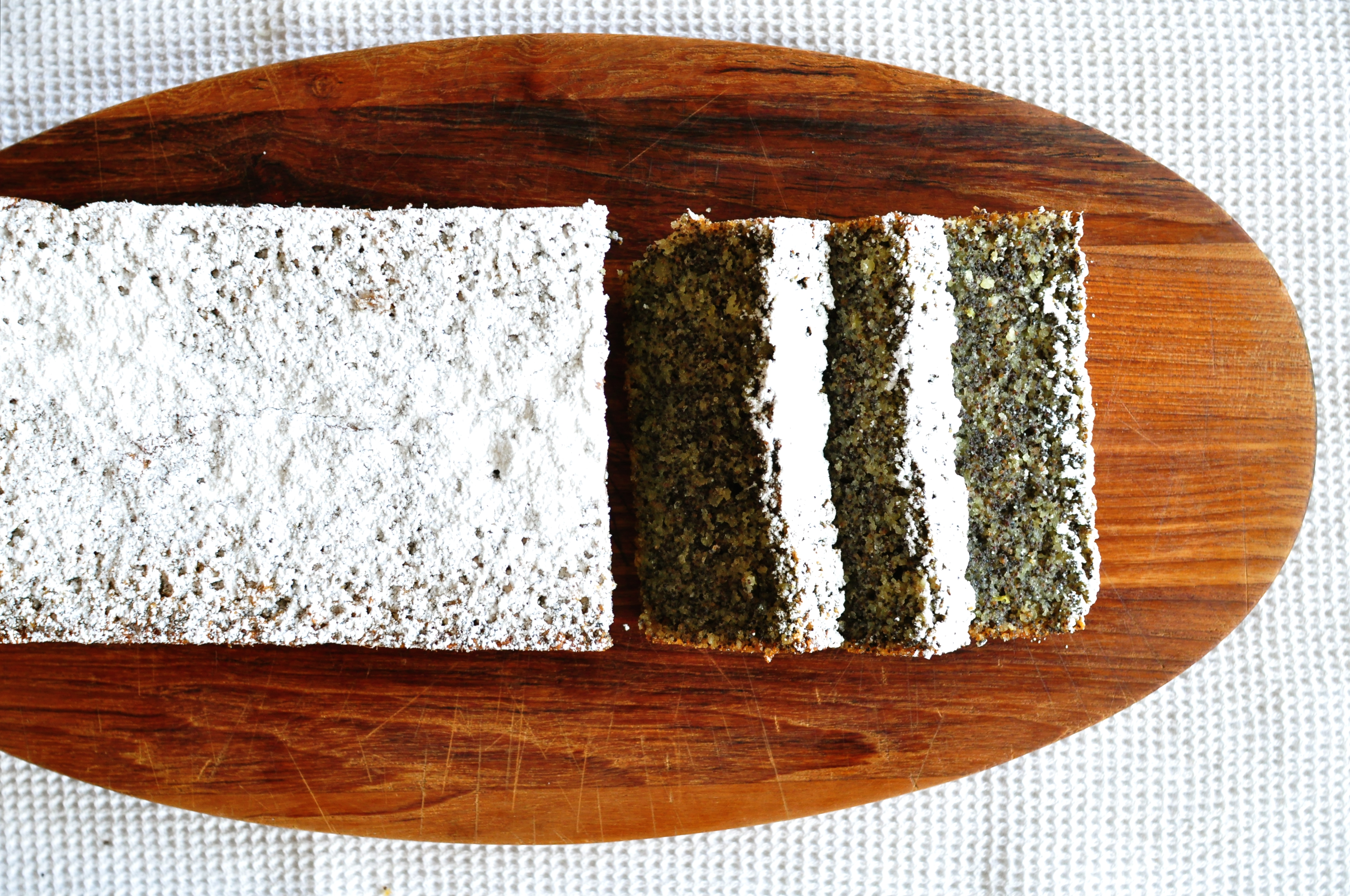
I wanted to write about this cake, which I made, in close succession, once for Louise’s first birthday, again to take these pictures, and another time in between.

It is fiendishly good. It also seems to be the object of a small controversy.

I found this cake on Lottie + Doof and it looked perfectly irresistible. But one small thing irked me about the recipe; the fact that it contains almond extract but no almonds, which feels like cheating, just a little bit. So I thought about adding almonds. I was slightly worried about the fluffiness factor so alluringly portrayed, so, standing there, in front of my ingredients, I pondered – a good five minutes – whether I should substitute some of the flour with ground almonds, or not. I decided yes. And barely half a minute later, I read the blog author’s response to a comment on his poppy seed cake post: “My recommendation would be to try the original before adding almond meal. The texture is what makes this so special, and the meal will change that.” I very nearly threw away my mix of almonds and flour. But I didn’t.

My cake, though undoubtedly much denser than the original, was also completely delicious.

The second time I made the cake I used no flour at all. Thomas insists it is the better version. I (respectfully) disagree. Without flour it is too grainy and buttery. This observation should of course be a hint that the initial version is in fact truly the best. Possibly. But I like dense cakes. Plus, the recipe without almonds can already be found in at least two places. I stand by this one.

***

Slightly adapted from Food and Wine via Lottie and Doof

3/4 cup (200 g) poppy seeds

2/3 cup (100 g) blanched almonds

14 Tbsps (200 g) unsalted butter

1 cup (200 g) sugar

4 eggs

3/4 cup (100 g) flour

2 tsps baking powder

1/4 tsp salt

1 tsp vanilla extract

1 tsp almond extract

Zest from 1/3 lemon*

Powdered (confectioners) sugar for dusting

***

Bring 1/2 cup (filtered) water to boil in a small saucepan, remove from heat, stir in the poppy seeds, cover, and let stand for 1 hour.

In a food processor, pulse grind the poppy seeds until lightly crushed. Remove poppy seeds and set aside. Pulse chop the almonds until finely ground.

Preheat oven to 350°F (175°C). Line a 10 x 5″ (25 x 13 cm) baking pan with parchment paper and butter the paper generously.

In a small bowl, mix the flour, almonds, baking powder, and salt.

In a large bowl, beat the (softened) butter and sugar until light and fluffy. Add the poppy seeds until well combined. Then add the eggs, one at a time, beating well to incorporate each time. Add the vanilla extract, almond extract, and lemon zest. Then gently stir in the almond/flour mixture until just combined. Pour the batter into the prepared pan.

Bake for 40 to 45 minutes, until a skewer or toothpick inserted in the center of the cake comes out clean.

Let the cake cool completely. Dust with powdered sugar through a fine mesh sieve before serving.

*The lemon zest should be just enough to make the flavors pop without giving a lemony taste.

Lentils

4 March 2011

In our house lentils are known as “cowboy food.” I still haven’t understood exactly why, but Thomas peddles his lentils-with-a-fried-egg dinner as such. And it works very well. The children might even call it their favorite dinner – it’s all about marketing, really.

Or it’s inherited, because we all love lentils, and I make them often as a side, especially in winter. Lentils were great with slow-roasted pork shoulder and sautéed baby bok choy, but they are also delicious with grilled salmon and braised fennel. Or with a fried egg. Seriously. Surely you can already hear the crackling embers of the campfire, the gurgle of whiskey poured into tin cups, horses neighing nearby…

I like this technique for cooking lentils, which breaks up the process into two basic steps: First cook the lentils in lots of water with aromatics and vegetables cut into large chunks until barely al dente. Remove from heat and discard the pieces of vegetables and herbs. Then brown more of the same vegetables, finely diced, return the lentils to the pan with the vegetable mirepoix (the finely diced vegetables browned in olive oil), and reheat until the lentils are cooked to desired consistency.

***

This recipe uses red onions and fennel, but yellow onions work just as well, and carrots and/or celery replace the fennel perfectly. I change it according to my mood, the rest of the meal, or what happens to be in the house.

2 cups green lentils (preferably Castelluccio or du Puy)

2 medium red onions

2 bulbs fennel

A good handful of sprigs of flat-leaved parsley

2 bay leaves

[Pancetta, optional]

Olive oil

Sea salt and freshly ground black pepper

Very good olive oil

Balsamic and red wine vinegar

***

Pick through the lentils to look for small stone intruders that must be discarded. To wash lentils, cover with cold water and drain in a fine mesh sieve.

Peel and cut into large chunks half an onion and half a fennel, reserving the rest for later.

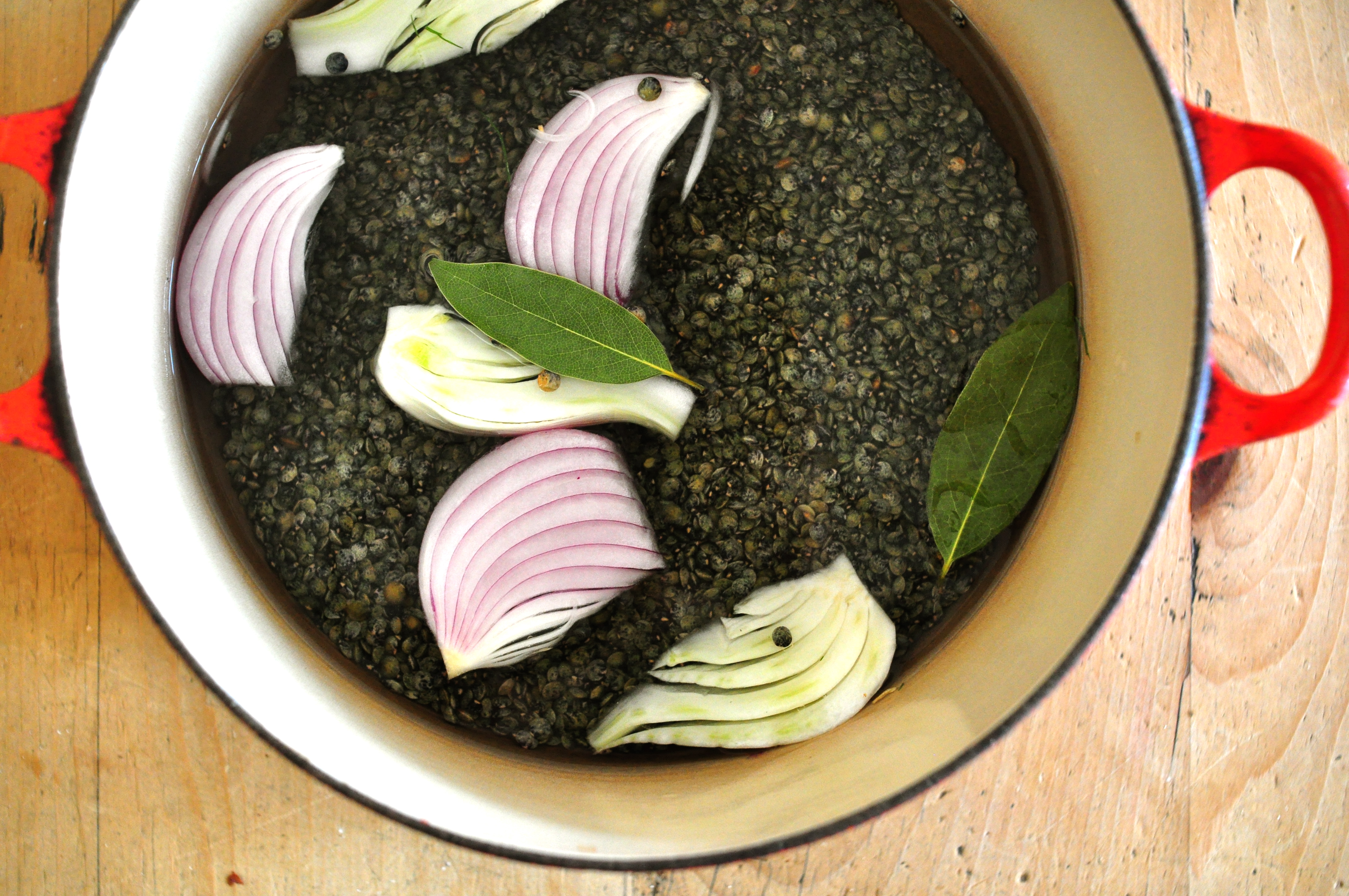
Place lentils into a large saucepan with 4 cups (double the volume) water. Add the vegetable chunks, a few sprigs of parsley, and the bay leaves, bring to a boil and let simmer, covered, for about 20 minutes. Remove from heat when the lentils are just starting to soften but still retain a nice bite (they will cook a bit more later). Discard the sprigs of parsley, bay leaves, and vegetable chunks, pour the lentils into a large bowl, and set aside. Quickly rinse and dry the saucepan for reuse.

Finely dice the rest of the vegetables, and wash and finely chop the rest of the parsley.

[If using, cook the pancetta until crispy, remove from pan, and cut into small strips]

Heat enough olive oil to cover the base of the saucepan. Add the onion and cook until nicely brown, stirring occasionally. Add the fennel and sweat for a few minutes until it becomes translucent. Add the lentils with some of the excess liquid. **The lentils should remain moist and shiny but not swimming in liquid. If necessary add of dash of plain water to prevent the lentils from drying out.** Season generously with salt and pepper and heat gently. The lentils will continue to cook, so test and remove from the stove when they have reached the desired consistency (I personally like lentils to retain some bite).

Check the salt and pepper seasoning, adjust, add 2 tablespoons of the best olive oil and 1 tablespoon each of balsamic and red wine vinegars [and the pancetta], stir in the chopped parsley, and serve warm.

Related recipes

Chidren’s dinner | Cowboy food

Spicy lentil and red kuri squash soup

Lentil and fennel salad with lemon and parsley

Slow-roasted pork shoulder (or butt)

2 March 2011

The long story of the slow-roasted pork shoulder starts in 1998, when I acquired my first cookbook: the River Cafe Cookbook Two (Yellow). The word at the time was that this wonderful cookbook not only had delicious recipes, but that they all worked. Indeed, this and the other River Cafe Cookbooks have been my number one go-to cookbooks over the years. I love the recipes and they always worked out very well.

For these past twelve years, the recipe for a slow-roasted shoulder of pork has smiled up at me, enticingly, from page 248, but I never tried it. One of the reasons was that I rarely ate pork, and never cooked pork, mainly because I could not find good pork. Until I discovered it at Union Square market; Flying Pigs Farm has single-handedly transformed me into a cooker of pork.

But I still didn’t make the slow-roasted pork shoulder. After so many years, the recipe seemed frozen in the forbidding aura of “I will make this one special day” dishes.

As I recently became somewhat fixated on slow-roasted lamb shoulders, and slow-cooked things in general, I gathered the necessary momentum to try the promising, melt-in-your-mouth, delicious slow pork. And it didn’t work. The recipe calls for “dry roasting” on an open rack in the oven. The flavor was amazing and the crackling skin predictably perfect, but the meat wasn’t falling off the bone. It was tasty and not forbiddingly dry, but not what I had expected. Since I had only been able to cook it the minimum suggested amount of time (8 hours), I decided that must be the problem. So I tried again. I cooked the second pork shoulder some 18 hours. Same result.

Rather than try to cook it even longer (the recipe says 8-24 hours), I decided to look elsewhere. Surely Hugh Fearnley-Whittingstall must have a failproof slow-cooked pork in his River Cottage Meat Book. Alas, the recipe basically starts: “Actually, versions of this dish have already been enthusiastically championed by both the River Cafe and Nigella Lawson” and proceeds to give the same cooking method. Not helpful.

Now I really did acknowledge that the problem must be me, but I just wasn’t convinced that cooking the pork even longer would have done the trick, and how many pork shoulders need I bungle before the winter is over?

So I perused my cookbook shelves for a different recipe, one that cooked pork in a closed dish. And, not surprisingly, found it with David Chang. His cookbook Momofuku‘s pork shoulder for ramen has a simple salt/sugar rub, but I was looking for cooking time and temperature.

The answer is 6 hours at 250°F (120°C). It was perfect.

***

The quantities below are for a piece of meat of approximately 6 lbs (3 kg). The seasoning should be adjusted according to size, but the cooking time remains the same.

Note from March 2012: I have revised the cooking method. I believe starting the pork on low is a better guarantee to completely and deliciously tender meat, and finishing on high assures a crisp outside.

1 bone-in pork shoulder or butt

8 garlic cloves

2 Tbsps Maldon sea salt (1 Tbsp if using regular salt)

6 Tbsps fennel seeds

Freshly ground black pepper

3 small dried red chilies

2-3 Tbsps olive oil

Juice from 3 lemons

***

Preheat the oven to 250°F (120°C).

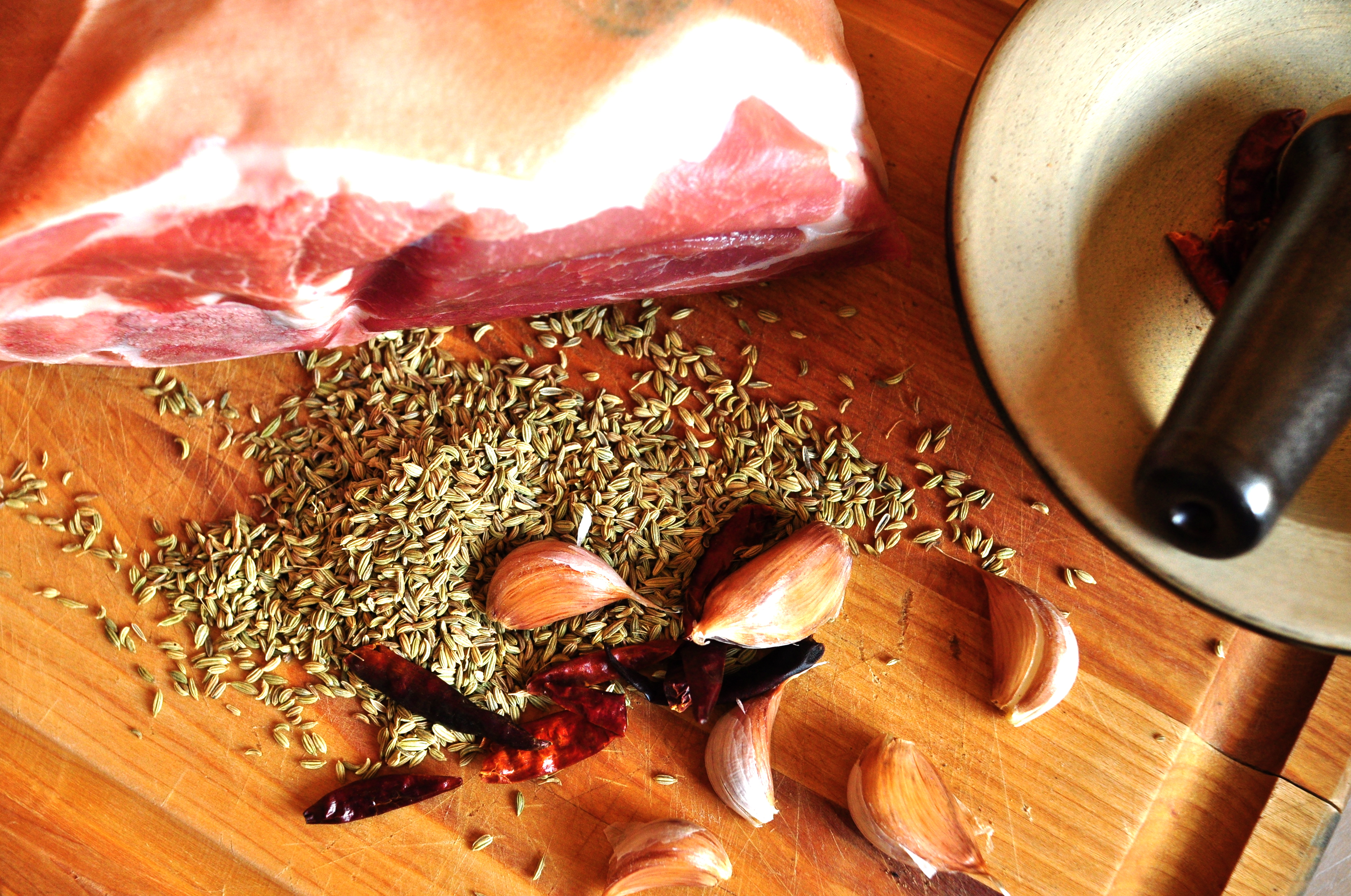
In a mortar, crush the garlic together with the salt, add the fennel seeds, a generous amount of back pepper, the crumbled chilies, and mix with the olive oil to create a thick paste.

Remove the skin and trim some of the fat. Cut deep, long gashes into the pork on all sides. Fill the gashes with the herb/spice mixture and rub all over the pork and place in an ovenproof dish with a lid (such as a Le Creuset dutch oven), then pour the lemon juice over the pork.

Cover with a tight fitting lid (or seal with aluminum foil) and cook in the low oven for 5 to 6 hours, basting occasionally.

(Optional: Finish by increasing the oven to 450°F (230°C), take off the lid, and brown on high heat for 20 to 25 minutes.)

Remove from the oven and let the meat rest for about 30 minutes before serving.

Note: Like most slow-cooked dishes, this pork will taste even better reheated. So if planning ahead, cook the pork on low the day before for about 4 1/2 hours to 5 hours. Let it cool slowly and once cold place it in the refrigerator. On the day you plan to serve the dish, reheat the meat at 250-300°F (120-150°C) for about 45 minutes, then turn up the heat to crisp up the outside as shown above — 450°F (230°C) for 20 to 25 minutes, as needed.

*

Related post:

Lentils

Slow-roasted lamb shoulder

Banana cake

10 February 2011

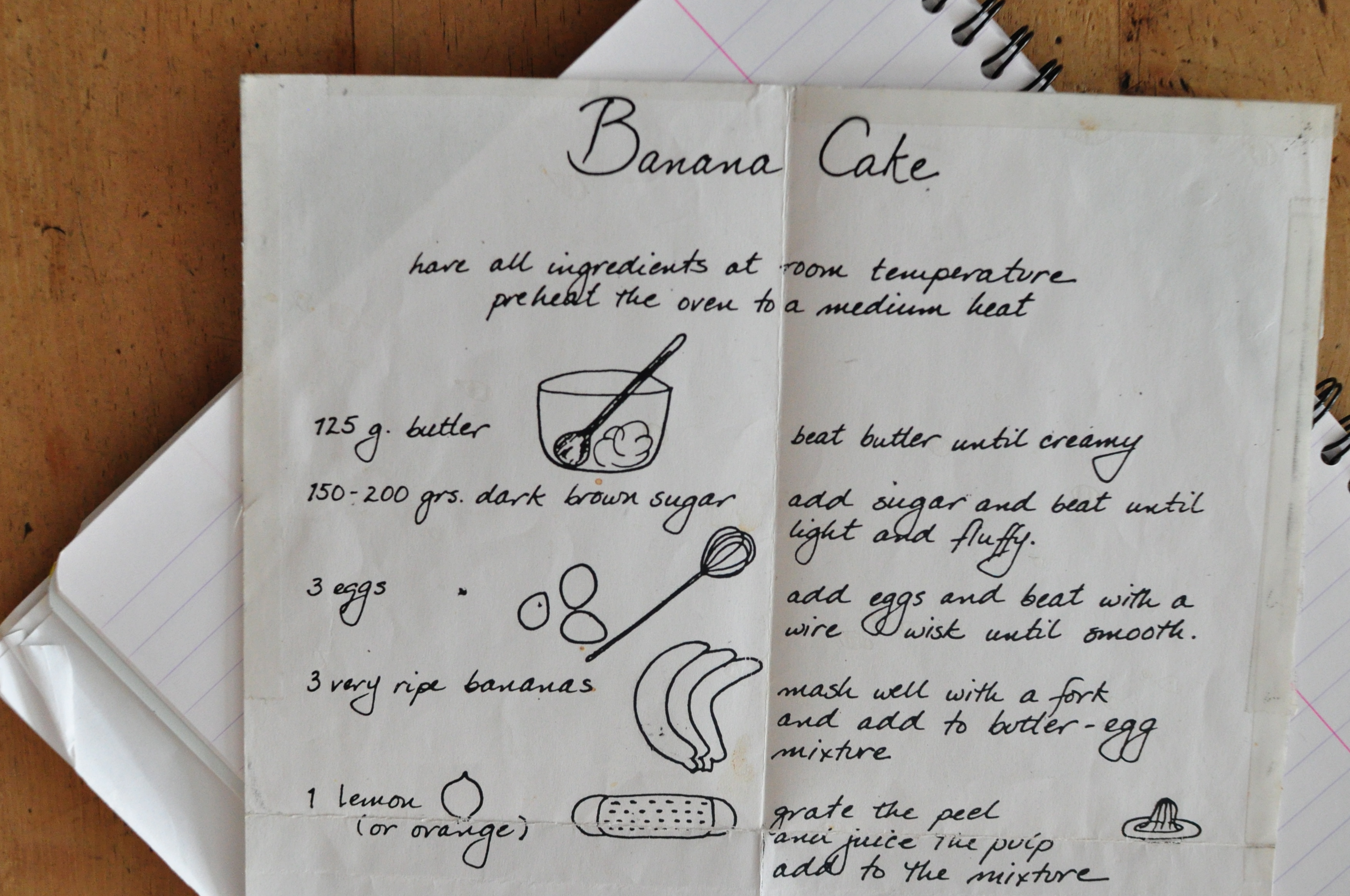
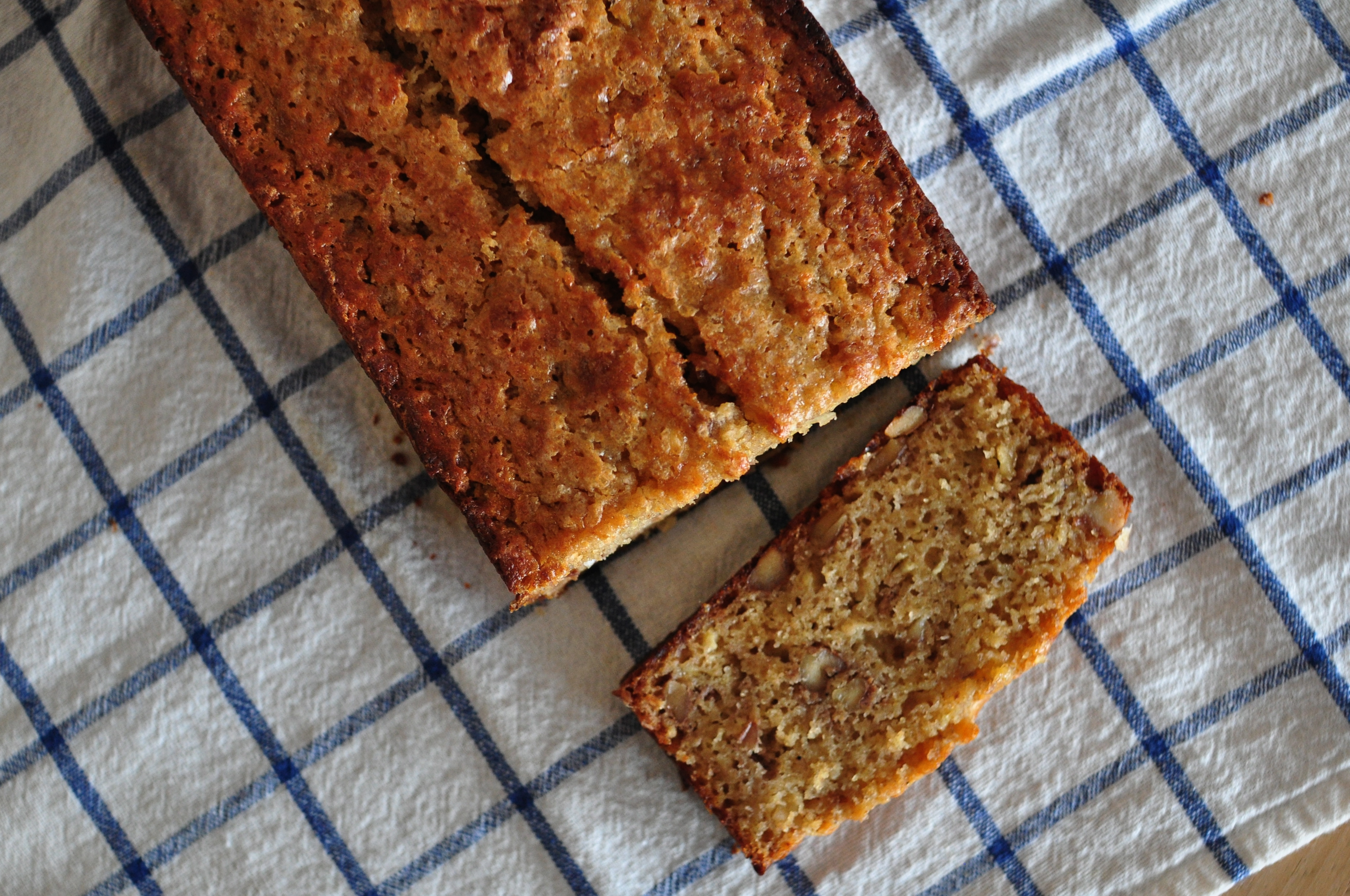
I have had this recipe since I was 7 or 8 years old. I must have been in second or third grade; a friend in my class brought a banana cake to school to celebrate his birthday and offered photocopies of the recipe. I kept the photocopy, and it appears that I have collected recipes ever since. Not obsessively or excessively, but, every once in a while, I wrote down a recipe I liked.

Some years ago I copied these recipes into an orange, cloth-bound dummy book (a sample with blank pages) on the architect R.M. Schindler that I was editing at the time. The recipes compiled in the “Schindler book” (as I now very personally refer to it) are not anonymous, they are not newspaper clippings I fell across and found enticing – they are all linked to memories, and people.

This banana cake reminds me of my first school in France, of Jacob (my school friend) and his family with whom we have not completely lost touch; it evokes their music and a lemon tree in their San Francisco garden that I have seen only in photographs.

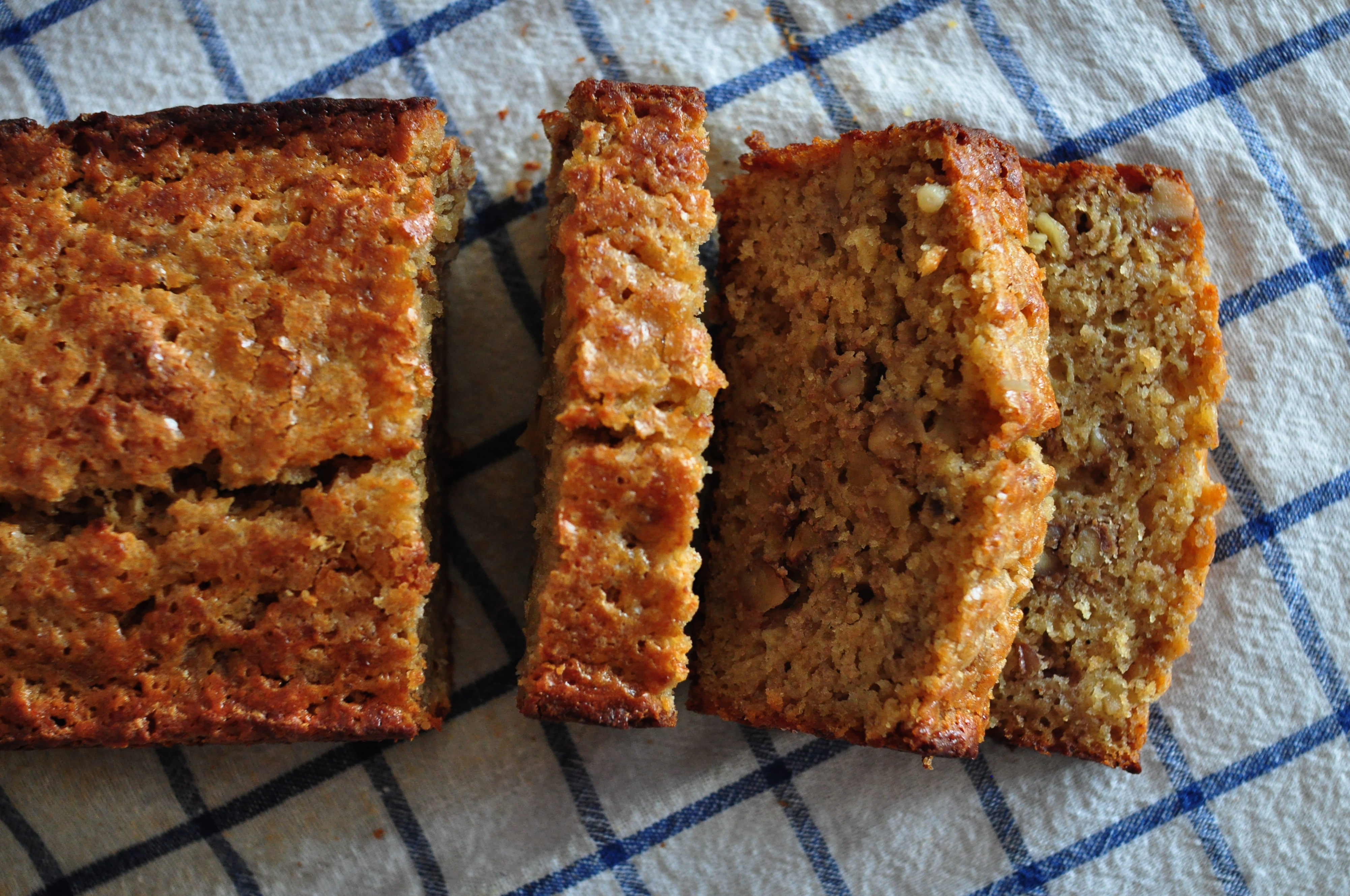
Also, it is a very good banana cake. I resisted tweaking the recipe except for the walnuts, as I seem unable to refrain from putting nuts in a cake.

***

10 Tbsps (125 g) butter

3/4 cup (150 g) brown sugar

3 eggs

3 very ripe bananas

1 lemon or orange

1 tsp vanilla extract

1 3/4 cups (200 g) flour (half whole wheat)

2 tsps baking powder

1 tsp sea salt

1 cup (100 g) shelled walnuts (optional)

***

Preheat oven to 350°F (175°C).

In a large bowl, beat the butter until creamy. Add the sugar and beat until light and fluffy. Add the eggs one at a time, beating with a wire whisk to incorporate until smooth.

Mash the bananas well with a fork and add to the butter/sugar/egg mixture.

Grate the zest and juice the lemon (or orange) and add to the batter with the vanilla extract. Mix well.

In a smaller bowl, mix together the flour, baking powder, and salt and add to batter. Stir just enough to blend everything together. Gently stir in the walnuts, if using.

Line a baking pan with parchment paper, butter the paper, and pour in the batter.

Slide into the oven for 45 to 55 minutes, until a knife inserted in the middle of the cake comes out dry. (If, like me, you like the cake to be very moist, take it out of the oven a little sooner, when the tip of the knife is still wet.)

Crêpes!

3 February 2011

Photo updated 2 February 2023

It feels wrong to write “crêpes” without an exclamation mark.

Because when you have grown up in France, crêpes invariably elicit a tingling sensation of irrepressible excitement. Crêpes were the rare summer treat sold in the van by the beach after a long hot hazy day. They were, on occasion, devoured at a boisterous restaurant with sticky tables and wooden benches. And, sometimes, crêpes were made at home. And, most probably, one of those times was February 2nd.

Today is La Chandeleur (Candlemas), which is technically a Christian festival that celebrates the presentation of Jesus at the Temple –piggybacked, like often, on an older mid-winter festival of light — but to most French men, women, and children, it is just “Crêpes Day” (Crêpes”!” Day). Every year we celebrate La Chandeleur, and if for me the thrill of crêpes may have abated somewhat, my children need those memories, too.

Usually February comes so fast that I end up haphazardly making a batch from a random recipe found online, or a very distant recollection of 12 eggs, 1 kilo flour, 1 liter milk, and some beer.

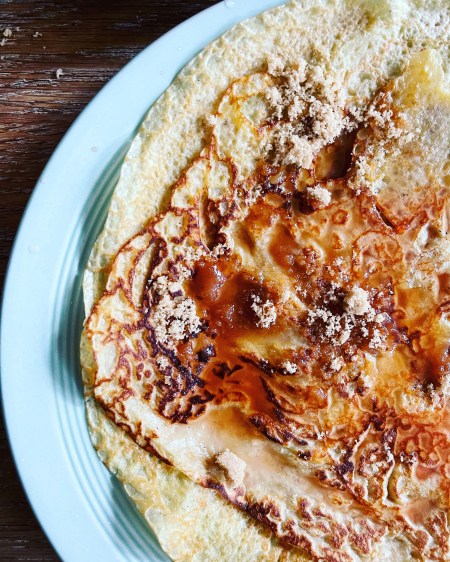
Until yesterday. I was asked to make a heap of crêpes for school, so I thought I would put the task to good use and test a few recipes. The best flour/egg/milk ratio I found was the Crêpes de Jeanne-Marie from La Bonne cuisine de Madame E. Saint-Ange. They are tasty enough to be eaten plain, though everyone knows that the real purpose of crêpes is the garnish: lemon and sugar, blueberry jam, walnuts and honey, banana chocolate, orange marmalade, apples and caramel, flambée with Grand Marnier…

Photo updated 2 February 2023

Recipe inspired by Les crêpes de Jeanne-Marie from La Bonne cuisine de Madame E. Saint-Ange

4 Tbsps (55 g) butter

2 cups (250 g) flour

2 Tbsp sugar

1 tsp salt

6 eggs

1 3/4  cups (400 ml) milk

1 tsp pure vanilla extract

2 Tbsps rum

Zest from 1 lemon

Butter or clarified butter = ghee* or coconut oil for cooking

***

Melt the butter and remove from the heat.

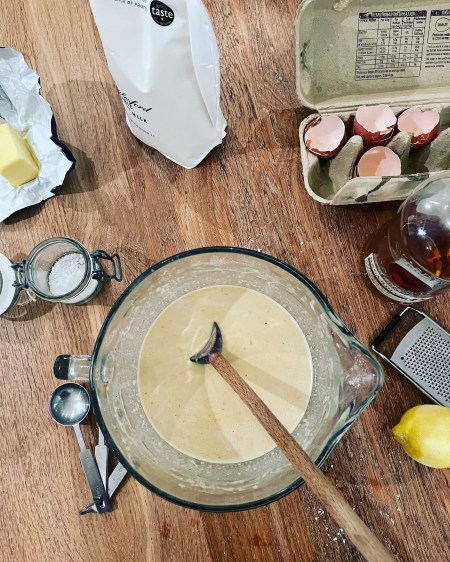
In a large bowl, mix the flour with the sugar and salt and make a well in the mixture. Add the eggs, one at a time, stirring them into the flour with circular movements. Pour in the milk little by little, whisking continuously to obtain a smooth batter. Add melted butter, vanilla, rum, lemon zest, and stir well.

Cover and place in the refrigerator for at least 1 hour and up to 2 days.

When ready to make the crêpes, remove the batter from the refrigerator. The batter should be nice and runny, and at this stage will probably require a little more liquid. Add water, a couple of tablespoons at a time, until the perfect consistency is achieved. **The best way to check the consistency is to make one crêpe and decide whether it is thin enough. Most people agree that the first crêpe never turns out perfectly anyway – the pan isn’t hot enough – so it can easily be sacrificed as a test.**

To cook the crêpes: Heat a non-stick skillet until it is piping hot (a drop of batter poured onto the pan should sizzle) then lower the heat to medium. Grease the skillet with a paper towel dabbed with butter (or clarified butter or coconut oil – there should only be a faint layer of fat in the pan). Holding the skillet in one hand, pour a ladle of batter with the other, turning the skillet quickly in a round motion to cover the base with a thin and even layer of batter (if there is too much batter, pour it back into the bowl, if there isn’t enough, quickly add a little). As soon as the surface of the crêpe is dry (barely a minute or two depending on the heat), lift it with a spatula and turn it around (or flip the crêpe by tossing it, if you feel so inclined). Barely another minute and the crêpe is ready. Repeat, stirring the batter lightly with the ladle from the bottom up between each crêpe.

The best way to keep crêpes warm is to place them on a plate over a pan of simmering water, covered with another large plate or lid. They will not dry out that way.

Garnish with the filling of choice — classic sugar and lemon, or jam, chocolate, apple sauce, etc. — then roll or fold the crêpes to eat!

*Madame E. Saint-Ange suggests using clarified butter, which is a great idea since without the milk solids, the butter doesn’t burn as quickly. To clarify butter, melt  in a small saucepan and continue to cook until the milk solids have risen to the surface and attached at the bottom. Skim off top layer and pour the clear butter without the solids into a clean bowl. Keeps well covered in the refrigerator.